

What Tuna Steak Sizes Are Available for Wholesale Orders?
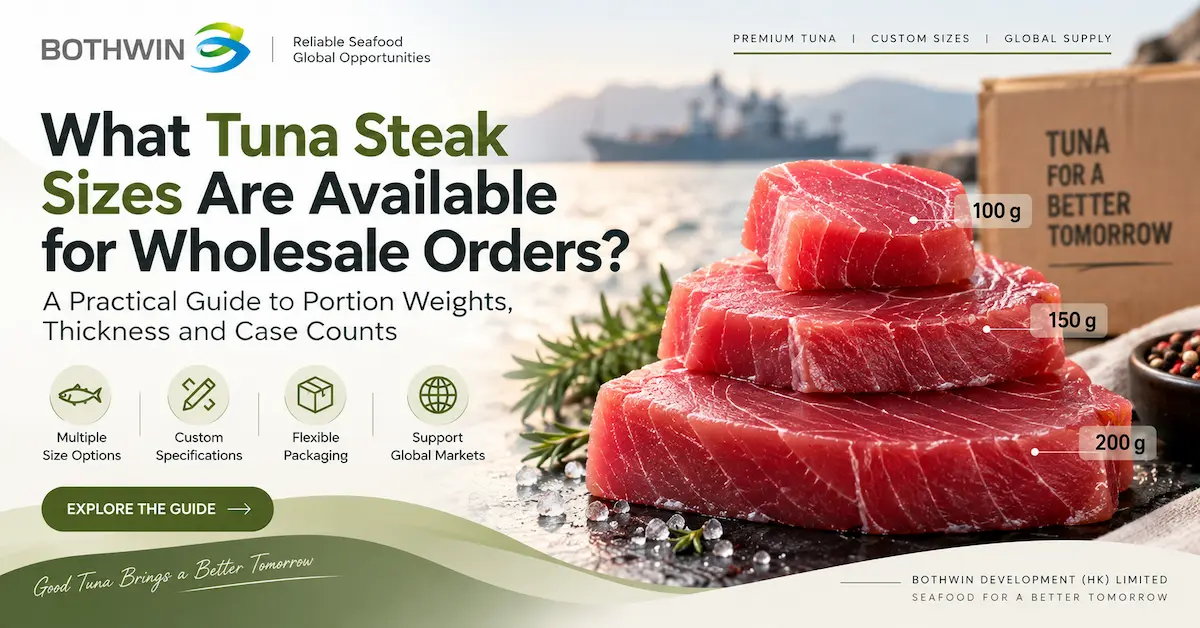
Wholesale tuna steak sizes can vary according to foodservice portions, retail packaging and buyer specifications. 100 g, 150 g and 200 g per steak are examples of buyer-requested portions identified in Bothwin’s customization guidance. The Bothwin frozen tuna product range lists customizable size grades rather than a fixed, comprehensive weight chart. These figures are starting points for an enquiry, not a live inventory list: the available weight, thickness, tolerance and packing arrangement must be confirmed for the proposed order. Other gram-based or ounce-based requirements can be submitted for review, but they should not be treated as confirmed supply options until quoted.
Tuna Steak Size Reference: Grams and Ounces
The first three weights below appear in Bothwin’s published buyer-request examples. The remaining entries are additional quotation-planning examples, included to help buyers translate their portion requirements—not to imply confirmed Bothwin stock sizes. Conversions are approximate; specify which unit governs the purchase rather than allowing rounded equivalents to become two competing specifications.
| Portion requirement | Approximate equivalent | How to use it in an enquiry |
|---|---|---|
| 100 g per steak | 3.53 oz | Published buyer-request example; confirm the complete specification |
| 150 g per steak | 5.29 oz | Published buyer-request example; confirm the complete specification |
| 200 g per steak | 7.05 oz | Published buyer-request example; confirm the complete specification |
| 6 oz per steak | 170.1 g | Additional ounce-based request requiring feasibility confirmation |
| 8 oz per steak | 226.8 g | Additional ounce-based request requiring feasibility confirmation |
| 250 g per steak | 8.82 oz | Additional gram-based request requiring feasibility confirmation |
A 6 oz Tuna Steak Is Not the Same as a 180 g Steak
Six ounces converts to approximately 170.1 g, while eight ounces converts to approximately 226.8 g. Therefore, substituting 180 g for 6 oz adds almost 10 g per portion; substituting 250 g for 8 oz adds roughly 23.2 g. Neither is simply a change of measurement units. When a menu or customer specification uses ounces, retain that target in the enquiry and show the gram equivalent separately. Agree on production and inspection precision rather than relying on rounded figures copied between emails.
Target Weight, Weight Range and Thickness Mean Different Things
A Target Portion Weight Needs an Agreed Tolerance
A request for a “200 g tuna steak” leaves an important question unanswered: how much variation is acceptable? As an illustration, 200 g ± 10 g defines individual limits of 190–210 g. That is different from requiring only a batch average of 200 g. Two pieces weighing 170 g and 230 g average 200 g, yet neither meets those individual limits. State whether acceptance depends on individual pieces, a batch average, or both, and agree on the sampling method. The figures in this example explain the distinction; they are not published Bothwin tolerances.
A Weight Band Does Not Specify the Average
An illustrative 150–200 g grade describes a permitted range, not a promise that most steaks will weigh 175 g. A shipment concentrated near one end of that range could behave differently in your portion planning from a shipment concentrated near the other. When evaluating a proposed weight band, ask for the expected distribution and an inspection record from a representative sample. Choose the range according to what your customers can actually use, rather than assuming every product within the band is interchangeable on the plate.
Thickness Cannot Be Inferred From Weight Alone
Two tuna steaks can weigh the same while having different dimensions: one can be broad and relatively thin, while another is narrower and thicker. Bothwin’s foodservice tuna specification guide identifies weight and thickness as separate considerations for portion-controlled purchasing. Where thickness matters, specify its target and tolerance, the condition of the product during measurement, and where the measurement should be taken. A weight requirement alone cannot communicate all of those expectations.
Choose the Portion Around the Sales Channel
Restaurants, Hotels and Foodservice Distributors
Start with the intended serving, then work backward to the purchased steak. For example, a kitchen considering 150 g and 200 g portions should compare them in its actual menu presentation rather than choosing solely from a supplier’s price list. Evaluate the plate, preparation procedure, portion cost and handling requirements together. Once a size is selected, ask whether the same weight and dimensional specification can be maintained across repeat orders. A distributor serving several restaurant groups may need separate specifications rather than one broad grade intended to satisfy every customer.
Retail and Private-Label Packs
For a two-steak retail concept, two nominal 150 g portions suggest a 300 g pack, while two nominal 200 g portions suggest a 400 g pack. Those calculations are useful for planning, but the individual target, permitted variation and final pack quantity still need separate agreement. Do not assume that meeting the tolerance for each steak automatically settles the pack-weight requirement. Include the intended piece count, product arrangement and package dimensions in the brief before approving artwork or ordering printed materials.
Processors and Central Kitchens
When the business intends to cut the tuna again, compare pre-portioned steaks with loins before requesting a tightly controlled steak size. Bothwin’s comparison of tuna steaks, loins and saku distinguishes portion-ready steaks from formats intended for different downstream preparation. For your own comparison, calculate the labor, trimming and accepted output required to reach the finished portion. Paying for a precise steak specification makes less sense when the next operation will substantially change its weight and shape.
How Portion Weight Changes Case Count
For preliminary planning, theoretical piece count equals net tuna weight divided by individual steak weight, using the same units. An illustrative 10 kg net case contains the equivalent of 50 portions at exactly 200 g, or 40 portions at exactly 250 g. These are calculations, not confirmed Bothwin packing configurations. Actual packing must reconcile individual tolerances, the number of pieces and the required case net weight. For example, 50 steaks weighing 190 g each total only 9.5 kg. They could all satisfy an illustrative 200 g ± 10 g piece specification while failing a separately agreed 10 kg minimum tuna-weight requirement. Piece conformity and case-weight conformity are two different checks.
Calculate Portion Cost on the Same Weight Basis
At an identical price per net kilogram, a 250 g portion carries 25% more tuna purchase cost than a 200 g portion, before any preparation losses or other expenses. That does not make either size better; it makes the menu and selling-price decision important. For a practical comparison, calculate the cost per accepted portion and then add any operation-specific trimming or preparation cost supported by your trial. Do not assume that the lowest quoted price per kilogram automatically gives the lowest cost per serving.
Keep Tuna Weight Separate From Glaze and Packaging
A scale reading that includes wrapping or an ice coating does not, by itself, establish the weight of the tuna. Bothwin’s glazing and net-weight guide explains why protective glaze, seafood weight and packaging weight must be distinguished. For a size-controlled order, agree on the product-weight basis and verification procedure before testing samples or inspecting a shipment. Do not compare one supplier’s wrapped, glazed measurement with another supplier’s deglazed measurement and call the difference a portion-size defect. Similarly, keep any separate preparation-yield test distinct from the agreed commercial weighing method.
What Should a Wholesale Tuna Steak Specification Include?
Use the following table as a purchasing brief, not as a list of fixed Bothwin specifications. It develops the product, size, packing and inspection fields discussed in Bothwin’s frozen seafood quotation guide. Complete the fields you have decided, and ask for proposed options where a requirement remains open.
| Specification item | What the buyer and supplier should agree |
|---|---|
| Product identity | Tuna species and the required commercial product description |
| Cut and preparation | Steak shape, skin condition, bone requirements and trimming |
| Individual weight | Target weight or permitted range, with one governing measurement unit |
| Weight tolerance | Individual limits, any average requirement and the acceptance method |
| Thickness | Target, permitted variation, measurement position and product condition |
| Weight basis | Tuna quantity distinguished from packaging and any glaze |
| Freezing and packing | Required freezing format, individual wrapping or inner packs, and handling arrangement |
| Case configuration | Piece count, net tuna weight and how both requirements will be satisfied |
| Identification | Size description, product code, batch reference and pack labels |
| Commercial requirements | Quantity by size, packaging requirements, destination and requested delivery schedule |
Check Size Consistency Before Approving Repeat Orders
Where a sample or trial order is available, use a written measurement plan rather than judging size from photographs alone. Have the responsible inspection team select representative pieces, use suitable checked measuring equipment, and record individual weights and thicknesses against the agreed procedure. Review the minimum, maximum, average and number outside specification—not just the average. Keep reference photographs with a scale or ruler, but use recorded measurements as the basis for dimensional decisions. Approve the written specification alongside the sample, and retain its revision number for subsequent orders. This prevents a later shipment from being assessed against an informal description that different teams interpret differently.
Confirm Custom Sizes, Packaging and Minimum Orders Together
A requested portion weight is only one part of a customized purchase. Bothwin’s custom tuna portion and packaging guidance identifies cutting requirements, order quantity, packaging approval and production scheduling as matters to resolve before placing a customized order. Ask for the minimum quantity for each proposed size and whether printed packaging has a separate minimum. Also request confirmation of product readiness and shipment timing; neither should be inferred from a general customization statement. When comparing two size options, have them quoted separately so that differences in weight, packing and commercial conditions remain visible.
How to Request a Size-Specific Tuna Steak Quotation
Send the selected portion requirement together with the destination, sales channel, opening quantity and expected repeat demand. An illustrative enquiry could read: “We are sourcing frozen tuna steaks for a foodservice program in [market]. Please assess a target of 200 g per piece with a proposed 190–210 g range. Required thickness is [target and tolerance]. We need 10 kg net tuna per carton, excluding packaging and glaze; please propose a case count that satisfies both the piece and carton requirements. Confirm species, cut, packaging, minimum quantity, inspection arrangements and delivery schedule.” These are example purchasing requirements, not an existing Bothwin offer. For supplier selection and the wider ordering process, refer to the wholesale tuna steak sourcing guide.
Frequently Asked Questions About Wholesale Tuna Steak Sizes
1. Which Tuna Steak Weights Does Bothwin Mention in Its Published Guidance?
Bothwin’s customization guide lists 100 g, 150 g and 200 g as examples of buyer-requested portions. They should be treated as enquiry references rather than a confirmed stock list; the complete supply specification requires confirmation.
2. Can I Request 6 oz or 8 oz Tuna Steaks?
You can submit those targets for assessment, but availability should not be assumed. State the ounce requirement explicitly, show the approximate gram equivalent, and request confirmation of achievable weight and thickness tolerances.
3. Is 100 g the Smallest Tuna Steak Available?
The published example does not establish a minimum size. For a smaller or larger portion, describe the intended use and request a feasibility assessment rather than extrapolating a complete size range from the examples.
4. Does a 200 g Tuna Steak Have a Standard Thickness?
Weight alone does not define thickness. Specify the required thickness separately, particularly where plate presentation or repeatable preparation matters, and ask the supplier to confirm the combination of dimensions and weight.
5. How Many 200 g Tuna Steaks Fit Into a 10 kg Case?
Exactly 50 pieces would total 10 kg if every steak weighed exactly 200 g on the agreed tuna-weight basis. With permitted variation, confirm both the actual packing count and the case net-weight requirement.
6. Is a 150–200 g Grade Equivalent to a 175 g Portion?
No. A 150–200 g band defines limits, whereas 175 g describes a target. The range alone says nothing about how many pieces fall near its upper or lower end, or what average the shipment will achieve.
7. Does “200 g per Steak” Mean 200 g After Cooking?
Not unless the specification explicitly defines a cooked-weight requirement and its test method. Identify the measurement stage in the purchase specification and evaluate preparation yield separately from the supplier’s commercial portion weight.
8. Can Different Tuna Steak Sizes Be Included in One Order?
Request confirmation for the proposed size mix. List the quantity and packing for each size separately, and ask whether each line has its own minimum. Agree on clear size identification before combining products in a shipment.
9. Does IQF Specify the Size of the Steak?
No. IQF means individually quick frozen; it describes freezing rather than portion weight. Bothwin lists freezing method and customizable size grades as separate product fields. Individual wrapping and carton configuration also need their own confirmation.
10. Should a Tighter Weight Tolerance Always Be Preferred?
Choose a tolerance that serves the application. Ask suppliers to quote feasible alternatives and compare the resulting portion control, packaging and total cost. An unnecessarily narrow tolerance is not automatically more valuable than a workable specification your customers can consistently use.
Conclusion
Wholesale tuna steak sizes should be selected as a complete portion specification, not as a weight number alone. Bothwin’s published 100 g, 150 g and 200 g request examples provide starting points, while other gram or ounce targets need order-specific confirmation. Agree on individual tolerance, thickness, net tuna weight and case count before comparing offers, then check that the proposed packing satisfies all of those requirements together. To move from a preferred size to a confirmed supply proposal, request a tuna steak quotation from Bothwin with your portion target, application, packaging, quantity and destination.