

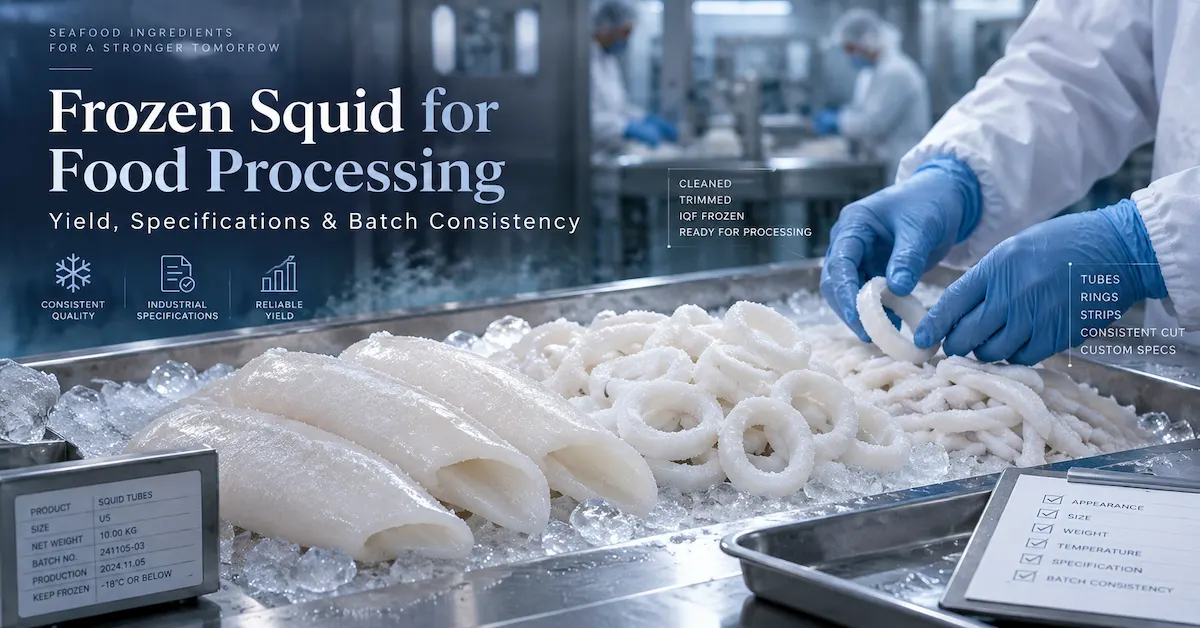
Frozen squid for food processing should be purchased as a controlled manufacturing ingredient, not simply as a frozen seafood commodity. For a food factory, the right squid must satisfy three conditions: it must meet the finished product specification, perform predictably on the production line, and deliver a competitive cost per kilogram of usable material.
That requires more than checking price, appearance, and carton weight. Squid species, cleaning level, size distribution, freezing format, glazing, thawing loss, cutting performance, texture, and batch-to-batch variation can influence production yield, labor requirements, equipment efficiency, and finished food consistency.
For manufacturers producing breaded squid rings, seafood mixtures, frozen ready meals, stuffed squid, dumpling fillings, or other value-added seafood products, a poorly defined raw material can create problems long after purchasing has approved the supplier. The real objective is to establish a repeatable raw material specification that works across procurement, production, quality assurance, and product development.
This guide explains how industrial buyers can evaluate frozen squid, compare supplier offers, structure factory trials, identify hidden processing costs, and prepare a more effective bulk sourcing inquiry.
What Should Food Manufacturers Check Before Buying Frozen Squid?
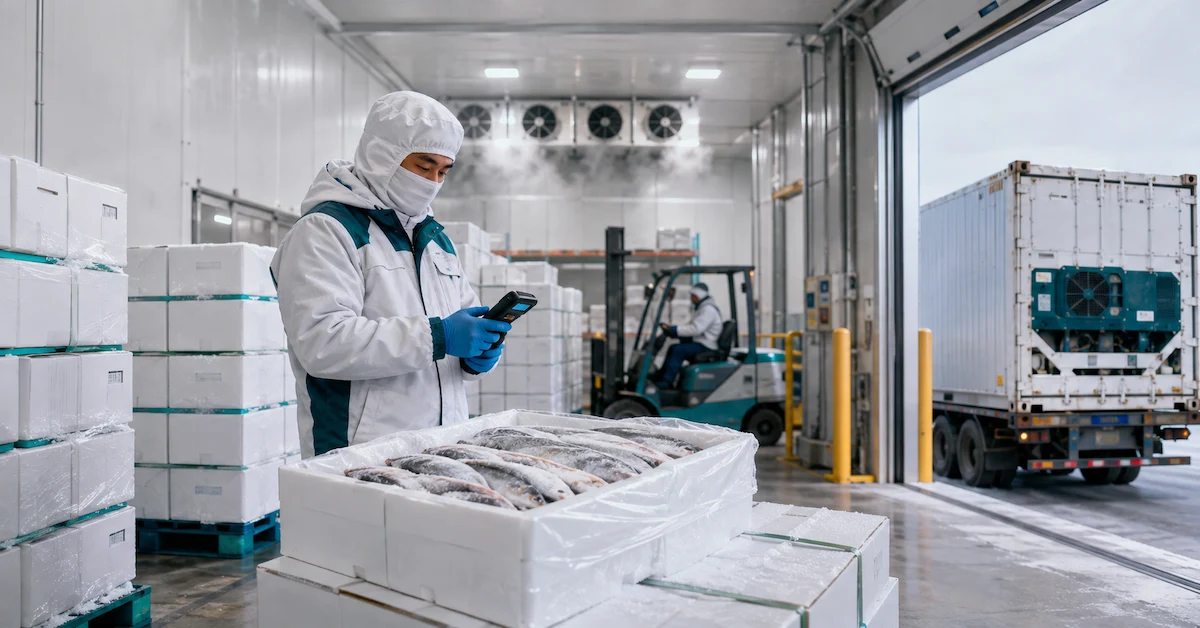
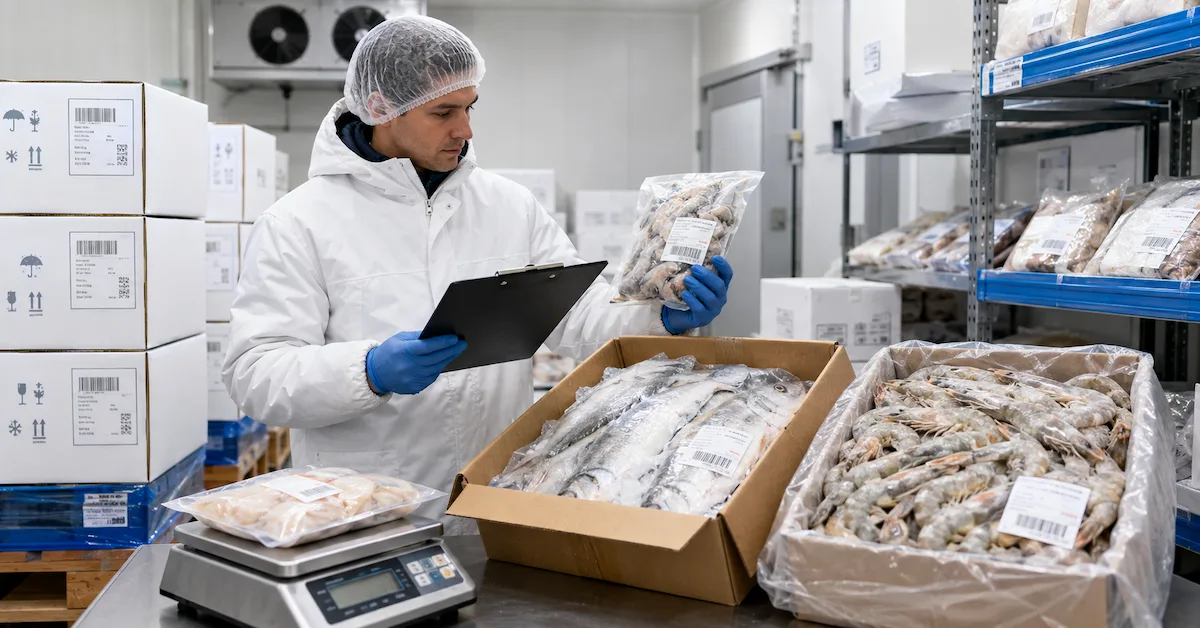
Food manufacturers should evaluate frozen squid according to how it behaves during industrial processing, not merely how it looks in the frozen carton.
A practical purchasing decision should connect raw material characteristics to four factory outcomes: usable yield, processing efficiency, finished product consistency, and food safety compliance.
The following table summarizes the main purchasing criteria.
|
Purchasing Factor |
What to Confirm |
Why It Matters to Food Processing |
|---|---|---|
|
Squid identity |
Commercial name, scientific species, origin where required |
Product authenticity, labeling and formulation consistency |
|
Processing form |
Whole, cleaned, tubes, rings, strips or tentacles |
Determines preparation steps and equipment compatibility |
|
Size grading |
Weight, dimensions, range and tolerance |
Affects cutting, portioning and cooking |
|
Cleaning standard |
Skin, viscera, cartilage, membrane and other removal requirements |
Determines labor, defects and usable yield |
|
Freezing method |
IQF, block frozen or another agreed format |
Influences thawing schedules and batch handling |
|
Glazing |
Level, calculation basis and verification method |
Affects price comparison and incoming material control |
|
Net weight |
Seafood weight excluding applicable protective glaze |
Determines actual raw material quantity |
|
Texture |
Thawed and processed texture |
Influences final food quality |
|
Processing yield |
Weight retained through preparation |
Controls raw material consumption |
|
Packaging |
Inner packs, bulk cartons, pallet configuration |
Supports factory receiving and storage |
|
Traceability |
Lot codes, production records and supplier identification |
Supports inventory control and recalls |
|
Food safety |
Applicable HACCP controls, testing and documentation |
Supports factory hazard analysis |
|
Supply consistency |
Repeat specifications and approved changes |
Protects continuous manufacturing |
These should be documented in an agreed raw material specification.
A quotation that only states “frozen squid, 20 kg/carton” leaves too many technical variables undefined for a food processing factory.
Why Food Processing Buyers Have Different Requirements From Foodservice Buyers
A restaurant may evaluate squid according to plate appearance, portion cost and cooking performance. A food manufacturer has a different operating environment.
The manufacturer may receive several tonnes of seafood, process it through multiple production stages, and incorporate it into thousands of finished products.
A small raw material variation can affect an entire production batch.
For example, a squid ring manufacturer may have calibrated equipment for a specific ring diameter and thickness. If the incoming tubes are smaller or thinner than the approved specification, the cutting operation may produce more offcuts, irregular rings or unacceptable pieces.
A ready-meal manufacturer may require consistent squid dimensions so that the seafood is distributed evenly across meal trays.
A dumpling manufacturer may be less concerned about whole-squid appearance but more concerned about cleaning quality, moisture, particle size and texture after mixing.
These differences should determine purchasing specifications.
Frozen Ready-Meal Manufacturers
Typical applications include seafood pasta, rice dishes, stir-fried meals, soups and frozen prepared dishes.
Important requirements include:
-
Consistent squid cuts
-
Controlled moisture release
-
Stable texture after cooking and reheating
-
Compatibility with filling and portioning equipment
-
Reliable raw material weight
-
Consistent batch appearance
Raw material variation can affect both finished product weight and the consistency of the recipe.
Breaded and Coated Squid Manufacturers
Manufacturers producing breaded calamari rings, battered squid and other coated products need to consider dimensional accuracy.
The most important purchasing factors may be:
-
Tube diameter
-
Ring thickness
-
Cut uniformity
-
Surface moisture
-
Broken-piece percentage
-
Coating adhesion
-
Finished weight consistency
In these applications, squid that performs well as a general seafood product may not necessarily perform well on the coating line.
Dumpling and Seafood Filling Manufacturers
Squid may be incorporated into dumplings, seafood fillings, mixed seafood products or other formulated foods.
Purchasing priorities include:
-
Cleaning consistency
-
Texture
-
Moisture variation
-
Suitability for chopping or mincing
-
Foreign material control
-
Ingredient identity
-
Stable mixing performance
The factory needs to understand how incoming squid behaves after cutting, mixing and any subsequent thermal process.
Seafood Mix and Frozen Ingredient Manufacturers
A mixed seafood product may contain squid alongside shrimp, fish or other seafood.
For these manufacturers, squid should be evaluated according to how well it integrates with the other ingredients.
Important variables include:
-
Piece dimensions
-
Appearance
-
Texture
-
Weight consistency
-
Thawing requirements
-
Packaging configuration
-
Labeling and traceability
For companies purchasing several seafood ingredients, Bothwin's broader frozen seafood product range can be useful when reviewing potential sourcing categories.
How to Specify Frozen Squid Raw Material for Industrial Processing
The first major sourcing mistake is failing to define exactly what type of squid is required.
A commercial product name is not a complete specification.
Factories should establish product identity before discussing processing options or price.
1. Confirm the Squid Species
Different squid species can vary in body dimensions, skin characteristics, texture and processing behavior.
Therefore, the purchasing specification should request:
-
Commercial name
-
Scientific name
-
Origin where relevant
-
Processing form
-
Applicable product identification documents
Do not assume that squid products from different origins or suppliers are interchangeable simply because the cartons use similar commercial names.
For manufacturers producing standardized finished foods, a species change may require a new technical evaluation.
It can also affect product declarations and customer-approved specifications.
2. Define the Cleaning Level
The word “cleaned” is frequently insufficient.
A factory should establish whether the supplier is expected to remove:
-
Internal organs
-
Quill or internal cartilage
-
Skin
-
Head
-
Beak
-
Eyes
-
Membranes
-
Other specified parts
The exact requirement depends on the intended use.
A manufacturer purchasing squid for mechanical cutting may require cleaned tubes. Another factory using multiple squid parts may prefer a less processed form.
A supplier offering cleaned material should be able to describe what the cleaning specification includes.
3. Define Size and Dimensional Tolerances
Size grading is particularly important when equipment has fixed operating parameters.
Depending on the product, the factory may specify:
-
Whole-piece weight
-
Tube length
-
Tube diameter
-
Wall thickness
-
Ring width
-
Strip dimensions
-
Maximum variation
-
Oversized or undersized allowance
A numerical grade should also identify its measurement basis.
For example, is the specified weight measured before or after cleaning?
Without that distinction, two offers may appear equivalent while representing different products.
4. Define Acceptable Defects
A good specification should describe unacceptable material.
Possible criteria include:
-
Residual internal material
-
Damaged tubes
-
Broken rings
-
Excessive skin retention
-
Unacceptable discoloration
-
Visible dehydration
-
Foreign material
-
Excessive size variation
The acceptance limits should be appropriate to the finished product and validated through the factory's quality approval process.
For factories evaluating supplier options, the Bothwin Frozen Squid Wholesale Buying Guide provides additional background on product identity, cleaning and commercial specification development.
Whole Squid vs Cleaned Squid vs Squid Tubes: Which Is Best for Manufacturing?
The right processing form depends on which operations the food factory performs internally.
A factory with established cleaning equipment may have different requirements from one operating only cutting, mixing and packaging lines.
|
Squid Form |
Suitable Manufacturing Application |
Main Advantage |
Main Limitation |
|---|---|---|---|
|
Whole squid |
Factories with primary cleaning and processing operations |
Flexibility over processing and by-products |
Requires more preparation and yield control |
|
Cleaned squid |
Further processing into prepared foods |
Reduces cleaning operations |
Cleaning definition must be precise |
|
Squid tubes |
Rings, stuffed products, sliced squid |
Standardized input for cutting |
Tube dimensions and damage matter |
|
Squid rings |
Breaded products, ready meals, frozen appetizers |
Reduces cutting work |
Ring consistency must be controlled |
|
Squid strips |
Stir-fry products, meal ingredients, seafood mixes |
Convenient for mixing and portioning |
Dimensions and moisture release matter |
|
Squid tentacles |
Prepared seafood and mixed products |
Suitable for selected specialty applications |
Size and trimming can vary |
|
Custom processed squid |
Specific automated manufacturing lines |
Better production compatibility |
Requires detailed specification approval |
These are industry processing options, not a statement that every form is permanently stocked by Bothwin.
Bothwin's current Squid product page describes frozen squid as available for discussion in whole or buyer-required processing forms. Exact availability, cleaning requirements, size and packaging must be confirmed for each project.
When Whole Squid Makes Commercial Sense
Whole squid may suit manufacturers with established receiving, cleaning, cutting and waste-management operations.
These factories can control more of the transformation process.
However, procurement should measure the true economic result.
A lower purchase price may be offset by:
-
Higher labor consumption
-
Cleaning equipment operation
-
Greater material waste
-
Additional sanitation procedures
-
Lower throughput
-
Higher wastewater or waste-disposal requirements
A factory should compare whole squid against cleaned squid using its own processing cost.
When Cleaned Squid Is More Efficient
Cleaned material may be attractive to manufacturers that want to concentrate on value-added processing rather than primary seafood preparation.
Potential benefits include:
-
Reduced cleaning labor
-
Simplified line preparation
-
More predictable raw material input
-
Reduced internal trimming
-
More efficient production scheduling
However, those benefits are only meaningful when the supplier's cleaning standard matches the factory's requirement.
A sample described as cleaned squid should be inspected to confirm the actual result.
When Pre-Cut Squid Is Worth the Additional Price
Pre-cut squid may reduce internal handling steps.
For example, a frozen meal manufacturer may be able to move suitable pre-cut pieces directly into a controlled production process after the required preparation.
That can reduce cutting time and equipment usage.
The trade-off is that the factory has less flexibility to adjust dimensions after receiving.
Therefore, pre-cut squid needs an especially clear dimensional specification.
IQF vs Block Frozen Squid for Industrial Processing
Frozen squid for food processing may be purchased using different freezing formats, subject to species, product form and supplier availability.
The two commonly discussed formats are individually quick frozen and block frozen.
Neither should be selected without considering the manufacturing process.
IQF Frozen Squid
Individually Quick Frozen products are designed so that individual pieces remain separated.
This can be useful for factories that:
-
Operate multiple product recipes
-
Need flexible batch quantities
-
Use automated portioning
-
Require separate pieces
-
Process different products on the same production line
IQF may reduce the need to thaw an entire large frozen unit when production requires only a smaller quantity.
However, the actual benefits depend on the product condition, glazing, packaging and manufacturing workflow.
Block Frozen Squid
Block freezing groups product into a frozen block.
This may be practical for factories that process entire blocks in scheduled production batches.
For example, a manufacturer that prepares a large batch of seafood filling may be able to incorporate full-block thawing into its production schedule.
Potential advantages include:
-
Bulk handling convenience
-
Straightforward batch planning
-
Suitability for certain high-volume processing operations
Limitations may include less flexible portion access and longer or more involved thawing operations.
How to Select the Freezing Method
|
Production Requirement |
IQF May Be More Suitable |
Block Frozen May Be More Suitable |
|---|---|---|
|
Small variable production batches |
Yes |
Less convenient |
|
Whole-block manufacturing batches |
Possible |
Often practical |
|
Individual piece separation |
Strong advantage |
Requires separation after thawing |
|
Multiple recipes from one inventory |
Flexible |
Depends on batch planning |
|
High-volume ingredient preparation |
Suitable |
Suitable |
|
Automated individual-piece feeding |
Often convenient |
May require additional preparation |
|
Partial use of a frozen unit |
Convenient |
Less flexible |
The critical question is not which freezing format sounds more advanced.
It is:
Which format produces the lowest practical handling cost while meeting the plant's product quality and safety requirements?
When requesting frozen squid for industrial use, ask whether the required freezing format is available for the selected species and processing form.
Glazing and Net Weight: Why Processing Factories Must Compare the Same Weight Basis
Glazing is a protective ice layer applied to frozen seafood.
Its purpose can include helping limit surface dehydration and oxidation during storage.
For food manufacturers, the commercial issue is how the glaze relates to declared seafood weight.
A purchasing department should distinguish:
-
Gross carton weight
-
Packaging weight
-
Glazed frozen product weight
-
Declared net seafood weight
-
Deglazed product weight
-
Thawed and drained weight
-
Usable processing weight
These are not interchangeable measurements.
Why Glazing Can Distort Quotations
Suppose two suppliers offer apparently similar cartons.
One quote uses a clearly declared net seafood weight excluding protective glaze.
The other quote uses an ambiguous weight description.
The purchasing department cannot make a reliable price comparison until the weight basis has been clarified.
A professional RFQ should specify:
-
Whether the seafood is glazed.
-
The proposed glazing level.
-
How that percentage is calculated.
-
The declared net-weight basis.
-
The method for verifying seafood weight.
-
The agreed tolerance.
The technical and commercial importance of glazing is also discussed in Bothwin's Frozen Seafood Glazing Percentage Guide.
A Regulatory Detail That Processing Buyers Should Know
Codex Alimentarius publishes Standard CXS 191-1995 for quick-frozen raw squid. However, its stated scope covers products offered for direct consumption without further processing and explicitly excludes products indicated for further processing or other industrial purposes.
Therefore, food manufacturers should not automatically treat that particular squid standard as a certification of industrial raw material suitability.
Instead, the factory must identify the standards, contractual specifications and destination-market requirements applicable to its particular raw material and finished product.
The distinction matters because a raw material can be commercially suitable for further processing without being identical to a direct-consumption retail specification.
How to Calculate Frozen Squid Processing Yield
Yield is one of the most useful measurements in seafood manufacturing procurement.
A supplier may offer attractive pricing, but the factory ultimately needs to know how much usable squid enters its production process.
The calculation should follow the factory's material flow.
Stage 1: Verified Incoming Seafood Weight
First, establish the actual seafood quantity on the agreed net-weight basis.
Do not begin a yield calculation using carton gross weight without removing packaging and accounting correctly for glaze.
Stage 2: Thawed and Drained Weight
Use a standardized thawing procedure and measure the product after the agreed drainage method.
This helps identify moisture loss during preparation.
Stage 3: Usable Processed Weight
Measure the material remaining after normal cleaning, trimming and rejection of unusable pieces.
Stage 4: Production-Ready Weight
For some applications, additional cutting or preparation takes place before the ingredient enters the main manufacturing process.
Measure the final accepted material at this stage.
The basic calculation is:
The corresponding raw material cost is:
For manufacturing comparisons, labor and processing costs should also be incorporated.
Example: Comparing Two Frozen Squid Raw Material Offers
The following is a hypothetical purchasing example, not a Bothwin quotation or actual factory performance record.
Two suppliers offer cartons with 20 kg of declared net seafood weight, excluding protective glaze.
Supplier A provides a less processed form.
Supplier B offers material with more preparation completed.
|
Cost and Yield Factor |
Supplier A |
Supplier B |
|---|---|---|
|
Declared net seafood input |
20.0 kg |
20.0 kg |
|
Carton purchase cost |
$120 |
$130 |
|
Thawed and drained weight |
18.4 kg |
19.0 kg |
|
Usable material after preparation |
15.5 kg |
18.0 kg |
|
Usable yield |
77.5% |
90.0% |
|
Additional preparation cost |
$20 |
$8 |
|
Total material and preparation cost |
$140 |
$138 |
|
Cost per usable kg |
$9.03 |
$7.67 |
Supplier B has the higher purchase price.
However, Supplier B produces more usable material and requires less additional preparation.
Its effective cost per usable kilogram is lower.
This example illustrates an important principle:
For food processors, the lowest quoted raw material price is not necessarily the lowest manufacturing input cost.
The same analysis can be extended to:
-
Electricity consumption
-
Equipment operating time
-
Labor
-
Waste handling
-
Packaging waste
-
Line interruptions
-
Rejected raw material
Why Yield Should Be Measured Across Multiple Lots
One small sample cannot establish long-term consistency.
Where feasible, a factory should test representative material from more than one lot.
The objective is to understand whether the supplier can provide repeatable results.
A product that yields 90% in one sample and substantially less in another may create planning problems.
The factory should define an acceptable yield range and determine how it will be checked during incoming inspection or production trials.
Thawing Performance: A Hidden Factor in Factory Productivity
Thawing is not only a preparation step.
It affects manufacturing schedules, material quality, sanitation and production throughput.
A frozen squid purchase should therefore be evaluated against the factory's available thawing capacity.
Important questions include:
-
How long does a normal batch require under the approved thawing procedure?
-
Can material be separated easily?
-
Does thawing create excessive drip?
-
Does texture change noticeably?
-
Is the material ready when the production line needs it?
-
Can the factory maintain its required temperature controls?
The factory should use a documented, validated thawing procedure appropriate to the product and its hazard analysis.
Drip Loss and Production Weight
Moisture released during thawing can reduce the weight available for manufacturing.
This is particularly relevant when a recipe relies on a fixed quantity of seafood.
A manufacturer that needs 1,000 kg of usable squid for a scheduled production run may need to purchase more than 1,000 kg of frozen input.
The required quantity depends on the measured yield.
A predictable thawing result supports more accurate production planning.
Thawing and Texture
Excessive quality deterioration during frozen storage or poor thawing practices can affect product texture.
Processors should inspect the thawed material before assuming it will perform correctly after mixing, cutting, cooking or coating.
Texture should be evaluated using the intended processing method rather than by visual appearance alone.
Match Squid Raw Material to the Actual Production Line
A technically acceptable food ingredient may still perform poorly on a particular manufacturing line.
This is why production engineering and quality assurance should participate in supplier approval.
Cutting and Slicing Equipment
Mechanical cutters require predictable input dimensions.
Inconsistent squid sizes may cause:
-
Irregular cuts
-
Increased trimming
-
Equipment adjustments
-
Reduced cutting efficiency
-
More off-specification pieces
For squid ring production, tube dimensions can directly influence the final cut.
The purchasing team should therefore ask production personnel which input dimensions are most stable for existing equipment.
Conveyors and Automated Feeding Systems
Production lines may depend on consistent piece separation and predictable material flow.
Frozen blocks, irregularly shaped pieces or material that clumps after thawing can require different handling.
During a factory trial, record:
-
Feeding consistency
-
Manual intervention
-
Material accumulation
-
Conveyor behavior
-
Piece damage
These observations help determine whether supplier processing requirements should be modified.
Mixing and Forming Equipment
Squid used in fillings or mixed seafood products should be evaluated for:
-
Particle size
-
Moisture variation
-
Texture
-
Distribution in the mixture
-
Recipe compatibility
A raw material that introduces unexpected water or requires additional cutting can alter the manufacturing process.
The product development team should verify whether changes are needed to keep finished product performance consistent.
Cooking, Blanching and Coating Lines
Cooking performance should be tested under the same conditions used in production.
Important observations may include:
-
Shrinkage
-
Moisture release
-
Piece integrity
-
Cooking uniformity
-
Surface behavior
-
Final texture
For coated products, additional measurements may include coating pickup and the percentage of damaged or rejected pieces.
These measurements should be incorporated into the factory's approval criteria when commercially important.
How to Run a Frozen Squid Factory Trial Before Bulk Ordering
A sample should be approved through a structured test, not a single visual inspection.
The most useful test reproduces the actual manufacturing process on a controlled scale.
Step 1: Establish the Trial Objective
Decide what must be demonstrated.
Examples include:
-
Improved usable yield
-
Lower cleaning labor
-
Acceptable ring dimensions
-
Stable texture
-
Reduced cutting waste
-
Better line feeding
-
Consistent finished product performance
Avoid testing many unrelated objectives without defining what constitutes success.
Step 2: Record Product Identity and Sample Information
Record:
-
Supplier
-
Product description
-
Scientific species where required
-
Processing form
-
Size grade
-
Cleaning specification
-
Freezing method
-
Glazing declaration
-
Lot identification
-
Packing information
Step 3: Verify Incoming Weight and Condition
Inspect the sample according to the agreed method.
Record frozen condition, packaging integrity and weight information.
Step 4: Use the Approved Thawing Procedure
Apply a consistent, food-safe procedure.
Do not compare supplier samples using different thawing conditions unless that difference is the intended subject of the test.
Step 5: Measure Drained and Usable Weight
Document thaw loss, trimming waste and accepted raw material.
Step 6: Run the Product Through the Intended Equipment
Observe:
-
Equipment compatibility
-
Processing speed
-
Manual intervention
-
Material waste
-
Product damage
-
Cleaning requirements
Step 7: Evaluate the Finished Product
Compare the finished product with the company's approved reference standard.
For example, a ready-meal manufacturer may evaluate final appearance and seafood distribution, while a coated squid producer may examine coating consistency and cooked texture.
Step 8: Record Costs and Defects
Calculate:
-
Usable yield
-
Material cost per usable kilogram
-
Preparation labor
-
Rejection percentage
-
Trial throughput
-
Significant processing problems
Step 9: Review the Result With Relevant Departments
Purchasing, production, quality assurance and product development should evaluate the results together.
A supplier should not be approved solely because its price satisfies the purchasing budget.
Step 10: Approve the Specification
After successful testing, document the product characteristics that must be maintained.
Connect the approved sample to measurable contractual requirements.
This is especially important when the factory intends to purchase the same squid raw material repeatedly.
Food Safety and HACCP Considerations for Squid Processing
Food safety requirements depend on the product, its intended use, the processing steps and the destination market.
Frozen storage does not eliminate every potential food safety hazard.
A food processing factory must therefore assess the raw material within its own food safety management system.
The U.S. FDA's Fish and Fishery Products Hazards and Controls Guidance provides a framework for seafood processors developing hazard analyses and HACCP plans. It emphasizes that hazard identification and control measures must be appropriate to the product and process.
Relevant areas for a squid processing operation may include the following.
Raw Material Acceptance
Receiving controls should address:
-
Correct product identity
-
Acceptable condition
-
Supplier approval
-
Packaging integrity
-
Temperature history where required
-
Lot identification
-
Required documentation
Biological Hazards
Hazards should be evaluated according to species, handling, processing method and intended consumption.
A product intended to receive a validated cooking step may have a different hazard-control strategy from a product intended for raw or minimally processed consumption.
A factory should not assume that freezing makes squid ready to eat.
Physical Hazards
Squid processing should consider potential foreign material and retained anatomical parts.
Depending on the product, relevant concerns may include cartilage or quill fragments, residual beak material, packaging fragments and other unwanted physical materials.
The incoming specification should identify which parts must be removed before delivery.
Chemical Hazards and Additives
Processors should request appropriate information about any additives or processing aids where relevant.
The factory should also assess chemical contamination risks according to the species, source, product history and destination requirements.
Do not assume that all frozen squid is treated identically.
Allergen Management
Squid is a mollusc, and allergen declaration requirements differ by destination market.
For example, the European Union specifically addresses molluscs and products thereof in its food allergen framework. Requirements in other jurisdictions may differ.
Manufacturers should verify ingredient declarations, cross-contact controls and finished product labeling for their target markets.
Traceability and Recall Readiness
A raw material supplier should support appropriate lot identification.
The receiving factory should be able to connect:
Supplier lot → receiving record → production batch → finished product lot
Without this connection, a quality issue may be difficult to isolate.
Food manufacturers evaluating the wider subject can also review Bothwin's Seafood Quality Control Guide.
The appropriate HACCP plan, testing program and legal requirements must be determined by qualified personnel for the specific manufacturing operation.
Industrial Packaging Requirements for Frozen Squid
Packaging should be selected according to factory handling, not simply export carton cost.
The purchasing team should consider the full material movement:
Container unloading → cold storage → internal transport → thawing area → production line
A suitable industrial pack can help reduce unnecessary handling and material damage.
Bulk Carton Configuration
Factories should specify:
-
Carton net weight
-
Inner packaging
-
Carton dimensions
-
Pallet arrangement
-
Label format
-
Lot identification
-
Required handling information
Packaging dimensions also affect warehouse utilization and pallet handling.
Inner Pack Size
A factory may prefer packaging that corresponds to its normal production batch.
For example, smaller inner packs may help a manufacturer operating several different recipes.
A large-volume operation processing entire cartons may prefer a simpler configuration.
Packaging Integrity
During supplier approval, verify that the packaging protects the product during:
-
Frozen storage
-
Inland transport
-
Container loading
-
Sea freight
-
Destination handling
-
Factory receiving
Damaged cartons or compromised inner packaging can create receiving losses and additional inspection work.
Bothwin's public squid information identifies bulk carton, foodservice and retail packing as available commercial discussions. Project-specific packaging, including private-label arrangements, must be confirmed according to volume and other order conditions.
Cold Chain Control From Supplier to Processing Factory
Industrial buyers should treat cold-chain conditions as part of the raw material specification.
The frozen condition must be protected during storage and transport.
Relevant stages include:
-
Supplier-side frozen storage
-
Inland transportation
-
Container loading
-
Refrigerated sea freight
-
Destination handling
-
Importer or factory cold storage
-
Internal movement before processing
For many frozen seafood products, approximately -18°C or colder is a commonly used storage reference, but the correct requirement must be determined by the product specification and applicable rules.
The factory should agree on receiving criteria.
Questions may include:
-
What frozen storage conditions were specified?
-
Is shipment temperature information required?
-
How are loading conditions controlled?
-
What should happen if product temperature or packaging condition is abnormal?
-
How are affected lots identified and held?
Temperature deviations may lead to extra inspections, delayed production or rejected material.
Bothwin discusses the wider transport process in its Frozen Seafood Cold Chain Management Guide.
What Documents Should Food Processing Buyers Request?
Documentation requirements differ by product, supplier, customer and importing country.
A processing factory should establish its requirements before confirming a shipment.
Possible documents and records include:
|
Document or Record |
Purpose |
|---|---|
|
Product specification sheet |
Defines the agreed raw material |
|
Commercial invoice |
Supports commercial and import transactions |
|
Packing list |
Identifies shipment quantities and packaging |
|
Origin information |
Supports traceability and applicable import requirements |
|
Health or sanitary documents |
Required where applicable |
|
Lot identification records |
Connects received material to production |
|
Quality inspection records |
Supports product acceptance |
|
Temperature records |
Supports agreed cold-chain verification |
|
Applicable certificates |
Verifies specific claims within their valid scope |
|
Laboratory reports, where required |
Supports defined safety or quality checks |
Do not require documents only because another buyer uses them.
Equally, do not assume that a supplier's general statement about international certifications satisfies the legal requirements of a particular destination.
For any HACCP, ISO or other certification, buyers should confirm the legal entity, facility, scope and validity before relying on it.
How to Compare the Total Cost of Frozen Squid for Food Processing
A factory's true raw material cost includes more than the invoice.
An effective procurement comparison should consider the cost required to produce the intended finished product.
A practical cost model may include:
Total Effective Input Cost = Raw Material Purchase Cost + Freight and Receiving Costs + Preparation Labor + Processing Costs + Disposal Costs + Other Relevant Costs
This amount should then be divided by the actual usable raw material output.
The calculation can be expanded to include conversion yield and finished product costs.
Hidden Cost 1: Cleaning Labor
A less processed squid product may require additional employees or operating time.
Hidden Cost 2: Processing Waste
Trimming, cleaning and out-of-specification cuts reduce usable material.
Hidden Cost 3: Variable Moisture
Unexpected moisture loss may change recipe input requirements.
Hidden Cost 4: Production Interruptions
Inconsistent dimensions may require extra adjustments or manual handling.
Hidden Cost 5: Rejected Raw Material
Material that fails incoming acceptance criteria may need replacement, sorting, rework where permitted, or disposal.
Hidden Cost 6: Inventory and Storage
Packaging configuration and storage requirements influence working capital and warehouse efficiency.
Hidden Cost 7: Specification Changes
An unapproved change in species, form or size may trigger additional product testing.
The purchasing team should compare these factors before accepting the lowest quotation.
For factories purchasing multiple seafood categories, Bothwin also provides a broader Frozen Seafood for Food Processing sourcing guide covering raw material consistency, packaging and bulk supply considerations.
How to Evaluate a Frozen Squid Supplier for Repeat Manufacturing Orders
Supplier selection should reflect manufacturing priorities.
A processor purchasing a one-time trial quantity may emphasize sample suitability.
A manufacturer planning regular production should also consider whether the supplier can maintain the specification across repeated orders.
The following is an illustrative supplier evaluation model. Weightings should be adjusted to match each factory's actual priorities.
|
Evaluation Area |
Suggested Weight |
|---|---|
|
Raw material specification compliance |
25% |
|
Cost per usable kilogram |
20% |
|
Production-line compatibility |
15% |
|
Quality control and traceability |
15% |
|
Supply continuity |
10% |
|
Packaging and cold-chain arrangements |
10% |
|
Communication and response quality |
5% |
|
Total |
100% |
A scorecard does not replace food safety approval.
A supplier that fails a mandatory safety or legal requirement should not be approved because of a high commercial score.
Repeat-Order Consistency
Factories should compare later deliveries against the original approved material.
Important checks include:
-
Species identity
-
Processing form
-
Size distribution
-
Cleaning quality
-
Glazing
-
Net weight
-
Packaging
-
Relevant product performance
Change Control
The agreement should define how changes are communicated.
A change in species, processing facility, freezing method, cleaning standard or other material characteristic may require review.
Not every change will require a full new factory trial, but the buyer should determine which changes affect product safety, quality or processing performance.
Corrective Action
If a shipment fails an agreed requirement, the buyer and supplier should have a procedure for documenting the issue and determining the next action.
That may include additional inspection, sorting where appropriate, rejection, replacement or an agreed corrective action.
A Practical RFQ Template for Industrial Frozen Squid Purchasing
A strong RFQ should make the required material easy to understand and quote.
Instead of:
Please quote frozen squid, best price.
Provide the relevant factory information.
Product Identity
Product: Frozen squid Species: Specify scientific name or request available species for technical approval Intended use: Food manufacturing / further processing
Processing Requirements
Required form: Whole / cleaned / tube / ring / strip / other Cleaning specification: Clearly describe retained and removed parts Size: Define range and measurement basis Tolerance: Confirm permitted variation
Freezing and Weight
Freezing method: IQF / block / subject to supplier confirmation Glazing: Required level and calculation method Net weight: Agreed seafood weight basis Packaging: Inner pack and export carton requirements
Quality Requirements
Physical condition: Agreed appearance and defect limits Traceability: Required lot information Testing: Defined inspection or laboratory requirements where applicable Reference sample: Required before commercial approval, if needed
Commercial Requirements
Trial quantity: State expected sample or trial volume Commercial order quantity: State estimated order volume Purchasing frequency: Monthly, quarterly or project-based Destination: Country and port where relevant Documents: List applicable requirements Delivery schedule: State requested dates for supplier confirmation
Factory Application
Explain the finished food product and important processing conditions.
For example:
We manufacture frozen breaded squid rings. We need squid raw material suitable for consistent ring cutting and coating. Please advise available species, tube dimensions, cleaning specifications, freezing formats, glazing, net weight, packaging and trial sample options.
This gives the supplier a clearer basis for discussion.
Buyers can also use Bothwin's Frozen Seafood Quotation Guide to organize the information needed for an initial sourcing request.
How Bothwin Supports Frozen Squid Sourcing for Food Manufacturers
Bothwin Development (HK) Limited serves international seafood buyers, including importers, wholesalers, distributors and food processing customers.
For frozen squid, the company publicly identifies the following as key commercial discussion points:
-
Species
-
Size
-
Cleaning level
-
Processing form
-
Net weight
-
Glazing
-
Packaging
-
Destination application
-
Export coordination
Rather than presenting every possible squid configuration as a fixed product, Bothwin states that processing requirements, availability and packaging should be discussed according to the buyer's project.
This approach is relevant to food processing factories because different manufacturing applications require different raw material inputs.
A squid ring manufacturer may need specific tube dimensions.
A ready-meal factory may need prepared cuts.
A seafood filling manufacturer may have different requirements for cleaning, texture and bulk handling.
The appropriate sourcing discussion therefore begins with the production application.
Buyers can review Bothwin's company background, explore its Factory and seafood solutions information, and provide the intended raw material specification through the company's contact channel.
Exact products, certifications, trial quantities, production arrangements, pricing and lead times should be confirmed for the individual order rather than assumed.
Frequently Asked Questions About Frozen Squid for Food Processing
1. What type of frozen squid is best for food processing factories?
The best type depends on the finished product and production equipment.
Cleaned tubes may be appropriate for factories producing rings or stuffed products. Pre-cut squid may be useful for certain ready meals, while whole squid may suit processors with their own cleaning and cutting operations.
Factories should select the product according to usable yield, processing compatibility, safety requirements and total input cost.
2. Is IQF squid better than block frozen squid for industrial processing?
Not necessarily.
IQF can be convenient when a factory needs individual pieces, flexible batch quantities or easier separation.
Block frozen squid may be practical when the manufacturer thaws complete blocks for high-volume processing.
The correct choice depends on production scheduling, thawing capacity, equipment and supplier availability.
3. How do food manufacturers calculate squid processing yield?
Start with verified seafood input weight on an agreed measurement basis.
Then record thawed weight, trimmed weight and accepted production-ready material.
Divide the usable weight by the verified input weight and multiply by 100.
Factories should use a consistent procedure across suppliers and representative lots.
4. Why is cleaned squid often more expensive than whole squid?
Cleaned squid may include additional processing work before delivery.
Its price can reflect cleaning labor, yield loss, handling, grading and other supplier-side processing costs.
However, a higher purchase price does not necessarily mean a higher manufacturing cost.
Factories should compare the amount of usable squid obtained and the additional labor required after receiving.
5. What is the difference between squid glazing and squid net weight?
Glazing is protective frozen water applied to the seafood surface.
Net seafood weight represents the product quantity according to the applicable declaration and measurement rules.
The two should not be treated as interchangeable.
Processors should confirm the glazing percentage, calculation basis, declared net weight and inspection method before ordering.
6. Can frozen squid be used in ready meals and other value-added foods?
Yes, squid can be used as an ingredient in various seafood-based prepared foods, depending on the formulation and intended processing.
Applications may include ready meals, seafood mixes, dumpling fillings, breaded squid products, soups and other prepared foods.
The manufacturer must validate the ingredient's suitability, food safety controls and finished product performance.
7. What should a factory check before approving a frozen squid supplier?
A processing factory should evaluate:
-
Product identity
-
Processing form
-
Size consistency
-
Cleaning standard
-
Freezing method
-
Glazing
-
Net weight
-
Yield
-
Equipment compatibility
-
Food safety documentation
-
Traceability
-
Packaging
-
Repeat supply arrangements
The supplier should meet mandatory requirements before commercial scoring.
8. Does frozen squid require HACCP controls?
Seafood processors should conduct appropriate hazard analysis and apply the food safety controls required by their jurisdiction and process.
In the United States, seafood processing is addressed by the Seafood HACCP regulatory framework under 21 CFR Part 123.
The relevant controls depend on the product and manufacturing process. General claims of HACCP compliance should be supported by applicable facility and process information.
9. Can frozen squid packaging be customized for industrial buyers?
Packaging arrangements may be discussed according to the supplier's capabilities and order requirements.
Processing factories may request bulk cartons, suitable inner packs, labeling and other handling configurations.
Bothwin's public frozen squid information identifies bulk carton, foodservice and retail packaging options and notes that private-label packing can be discussed under appropriate commercial conditions.
Specific formats and quantities require confirmation.
10. What information should I send to request bulk frozen squid pricing?
Provide the squid product or species, intended manufacturing application, processing form, cleaning standard, size requirements, freezing method, glazing and net-weight basis, packing format, quantity and destination.
If possible, also explain the production line requirements and whether a trial sample is needed.
A complete RFQ helps the supplier assess availability and prepare a quotation based on a clearly defined material.
Conclusion
Selecting frozen squid for food processing requires more than comparing carton prices. Food manufacturers should prioritize species accuracy, processing form, usable yield, equipment compatibility, quality control, and repeat-order consistency. An approved sample, measurable specification, and realistic production trial provide a stronger foundation for long-term sourcing.
Bothwin supports frozen squid procurement discussions for international food processing buyers, with specifications and commercial conditions confirmed by project. To evaluate suitable supply options, share your raw material requirements and contact Bothwin for a frozen squid sourcing quotation.