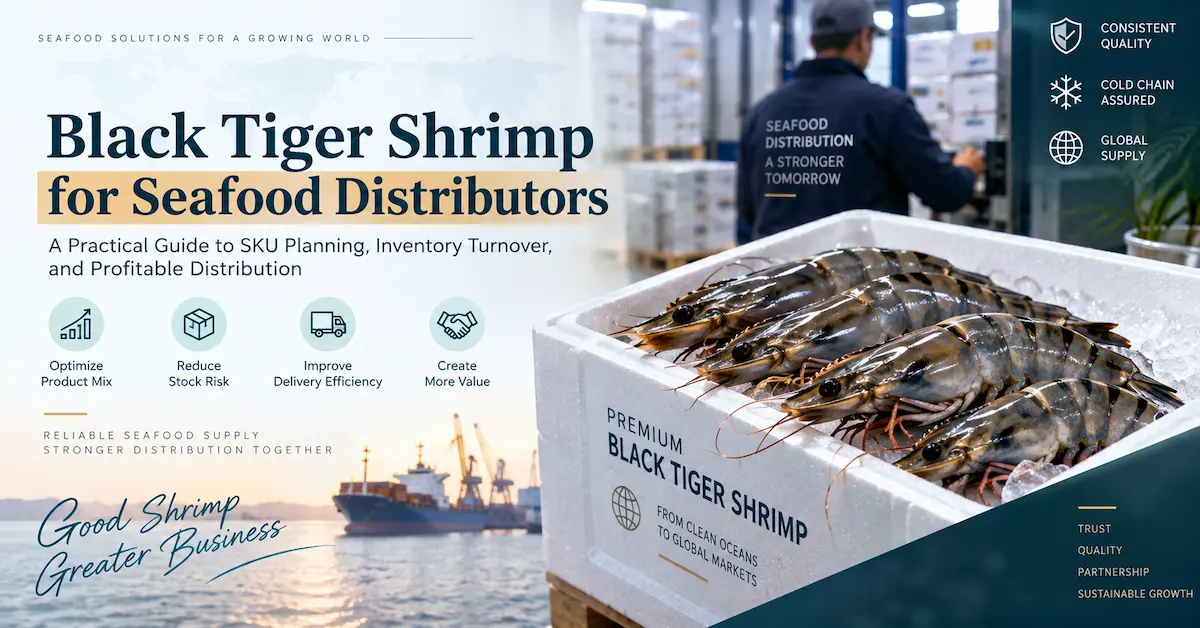


Finding a black tiger shrimp wholesale supplier is relatively straightforward. Finding one that can support consistent product specifications, predictable delivered costs, and repeatable wholesale orders is a different challenge.
For international seafood importers, the purchasing risk rarely ends when a supplier confirms availability and sends a price. Differences in shrimp count, head and shell condition, glazing, packaging, cold-chain handling, and shipment documentation can influence what the buyer actually receives and how much of the shipment can be sold profitably.
A quotation may look attractive at the point of purchase but become less competitive after freight, warehouse handling, quality losses, and customer complaints are considered.
The most effective way to select a black tiger shrimp wholesale supplier is to compare verified net shrimp weight, HOSO specifications, size consistency, quality acceptance criteria, and total landed cost rather than relying on the lowest quoted price per kilogram.
This guide provides a practical procurement framework for seafood importers, wholesale distributors, supermarket purchasing teams, foodservice suppliers, and frozen seafood trading companies.
It explains how to create a commercially measurable shrimp specification, evaluate purchasing costs, reduce shipment risks, and establish a repeat-order system that works beyond the first container.
Buyers preparing a new sourcing project can review Bothwin's frozen black tiger shrimp product and submit their specifications through the Bothwin contact page.
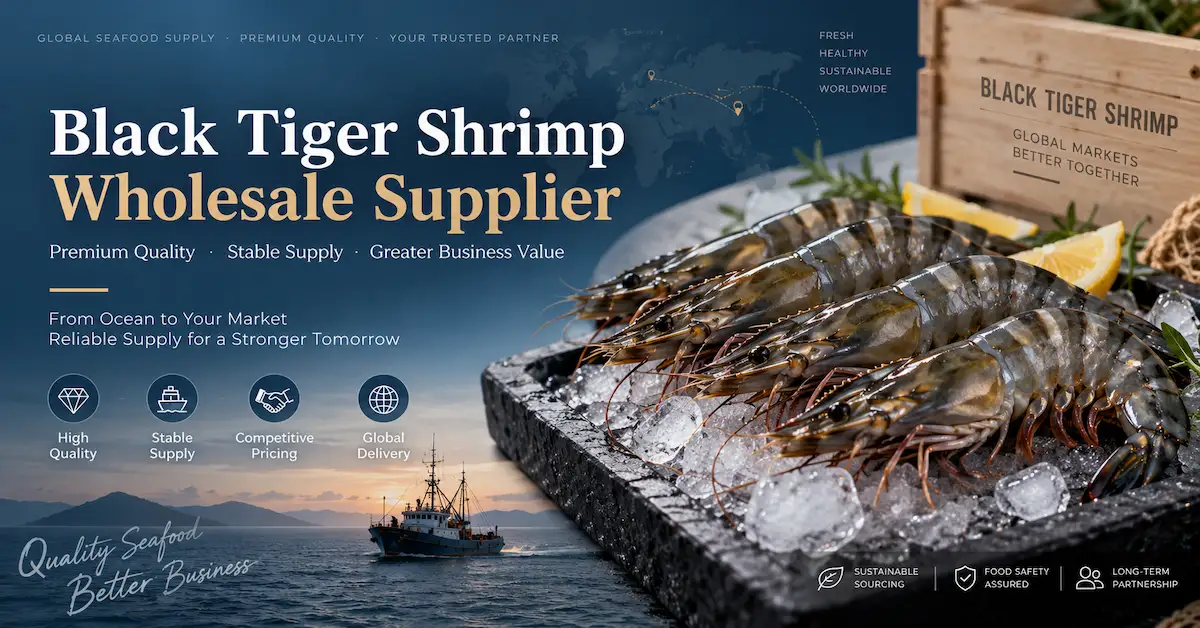
1. What Should Buyers Expect From a Black Tiger Shrimp Wholesale Supplier?
A professional wholesale shrimp supplier should be able to help the buyer establish a product specification that can be used consistently for quotations, samples, pre-shipment inspections, receiving checks, and repeat orders.
The supplier does not necessarily need to keep every size and packaging format in permanent stock. However, it should clearly distinguish between available products, customizable options, and requirements that still need confirmation.
For importers, seven questions determine whether a quotation can be evaluated properly.
| Procurement question | Information to request | Commercial importance |
|---|---|---|
| What shrimp are being supplied? | Scientific identity, production origin, raw or cooked condition | Prevents product identity and import-document mismatches |
| What is the processing form? | HOSO or another explicitly confirmed form | Determines preparation work and usable yield |
| How is size controlled? | Count range, unit, tolerance, and sampling procedure | Protects resale grading and portion consistency |
| How much shrimp is being purchased? | Declared net seafood weight, glazing basis, carton configuration | Makes competing quotations comparable |
| How will the product be inspected? | Defect definitions, samples, acceptance criteria, records | Reduces quality disputes |
| How will it be transported? | Freezing, packaging, loading and cold-chain requirements | Protects quality during distribution |
| Can the same specification be supplied again? | Written product approval, change control, and order planning | Supports long-term wholesale relationships |
A supplier that cannot answer every question immediately should explain what information is pending, who will confirm it, and whether the requirement is feasible.
Clear communication is more valuable than an unsupported promise that every specification can be supplied without restriction.
Why repeat-order consistency matters
Many distributors build their customer relationships around stable product grades.
A seafood wholesaler might sell one count size to restaurants and another to retail seafood counters. A supermarket chain may use a particular pack weight and label design. A hotel purchasing department may base its menu costing on a defined number of shrimp per serving.
Unexpected changes can create costs throughout the distribution chain.
If a shipment contains significantly more undersized shrimp than the approved reference, the distributor may need to discount part of the stock. If head damage increases, a premium whole-shrimp customer may reject a portion of the delivery. If cartons change dimensions, a warehouse may need additional storage space.
These problems make specification control a central part of wholesale supplier selection.
2. Understand the Product Before Negotiating Wholesale Prices
Black tiger shrimp are commonly identified as Penaeus monodon. They are recognized commercially for their striped shell appearance and use in various wholesale, retail, and foodservice markets.
However, a trade name is not a complete purchasing specification.
Before comparing quotations, an importer should confirm the scientific identification used for the actual shipment, the product's origin, its processing location, and the form in which it will be delivered.
HOSO black tiger shrimp
HOSO means Head-On, Shell-On.
The shrimp retain their heads and shells, providing the complete appearance that many seafood buyers expect for whole-shrimp retail displays, grilled presentations, seafood platters, and specialty restaurant menus.
The main commercial advantage of HOSO shrimp is that the whole appearance remains part of the product.
The main purchasing consideration is that head and shell weight must be included when evaluating preparation yield for applications that remove those parts.
A kilogram of HOSO shrimp is not commercially equivalent to a kilogram of peeled shrimp.
Other common shrimp forms
The following forms are useful for procurement comparisons, but buyers should not assume that every form is available from every supplier.
| Commercial form | Description | Typical buyer priority |
|---|---|---|
| HOSO | Head-on, shell-on | Whole presentation and shell condition |
| HLSO | Headless, shell-on | Reduced head-removal work |
| PTO | Peeled, tail-on | Portion presentation and preparation convenience |
| PUD | Peeled, undeveined | Further processing flexibility |
| PD | Peeled and deveined | Reduced kitchen or factory preparation |
| Specialty cuts | Buyer-defined processing format | Specific recipe or product requirements |
Bothwin's published black tiger shrimp specification identifies its product as frozen, whole, head-on, and shell-on.
The company also describes customized sizing on request and bulk export or OEM packaging options. Availability of alternative processing forms should be confirmed separately rather than assumed.
3. Build a Purchase Specification That Protects Your Wholesale Margin
A black tiger shrimp wholesale order should begin with a written technical and commercial specification.
This document is more than an attachment to a purchase order. It becomes the common reference used by the supplier, importer, quality inspector, logistics provider, and receiving warehouse.
Without it, different departments may interpret the same order differently.
Recommended HOSO specification sheet
| Specification field | Recommended buyer requirement |
|---|---|
| Commercial product name | Frozen Black Tiger Shrimp |
| Scientific identity | Confirm applicable species identity |
| Product condition | Raw or cooked, as agreed |
| Processing form | Whole, Head-On, Shell-On |
| Origin | Actual raw-material origin, to be confirmed |
| Processing location | Actual processing facility, to be confirmed |
| Size grade | Defined count range per kg or lb |
| Count tolerance | Agreed acceptance range |
| Freezing method | Confirmed method for the proposed product |
| Glazing | Defined calculation basis and tolerance |
| Declared net weight | Seafood weight excluding glaze where required |
| Inner packaging | Agreed material, weight, and configuration |
| Master carton | Net weight, gross weight, dimensions, and quantity |
| Storage | -18°C or below for the listed Bothwin product |
| Quality acceptance | Written defect criteria and sampling method |
| Traceability | Lot identification and supporting records |
| Labeling | Destination-market and buyer requirements |
| Quantity | Trial, pallet, container, or repeat volume |
| Commercial terms | Agreed Incoterm, currency, and delivery location |
This is a buyer's specification template, not a list of confirmed stock sizes or fixed commercial terms offered by Bothwin.
The advantage of preparing it before supplier selection is simple: every quotation can be measured against the same requirement.
Buyers who want to develop a detailed sourcing inquiry can refer to the Bothwin Frozen Seafood Quotation Guide.
4. Why Shrimp Count Size Can Change the Real Value of an Order
Shrimp count size is one of the most important variables in wholesale purchasing.
In many markets, shrimp are graded by the number of pieces per unit of weight. The unit may be kilograms or pounds, depending on the destination market and established commercial practice.
In general, a lower number of shrimp per kilogram indicates larger individual shrimp, assuming the same product form and weighing basis.
However, buyers should not compare count labels without confirming how those numbers were measured.
Count size is not the same as visual size
Consider two suppliers offering shrimp described as "large."
One supplier may grade the entire HOSO product by count per kilogram. Another may use a grading convention based on a different product form or measurement procedure.
Even when both suppliers use kilograms, their accepted tolerance ranges may differ.
A restaurant distributor can experience portion-cost problems if the actual average piece count varies significantly from the approved standard.
What should be written into the purchase agreement?
A proper count specification should identify the unit, product form, target grade, permitted variation, and inspection method.
Buyers should also agree on whether damaged or broken pieces are included in the count assessment and how representative samples will be selected.
A single carefully selected carton is not reliable evidence of shipment-wide uniformity.
Example of count-related commercial risk
Suppose a foodservice distributor sells shrimp to restaurants using a fixed number of whole shrimp per plate.
If incoming shrimp are smaller than expected, the restaurant may need more pieces to achieve its intended portion presentation.
If incoming shrimp are larger, the kitchen may encounter portion-weight and cooking-time differences.
Neither result is necessarily desirable, even when the product is safe and visually attractive.
The most commercially useful grade is the one that matches the customer's actual use with an acceptable level of variation.
Buyer takeaway: Always ask your black tiger shrimp wholesale supplier to confirm the count unit and tolerance before comparing price.
5. Glazing and Net Weight: Avoid Paying for an Unclear Quantity of Shrimp
Frozen seafood is often protected by glazing, a layer of frozen water applied to the product surface.
Appropriate glazing can help reduce dehydration and protect product quality during frozen storage.
The commercial problem is not glazing itself. The problem arises when a buyer and supplier use different weight definitions.
Codex's Standard for Quick-Frozen Shrimps or Prawns, CXS 92-1981, states that declared net contents for glazed products are exclusive of the glaze.
Importers must also comply with the applicable rules in their destination markets.
Four different weights buyers should understand
| Weight term | Meaning |
|---|---|
| Shrimp net weight | Declared quantity of shrimp excluding applicable glazing and packaging |
| Glazed product weight | Shrimp together with its protective ice glaze |
| Packaging weight | Bags, liners, cartons, and other packaging materials |
| Gross shipping weight | Relevant total weight used for transport and logistics |
A supplier quotation should make these distinctions clear.
Why the glazing calculation basis matters
The expression "10% glazing" is incomplete unless the calculation method is defined.
One party may calculate the percentage using glazed shrimp weight as the denominator. Another may calculate it relative to deglazed shrimp weight.
These methods produce different numerical results.
Consequently, an RFQ should identify the agreed testing procedure and weight basis instead of relying on the percentage alone.
Compare quotations using seafood quantity
For an internal purchasing analysis, a useful principle is:
Effective purchased seafood cost per kg = Total relevant purchase cost ÷ Verified seafood net weight
This formula assumes the costs and weights refer to the same shipment and that the net weight has been established under an agreed method.
If both offers already quote accurately against deglazed net shrimp weight, the buyer should not deduct glaze a second time.
For additional explanation of this issue, see How Glazing Percentage Affects Frozen Seafood Cost.
Agree on an inspection method before shipment
An importer should decide how many cartons will be tested, how samples will be selected, and which weighing and deglazing method will be used.
The procedure must be appropriate for the product and destination market.
Disputes are harder to resolve when a buyer applies one method at the destination while the supplier uses another at origin.
A written method protects both parties by making the expected result measurable.
6. Calculate Landed Cost Per Saleable Kilogram, Not Just Purchase Price
For serious wholesale buyers, purchase price represents only part of the cost.
The more useful measure is the total cost associated with obtaining shrimp that can actually be sold or processed for the intended customer.
This requires combining commercial charges with realistic product acceptance and yield assumptions.
What should landed cost include?
Depending on the agreed Incoterm and destination, the buyer's analysis may need to account for freight, cargo insurance, customs duties, import charges, inland transport, cold storage, warehouse handling, inspections, and repacking.
Buyers must avoid double-counting costs already included in a quoted trade term.
For example, a CIF quotation includes certain transport and insurance obligations that are not included in the same way under an FOB quotation.
A fair comparison uses one defined delivery point and one consistent cost boundary.
A practical wholesale cost model
For internal comparison:
Landed cost per net shrimp kg = Total landed cost ÷ Verified net shrimp quantity
For a buyer whose business removes parts of the shrimp or rejects nonconforming units:
Effective cost per usable kg = Total landed cost ÷ Accepted usable shrimp quantity
These are purchasing management formulas, not official regulatory formulas.
The usable quantity must be measured against the intended application.
Illustrative comparison: Supplier A vs Supplier B
The following numbers are hypothetical calculations designed to explain procurement economics. They are not current market prices, actual shrimp yields, or quotations from Bothwin.
| Cost and quality factor | Supplier A | Supplier B |
|---|---|---|
| Purchase price per net kg | USD 8.20 | USD 8.55 |
| Additional landed expenses per net kg | USD 1.25 | USD 1.20 |
| Landed cost per net kg | USD 9.45 | USD 9.75 |
| Accepted product proportion | 95% | 99% |
| Usable processing yield of accepted product | 76% | 79% |
| Effective cost per usable kg | USD 13.09 | USD 12.47 |
Supplier A offers a lower purchase price and lower landed cost per purchased kilogram.
However, under these hypothetical acceptance and processing assumptions, Supplier B delivers the lower effective cost per usable kilogram.
For Supplier A:
USD 9.45 ÷ (0.95 × 0.76) = approximately USD 13.09 per usable kg.
For Supplier B:
USD 9.75 ÷ (0.99 × 0.79) = approximately USD 12.47 per usable kg.
The example demonstrates why buyers should calculate what happens after delivery.
A cheaper invoice does not always produce a cheaper final product.
Actual acceptance rates and processing yields must come from representative samples or operational records. They should never be treated as guaranteed values for black tiger shrimp generally.
Different channels need different cost models
A whole-shrimp retailer may consider a cosmetically acceptable HOSO shrimp entirely saleable without removing the head or shell.
A prepared-food manufacturer may use only a portion of the original HOSO weight in the final recipe.
A restaurant may use the heads and shells for stock or sauces, creating additional value that another operation would not realize.
Therefore, a wholesale supplier comparison should use the purchasing channel's actual definition of usable product.
This single adjustment can make a cost model much more relevant to the buyer's business.
7. HOSO Shrimp Yield: Match Product Form to the Customer's Operation
HOSO black tiger shrimp can be attractive to buyers that sell or serve shrimp with the complete head and shell.
The product's commercial value may come from appearance, whole-shrimp presentation, customer preference, or its use in particular dishes.
For buyers that remove the head, shell, and other parts before sale, yield becomes more important.
How to conduct a useful sample yield test
Begin with a representative, correctly identified shrimp sample.
Record the starting seafood weight according to the agreed basis. Thaw the sample under an approved food-safety procedure, then process it exactly as the intended customer would.
Record the quantity of usable material and any relevant processing waste or separately recoverable by-products.
The result should distinguish product quality loss from normal preparation loss.
For example, removing the head because the final product requires headless shrimp is not the same as rejecting a shrimp because its head is damaged.
Questions to ask during testing
-
How much labor does the required preparation involve?
-
Does the size grade affect processing efficiency?
-
How much damage occurs during normal handling?
-
Are the heads and shells used or discarded?
-
How does the shrimp perform after cooking?
-
Does the finished product meet customer appearance and portion requirements?
A supplier cannot determine the ideal commercial form without knowing the buyer's intended application.
Why form comparisons must be handled carefully
A processed shrimp may have a higher price per kilogram than HOSO shrimp.
However, the processed form might reduce labor, shorten preparation, improve production throughput, or simplify portioning.
Conversely, HOSO may provide greater value when customers specifically want whole shrimp.
Neither form is universally better.
Importers should calculate the value of the product in the form their customers actually purchase.
Bothwin's currently published black tiger shrimp product is HOSO. Buyers interested in other forms should first ask whether those options can be sourced or processed for their particular order.
8. Cold Chain and Frozen Storage: Protect the Shipment's Commercial Value
Maintaining frozen shrimp quality requires more than setting a reefer container to a specified temperature.
Product condition before loading, packaging performance, temperature exposure during handling, and receiving procedures all matter.
Bothwin's published black tiger shrimp specification lists storage at -18°C or below.
This is also consistent with the storage instruction addressed in Codex CXS 92-1981 for quick-frozen shrimp.
Product temperature and reefer settings are different measurements
A container set point indicates the control setting used by the refrigeration system.
It does not automatically demonstrate that every carton or shrimp unit has remained at the required product temperature throughout the journey.
Temperature records should be interpreted alongside loading conditions, equipment performance, shipment events, and receiving observations.
A properly operating reefer is designed to maintain the condition of appropriately prepared frozen cargo, not to compensate for poorly frozen or improperly handled product.
Pre-loading considerations
Before loading, buyers and logistics coordinators should confirm the actual cargo condition, packaging suitability, container cleanliness, equipment condition, and required shipment settings.
Pallet arrangements and airflow also matter.
Cartons should not be loaded in a way that obstructs the refrigeration system's designed air circulation.
What happens at destination?
Receiving staff should inspect the container and cargo using an agreed procedure.
Important observations may include damaged cartons, signs of thawing and refreezing, abnormal ice accumulation, wet or collapsed packaging, and inconsistencies between labels and shipping documents.
A warehouse should document suspicious product conditions rather than immediately distributing the affected cases.
Where food safety is uncertain, the affected product should be held for the appropriate evaluation.
Repeat-order cold-chain monitoring
For recurring shipments, buyers can compare temperature records and receiving outcomes across lots.
If problems repeatedly appear at the same transfer point or warehouse, the investigation should focus on the relevant handling process instead of automatically attributing every defect to production.
This approach improves supplier and logistics management.
Cold-chain performance becomes a measurable part of purchasing, not merely a line in the contract.
9. Quality Inspection: What Should Be Checked Before Shipping?
A black tiger shrimp wholesale supplier should be evaluated through measurable product and process requirements.
Statements such as "premium quality" or "export grade" can help describe commercial intent, but they are not substitutes for documented acceptance criteria.
Importers should prepare a quality inspection plan before the first commercial shipment.
Practical HOSO inspection criteria
| Inspection area | Buyer evaluation | Possible commercial risk |
|---|---|---|
| Product identity | Confirm agreed species and form | Mislabeling or incorrect product |
| Head attachment | Assess loosened or separated heads | Reduced value for whole-shrimp presentation |
| Shell condition | Inspect cracks and physical damage | Breakage and retail complaints |
| Size grading | Check count consistency | Incorrect portion or resale grade |
| Appearance | Assess agreed color and defect standards | Visual downgrading |
| Foreign material | Check for unwanted material | Safety and quality concern |
| Odor | Evaluate under controlled inspection conditions | Possible deterioration |
| Net weight | Apply agreed weighing method | Short-weight disputes |
| Packaging | Check seals, damage, and carton integrity | Contamination or distribution damage |
| Lot marking | Match products and shipment records | Traceability failure |
The supplier and buyer should define acceptable tolerances before inspection.
A subjective description such as "good appearance" is difficult to enforce consistently across different inspectors.
Black spots and melanosis
Dark discoloration on shrimp shells may relate to melanosis, commonly called black spot.
Melanosis is an appearance-related process and does not by itself establish whether a shrimp is microbiologically safe or unsafe.
However, pronounced discoloration can reduce commercial value in markets where buyers expect a particular whole-shrimp appearance.
The purchasing specification should distinguish cosmetic acceptability from food-safety requirements.
Buyers should also clarify whether any anti-melanosis treatments are used and request appropriate ingredient, additive, or residue information where relevant.
Permitted treatments and labeling requirements depend on the destination market.
Inspection must use representative sampling
Inspecting only the top layer of a carton can create a misleading impression of the lot.
For meaningful quality evaluation, buyers should define a sampling plan appropriate to the shipment size, product type, contract, and applicable standards.
The procedure should document the sample identity, inspection date, product condition, grading result, defect observations, and net-weight findings.
These records provide a useful basis for claims, corrective actions, and comparisons with subsequent orders.
10. Food Safety and Regulatory Compliance for International Shrimp Importers
Food safety compliance is an essential supplier qualification topic, but importers should separate three concepts:
-
The legal requirements governing the destination market.
-
The food safety systems and controls used by the actual processing facility.
-
The certificates, approvals, reports, and records available for the specific shipment.
A general website statement about quality management does not prove that every facility, product, or shipment holds every certificate a buyer might request.
HACCP and seafood processing
Hazard Analysis and Critical Control Points, or HACCP, is a preventive approach to food-safety management.
The U.S. Food and Drug Administration regulates seafood HACCP under 21 CFR Part 123 and provides guidance for seafood processors and importers.
For a U.S.-bound shipment, the importer should determine applicable seafood HACCP obligations and verify that the required compliance and importer-verification arrangements are in place.
Other destinations may require different establishment approvals, health certificates, inspections, or documentation.
What food-safety evidence should buyers request?
Depending on the product and market, an importer may need to review the processing facility's identity, relevant food safety certificates, approved establishment details, hazard-control records, traceability information, and applicable testing documentation.
The exact documents should be confirmed against current destination requirements.
For shrimp, relevant risk assessments may also consider microbiological hazards, chemical residues, food additives, allergens, and handling conditions.
No single certificate automatically removes the need for shipment-specific controls.
Confirm approval scope, not only certificate names
If a supplier provides an ISO 22000, HACCP, Halal, or other certificate, review the issuing body, certificate holder, site address, scope, expiration date, and relationship to the proposed product.
A certificate covering one facility may not cover another processing location.
Similarly, a certificate covering a particular category of food products may not establish approval for every seafood SKU.
Bothwin's black tiger shrimp page describes HACCP-oriented quality management, hygiene controls, cold-chain controls, and batch traceability. Buyers should request supporting evidence relevant to the proposed order rather than treating those public descriptions as independently verified facility certifications.
This distinction is especially important when a shipment is intended for supermarket chains or tightly controlled foodservice programs.
11. Wholesale Packaging Should Be Designed for the Distribution Channel
Packaging is sometimes treated as a secondary purchasing decision.
For international wholesale shrimp, it can affect storage efficiency, labor, traceability, retail presentation, product protection, and distribution cost.
A packaging specification should therefore be developed alongside the product specification.
Bulk export cartons
Bulk export packaging is generally relevant to importers and wholesalers handling large quantities.
The buyer should confirm inner pack weight, master carton quantity, dimensions, packaging materials, sealing method, lot identification, and stacking requirements.
A carton should be suitable for the intended frozen distribution conditions.
The cheapest carton is not necessarily economical if it performs poorly during transportation or repeated warehouse handling.
Inner pack selection
The inner unit matters to the people who actually handle the product.
A foodservice distributor may break down master cartons and supply restaurants in smaller units. A processor may prefer a pack that fits the production schedule. A wholesale market may prioritize handling efficiency and clear product identification.
Ask whether the inner pack can be handled without damaging shrimp or losing traceability information.
OEM and private-label packaging
Private-label packaging may involve artwork, brand colors, product names, nutritional information, origin declarations, storage instructions, barcodes, and destination-specific mandatory labeling.
These elements require approval before printing.
Bothwin's published black tiger shrimp page identifies bulk export packaging and OEM/ODM packaging as available discussion options. Custom specifications, printed materials, minimum quantities, and production timing should be confirmed individually.
For a new retail program, consider a packaging approval sequence:
-
Confirm the product and market requirements.
-
Review the proposed packaging structure.
-
Approve language and required product information.
-
Verify artwork, barcode, and lot-code placement.
-
Inspect a representative printed sample.
-
Confirm the accepted version before commercial packing.
This prevents expensive label changes after packaging materials have already been produced.
Buyers can begin the discussion through Bothwin's seafood sourcing and contact team.
12. Import Documents, Origin, and Commercial Responsibility
A supplier's office location, the shrimp's production origin, the processing location, and the loading port are separate facts.
They should not be assumed to be identical.
This distinction is particularly important for importers comparing international seafood suppliers.
An importer needs documentation that accurately reflects the actual transaction and complies with the destination's rules.
Recommended document coordination checklist
| Document or record | Why it may matter |
|---|---|
| Commercial invoice | Identifies seller, buyer, product, and transaction |
| Packing list | Details quantities, packaging, and shipment composition |
| Transport document | Supports shipment and delivery control |
| Origin evidence | Supports origin declarations and applicable trade requirements |
| Health or sanitary certification | Required for certain products and destinations |
| Processing establishment information | May be needed for market-access verification |
| Traceability and lot records | Support identification of affected product |
| Product specification | Provides agreed quality and commercial reference |
| Inspection or testing records | Support applicable buyer or regulatory requirements |
| Insurance documentation | Relevant according to trade arrangements |
Not every document applies to every shipment. The importer should verify the destination-specific requirements with the relevant competent authorities and logistics professionals.
Agree on Incoterms carefully
FOB, CIF, FCA, and other Incoterms describe different allocations of delivery responsibilities, costs, and risks.
The exact named place or port matters.
A quotation should identify the agreed Incoterms rule and version, the named location, currency, quantity, and scope of charges.
For example, a price described only as "CIF" is incomplete without the named destination port and the other commercial assumptions required for a valid comparison.
A buyer should also distinguish contractual delivery responsibility from the separate requirement to preserve frozen product quality during shipment.
13. How to Compare Black Tiger Shrimp Wholesale Suppliers Objectively
Price should be considered after confirming that suppliers are quoting a comparable product.
A structured supplier scorecard helps procurement teams avoid making decisions based on incomplete or inconsistent information.
The following is a suggested internal evaluation model. Its weighting can be adjusted to suit the buyer's business.
| Evaluation category | Suggested weighting | Example evidence |
|---|---|---|
| Product and size consistency | 25% | Sample results, count records, approved specification |
| Quality and food-safety evidence | 20% | Relevant controls, facility documentation, inspection records |
| Landed cost competitiveness | 20% | Normalized delivered-cost comparison |
| Packaging and traceability | 10% | Approved packs, labels, batch information |
| Logistics and documentation | 10% | Agreed responsibilities, shipment records |
| Communication and problem resolution | 10% | Response quality, corrective-action process |
| Repeat-order reliability | 5% | Confirmed performance across multiple deliveries |
| Total | 100% | Evidence-based evaluation |
The recommended approach is to use documented criteria for assigning scores.
Do not give a supplier a high score simply because its marketing materials use terms such as "best quality" or "competitive price."
Where evidence is unavailable, mark the category as pending rather than assigning a guessed score.
How to make the scorecard commercially useful
Suppose a supplier performs well on cost but poorly on labeling accuracy.
For a wholesale trading company selling bulk unbranded cartons, the risk might be manageable under a corrective-action plan.
For a major supermarket chain, label errors could create unacceptable compliance and product-recall exposure.
The same evaluation result therefore has different commercial implications depending on the buyer's channel.
A practical supplier decision combines weighted performance with any mandatory pass-or-fail requirements.
Regulatory compliance and critical food-safety controls should not be traded away simply because a supplier offers a lower price.
14. Building a Repeatable Bulk Shrimp Supply Program
A successful first order does not automatically guarantee successful repeat orders.
Frozen seafood procurement is affected by supply availability, customer demand, quality variation, international logistics, packaging requirements, and changes in destination regulations.
Buyers should establish a repeat-order process that prevents unauthorized or poorly communicated specification changes.
Create an approved specification version
After the first shipment, maintain a reference showing the accepted product identity, grade, form, packaging, labeling, and inspection requirements.
Assign the specification a version or revision date.
When a new purchase order is prepared, the supplier should know which version applies.
If a proposed change affects product form, grade, origin, packaging, or other material characteristics, the buyer should approve it before the change is implemented.
Plan around real demand
Wholesale purchasing volume should reflect the buyer's sales and storage capacity.
Review weekly or monthly demand by customer, grade, and packaging format. Include the effect of promotions, seasonal purchasing, holidays, and periods of lower turnover.
Holding more inventory can protect availability, but it also increases working capital requirements and cold-storage exposure.
Inventory measures worth tracking
Useful internal indicators include inventory days on hand, stock turnover, lot age, sell-through by grade, claims per shipment, and remaining shelf life at receipt.
A distributor may also track cost per accepted kilogram and repeat-order acceptance performance.
These metrics provide a more balanced picture than monitoring purchase price alone.
Protect traceability after carton splitting
A full container may be delivered to one central cold store and subsequently distributed to many customers.
If master cartons are opened and inner packs are separated, the distributor should maintain enough information to identify the original shipment and product lot.
Without suitable traceability, even a limited quality problem can become difficult to isolate.
Review supplier performance after each shipment
The first delivery should establish a measurable baseline.
Compare later shipments against the same quality and cost criteria.
If performance changes, investigate the cause and agree on corrective action.
A stable wholesale program is built through documented feedback rather than repeated informal assurances.
15. Approve a Representative Sample Before a Large Commercial Order
A representative sample can reveal problems that a product photograph or specification sheet cannot.
However, sample approval is only useful when the tested product reflects the proposed commercial supply.
Stage 1: Written specification review
Before requesting samples, send the supplier your intended product identity, HOSO form, count size, freezing requirements, net-weight basis, packaging, and destination details.
Ask the supplier to identify which requirements are confirmed and which remain under review.
Stage 2: Physical sample evaluation
Check size consistency, head attachment, shell appearance, odor, packaging, and product condition.
Where relevant, use an agreed method to evaluate net weight and other measurable characteristics.
Maintain photographs and sample records.
Stage 3: Application test
If shrimp will be sold whole, evaluate the appearance under the actual retail or foodservice conditions.
If the product will be processed, record processing yield, labor requirements, and product suitability.
Different applications may require different tests.
Stage 4: Commercial feasibility review
After sample evaluation, confirm quotation validity, available quantity, proposed packaging, shipment timing, and required documentation.
A sample that meets the specification is useful only if the same specification can be delivered commercially.
Stage 5: Trial shipment and corrective action
For a new supplier relationship, consider whether a controlled trial shipment is practical before committing to a larger recurring program.
After arrival, compare actual product results with the approved sample and contractual requirements.
Document any deviations, assign responsibilities, and decide whether the specification or operating procedures need revision.
This approach reduces the risk of scaling a purchasing problem across multiple containers.
16. Prepare a Complete RFQ for a Black Tiger Shrimp Wholesale Supplier
A short message asking for "best price" rarely gives a supplier enough information to prepare a useful wholesale quotation.
A better inquiry identifies the product, the intended use, and the commercial conditions that affect price.
Buyer RFQ checklist
| RFQ field | Information to provide |
|---|---|
| Company and market | Buyer company and destination country |
| Product | Black tiger shrimp, scientific identity to be confirmed |
| Preferred form | HOSO, or another separately requested form |
| Size | Count range and unit |
| Freezing | Preferred method, subject to availability |
| Weight | Required seafood net weight and glazing basis |
| Packaging | Inner pack, outer carton, label requirements |
| Quantity | Trial or estimated commercial volume |
| Destination | Port or delivery location |
| Shipping terms | Requested Incoterm and version |
| Compliance | Required destination documents and applicable approvals |
| Timing | Desired shipment period |
| Application | Wholesale resale, retail, restaurant, or processing |
| Inspection | Proposed acceptance criteria and sample requirements |
Example of a professional wholesale inquiry
Subject: RFQ – Frozen HOSO Black Tiger Shrimp for Wholesale Distribution
Dear Bothwin Sales Team,
We are evaluating a supplier for frozen black tiger shrimp intended for wholesale distribution in our market.
Our preferred product is raw, whole, head-on, shell-on black tiger shrimp. Please confirm the available count grades, scientific identity, product origin, freezing method, glazing terms, net weight, and export packaging options.
Our estimated initial requirement is [quantity], with potential repeat orders depending on sample approval and customer demand. The destination is [country/port], and our preferred quotation basis is [Incoterm and named place].
Please also advise current availability, MOQ, proposed lead time, quotation validity, applicable product documentation, and whether OEM packaging can be discussed.
We would appreciate a product specification and information about a representative sample.
Kind regards,
[Buyer Name]
[Company]
[Country]
This format allows the supplier to respond against a real purchasing requirement instead of offering an unrelated price.
Send Your Black Tiger Shrimp Wholesale RFQ to Bothwin
17. Why Consider Bothwin for Wholesale Black Tiger Shrimp Sourcing?
Bothwin Development (HK) Limited presents itself as an international seafood sourcing and supply company serving importers, wholesalers, seafood distributors, and foodservice businesses.
According to its company profile, the business was established in 2005 and focuses on farmed and wild seafood supply.
For black tiger shrimp, the company publishes a product specification covering frozen whole shrimp with heads and shells intact.
Its product information also identifies customized sizing upon request, bulk export packaging, OEM/ODM packaging discussion, and storage at -18°C or below.
What buyers can verify from the public product information
| Product detail | Published Bothwin information |
|---|---|
| Product | Black Tiger Shrimp |
| Condition | Frozen |
| Form | Whole, Head-On, Shell-On |
| Size | Customized upon request |
| Packaging | Bulk export packaging / OEM available |
| Storage | -18°C or below |
| Target customers | Seafood wholesalers, distributors, traders, and foodservice buyers |
| Quality management | HACCP, hygiene, cold-chain control, and traceability described by the company |
These are public product descriptions rather than a guarantee that every requested option is available for every shipment.
Final count grades, origin details, glaze specifications, inspection arrangements, certificates, minimum order quantity, delivery schedule, and price require direct confirmation.
How Bothwin can fit into a buyer's procurement process
Bothwin's published business positioning covers product sourcing, specification coordination, quality management, export packaging, and international shipment support.
For importers evaluating a wholesale shrimp program, the practical next step is to provide a complete RFQ and request confirmation of the proposed product.
The buyer can then compare the response with other quotations using the same commercial criteria.
For distributors planning repeat orders, it is especially important to discuss product consistency, packing requirements, and lot-level documentation from the beginning.
Explore Bothwin's Whole Black Tiger Shrimp
Contact Bothwin to Discuss Bulk Shrimp Supply
18. Frequently Asked Questions About Black Tiger Shrimp Wholesale Supply
What should I look for in a black tiger shrimp wholesale supplier?
Look for accurate product identification, clear HOSO specifications, defined count sizes, transparent net-weight terms, reliable quality evidence, appropriate cold-chain arrangements, and consistent shipment documentation.
A supplier should also explain which sizes and packing formats are available for the actual order.
The best purchasing decision considers total landed cost and repeat-order performance rather than the initial price alone.
What does HOSO mean in wholesale shrimp trading?
HOSO means head-on, shell-on.
It describes shrimp supplied with their heads and shells intact. This form can be useful for whole-shrimp retail display, restaurant presentation, and specific seafood dishes.
Buyers should still define the count size, grading tolerance, quality criteria, and packaging because HOSO alone does not establish a complete purchasing specification.
Is frozen black tiger shrimp suitable for supermarket distribution?
Frozen black tiger shrimp can be suitable for supermarket distribution when the product, labeling, packaging, food-safety controls, and storage conditions meet the retailer's requirements.
Wholesale cartons and consumer-facing retail packs may require different packaging arrangements.
Buyers should confirm the proposed SKU and labeling specifications rather than assume that an export carton is automatically suitable for retail sale.
How should importers compare wholesale shrimp prices?
First confirm that quotations use the same product form, count size, net-weight basis, packaging, quality criteria, and delivery terms.
Then calculate the total landed cost to a consistent delivery point.
If the buyer will process the shrimp, include actual accepted usable yield and relevant preparation expenses.
This provides a more useful commercial comparison than price per carton alone.
Does glazing count toward frozen shrimp net weight?
Codex CXS 92-1981 states that declared net contents for glazed quick-frozen shrimp are exclusive of the glaze.
Buyers should verify the applicable legal requirements in their destination market and agree on a suitable inspection method.
The quotation should distinguish seafood net weight from protective ice and packaging weight.
Can HOSO black tiger shrimp be used for foodservice?
Yes. HOSO black tiger shrimp can suit restaurant menus that benefit from whole-shrimp presentation.
However, the buyer should test portion consistency, head attachment, shell appearance, preparation time, and cooking performance.
A high-volume kitchen may have different requirements from a premium seafood restaurant.
Additional application considerations are covered in Bothwin's Black Tiger Shrimp Foodservice Buying Guide.
Can Bothwin provide OEM packaging for black tiger shrimp?
Bothwin's black tiger shrimp product page identifies bulk export packaging and OEM/ODM packaging as available options for discussion.
Actual packaging formats, artwork requirements, order quantities, costs, and lead times need to be confirmed for the proposed project.
Buyers should submit packaging specifications together with the product RFQ.
What temperature is required for frozen black tiger shrimp storage?
Bothwin's published black tiger shrimp specification states storage at -18°C or below.
Importers should also establish appropriate transportation and receiving controls.
A reefer container's displayed set point alone is not complete proof of product temperature throughout the shipment.
What information is needed for a bulk black tiger shrimp quotation?
Provide the shrimp form, desired count grade, count unit, net-weight and glazing requirements, packaging, estimated order volume, destination port, target shipment period, and intended sales channel.
Also identify any market-specific certification, labeling, inspection, or documentation requirements.
The supplier can then confirm current availability and commercial terms.
Is the cheapest black tiger shrimp supplier always the best option?
No.
A low quoted price can become less competitive if a shipment has higher processing losses, inconsistent count grades, damaged heads, unclear weight terms, or additional logistics costs.
A professional importer should compare total cost per accepted saleable or usable kilogram using evidence from the intended supply program.
How can distributors reduce quality problems in repeat orders?
Use a written, version-controlled product specification and maintain reference samples or approved photographs.
Review count results, net weight, defects, packaging condition, and receiving performance for each shipment.
Require approval of material product or packaging changes before production and investigate recurring deviations through documented corrective actions.
Conclusion
Choosing a black tiger shrimp wholesale supplier is not simply a matter of finding frozen shrimp at an attractive price.
For importers, wholesalers, seafood distributors, foodservice suppliers, and private-label businesses, the more important objective is to purchase a clearly specified product that arrives in the expected condition, meets customer requirements, and supports profitable repeat orders.
A reliable sourcing program begins with product identity and HOSO specifications. It then moves through count grading, glazing and net-weight verification, quality inspection, packaging approval, food-safety documentation, cold-chain management, and landed-cost analysis.
Each of these factors influences the commercial value of a shipment.
Importers who compare suppliers using a consistent specification and actual cost-per-usable-kilogram calculations are better positioned to identify avoidable expenses before committing to large orders.
For repeat purchasing, maintaining approved specifications and reviewing shipment performance can be just as important as negotiating the initial price.
Bothwin Development (HK) Limited offers a starting point for buyers seeking frozen whole black tiger shrimp, with customized sizing and export packaging options described in its public product information. Availability and shipment-specific conditions should be confirmed through direct communication.
Whether you are sourcing HOSO shrimp for wholesale distribution, evaluating seafood supply for restaurant customers, or developing a private-label frozen shrimp program, a complete purchasing specification will help you obtain a more meaningful quotation.
View Bothwin's Black Tiger Shrimp Product | Request a Wholesale Quotation
Send your required count grade, packaging specifications, estimated order quantity, destination, and target shipment period to discuss a black tiger shrimp supply arrangement that fits your market.