

The Distributor's Quick Answer
Start with three linked decisions: which customers will buy whole head-on, shell-on (HOSO) shrimp; which limited set of count grades and pack sizes fits those customers; and how much stock can be turned before storage and service costs erode margin.
Approve a written specification and build a reorder rule using demand, replenishment lead time, and safety stock. Measure contribution after local distribution—not only markup over the import price.
1. Separate Distributor Strategy From Supplier Selection
A supplier comparison asks whether the proposed shrimp meets the buyer's specification. A distribution strategy asks which specification the market will purchase repeatedly, in what quantity, and through which delivery service.
For example, a regional distributor might service seafood restaurants twice weekly, independent retailers weekly, and hotel accounts by planned contract. Each group has a different expectation for count grade, packaging, labeling, minimum order, and forecast accuracy. Trying to serve them all with one undifferentiated product can create costly exceptions.
Build the assortment from proven demand rather than first purchasing a wide range of stock and looking for customers afterward. Before listing a new shrimp SKU, interview sales representatives and several target accounts. Ask about preferred product form, count unit, use per week, presentation standards, case size, acceptable substitutions, and seasonal demand.
The operational goal is a repeatable sell-through pattern, not simply an impressive catalog.
Buyers seeking a wider primer on shrimp procurement can consult Bothwin's frozen black tiger shrimp sourcing guide, while this article concentrates on downstream distribution decisions.
2. Match HOSO Shrimp to the Correct Sales Channel
Black tiger shrimp are commercially associated with the species Penaeus monodon, but the actual species identity, origin, and shipment specifications must be confirmed.
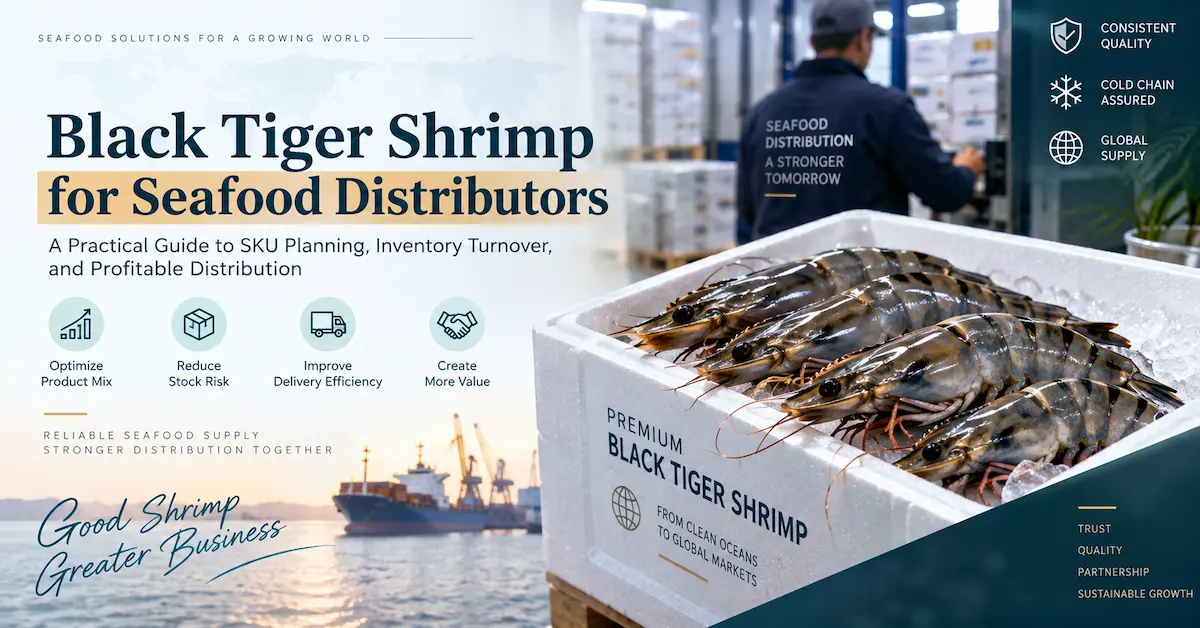
Bothwin's listed product is frozen, whole, head-on, shell-on shrimp. HOSO gives buyers a complete shrimp presentation; it is not a substitute for processed forms where customers need labor-saving peeled material.
| Customer Channel | Potential Value of HOSO | Distributor's Key Decision |
|---|---|---|
| Seafood restaurants | Whole-shrimp visual presentation for grilled, steamed, or specialty dishes | Align grade and case quantity with portions and delivery frequency |
| Hotel and banquet suppliers | Attractive whole-shrimp display and planned volume for events | Secure advance forecasts and define approved substitutes |
| Independent seafood retailers | Recognizable striped shells and premium whole-shrimp merchandising | Evaluate pack size, shelf presentation, and retail turnover |
| Ethnic and specialist markets | Whole product where local recipes and buyer preferences favor HOSO | Verify market-specific count, appearance, and labeling expectations |
| Food processors | Possible raw material when the process can handle whole shrimp | Compare labor and yield against approved processed formats |
There is no universally best shrimp grade. The correct grade is the one that supports a particular customer's recipe, price point, and purchase frequency.
A premium restaurant may accept slower inventory turnover in exchange for a large whole-shrimp presentation. A high-volume distributor may need a more accessible price band and faster replenishment.
3. Build a Three-Tier Shrimp SKU Architecture
Instead of purchasing every available count and pack, consider dividing the initial assortment into three commercial roles. These tiers are a planning example, not confirmed Bothwin stock grades.
| SKU Role | Target Accounts | Inventory Policy | Success Metric |
|---|---|---|---|
| Core mover | Accounts with reliable weekly consumption | Hold forecast-based inventory and maintain reorder discipline | Repeat order rate and weekly case movement |
| Premium trade-up | Hotels, chef-led restaurants, specialist retail | Use smaller commitments or pre-orders where feasible | Contribution per case and low aged-stock exposure |
| Market-test SKU | New segments or private-label customers | Set a trial volume and review date before replenishing | Customer conversion and repeat-purchase evidence |
Each SKU should have a unique stock code incorporating product form, grade, pack, and label version.
Keep the count unit explicit: pieces per kilogram and pieces per pound are not interchangeable. Likewise, an HOSO count should not be casually compared with peeled-shrimp counts.
4. Design the Case Around Warehouse and Customer Workflows
The export master carton is not necessarily the unit a distributor delivers. One imported master case may be split into smaller orders, and each split creates handling work and traceability responsibilities.
Evaluate three levels: the master carton used for transport, the inner unit used in case picking, and the selling unit shown on the invoice.
Record actual carton dimensions, net contents, pieces per case, pallet layout, and label visibility. Do not assume a carton configuration until it is confirmed for the quote.
For customers ordering full master cases, a robust carton and clear external grade marking may be enough.
For split-case orders, inner-pack identity and handling durability become more important. If the inner unit loses its lot identification when the outer carton is discarded, downstream traceability becomes harder.
Practical Receiving-to-Delivery Test
- Receive an approved trial case and record its lot, pack, and physical condition.
- Store it in the intended freezer location and check readability of the label.
- Pick a typical customer order using normal warehouse staff and equipment.
- Check whether split units retain sufficient traceability information.
- Estimate handling minutes and packaging losses per delivered case.
The test can expose hidden labor costs before a distributor scales the purchase volume.
Bothwin states that bulk export and OEM packaging are available for discussion; individual pack types, artwork, printing quantities, and feasible order volumes require confirmation.
5. Set a Reorder Point Before the First Container Arrives
Distributors can lose sales by ordering too late and lose margin by ordering too much.
A simple reorder-point model makes the purchasing decision repeatable. It should use the time until saleable replacement stock is available, including production, shipment, customs, and receiving where relevant—not merely vessel transit time.
Illustrative example: A distributor sells an average of 18 cases per week. If replenishment takes five weeks and management holds 30 cases of safety stock, the reorder point is 120 cases (18 × 5 + 30).
This is a worked example only; it is not Bothwin's lead time or a recommended universal safety stock.
Inventory position should include usable stock on hand and confirmed inbound orders, less allocated or backordered cases.
Buyers should recalculate safety stock when demand changes sharply or lead time becomes unreliable.
During holiday promotions and peak banquet seasons, normal averages may understate demand.
Three Questions Every Replenishment Review Should Answer
- Sales: Are recent shipments representative of ongoing demand or inflated by a one-off order?
- Supply: Is the replacement product actually confirmed for the same grade, packaging, and destination?
- Capacity: Can the cold store and delivery routes absorb another order without creating aged stock?
6. Control Inventory Age, Stock Rotation, and Shrink
A frozen product does not become commercially risk-free merely because it remains below its storage temperature limit.
Shelf life, packaging damage, customer acceptance, and storage cost still matter.
Use first-expired, first-out (FEFO) where applicable, supported by lot-level receiving dates and best-before information.
FIFO by receipt date alone may be inadequate if different lots arrive with different remaining shelf lives.
| Operating Metric | Simple Calculation or Observation | What It Reveals |
|---|---|---|
| Weeks of supply | Saleable cases on hand ÷ forecast weekly cases | Overstock or shortage exposure |
| Sell-through rate | Cases sold ÷ cases available over a defined period | Whether a SKU deserves repeat purchasing |
| Remaining shelf life | Recorded shelf-life end date minus receipt or delivery date | Whether customers will accept the lot |
| Claim rate | Credited cases ÷ delivered cases, with an agreed definition | Product or distribution problems |
| Pick cost per case | Allocated picking labor and materials ÷ picked cases | Cost of small or complex customer orders |
7. Calculate Profit After Local Delivery
A distributor's useful margin metric is the return after the costs needed to get the shrimp from the import or purchasing point to the customer.
Sales teams often discuss gross margin before considering warehouse handling, cold storage, drops, and credits.
Consider the following hypothetical per-case example. These are invented teaching values, not a Bothwin quote or published market benchmark.
| Per-Case Item | Illustrative Amount |
|---|---|
| Net customer sale price | USD 170 |
| Product plus landed costs | USD 124 |
| Warehouse picking | USD 5 |
| Cold storage allocation | USD 4 |
| Local delivery allocation | USD 8 |
| Expected credits/returns allocation | USD 3 |
| Contribution after listed costs | USD 26 |
The result is not net profit: it excludes unlisted operating expenses, finance costs, taxes, and other overhead.
The example illustrates why a delivery-heavy customer can contribute less than a customer taking full cases, even when both buy at a similar price.
Compare customer groups by contribution per case, delivery frequency, credit risk, and stock turnover.
This may justify a separate delivered price, an order minimum, or a scheduled delivery day for small accounts. Commercial policies should be practical and communicated clearly to customers.
8. Improve Route Density Without Sacrificing Customer Service
For a frozen shrimp distributor, the last refrigerated delivery can consume a meaningful portion of margin.
The service promise should reflect route density, customer order size, and available temperature-controlled transport.
Segment customers into planned-route accounts, high-volume contract accounts, and exceptional urgent orders.
Set realistic ordering cutoffs, full-case or split-case rules, and route schedules.
Track whether smaller deliveries repeatedly require additional handling or route deviations.
9. Treat Customer-Specific Packaging as a Mini Product Launch
Retail-ready or private-label shrimp programs can expand distribution opportunities, but they add coordination work.
A buyer may need a specific pack weight, design, barcode, origin statement, ingredient or allergen declaration, and destination-market label language.
Before confirming a private-label deal, ask the customer to approve the intended selling unit, net quantity, label claims, packaging dimensions, artwork version, and forecast.
Confirm which party owns the artwork and how obsolete printed materials will be handled if demand changes.
Bothwin's public Black Tiger Shrimp product page lists bulk and OEM packaging.
It does not publish a universal minimum print run or promise every requested retail format, so buyers should request project-specific feasibility.
10. Maintain Traceability When Master Cartons Are Split
Seafood distributors often divide inbound shipments among many customers.
The receiving lot may be easy to identify at the cold store but difficult to track after cases are split, relabeled, or repacked.
Set a record linking the supplier lot, receiving date, stock code, quantity received, repacked units where relevant, and each outbound customer delivery.
If a complaint occurs, the distributor should be able to identify affected stock and destinations promptly.
Confirm relevant national requirements for seafood traceability, food safety, handling, and labeling.
The needed records vary by jurisdiction and product, and a website description of quality control is not a substitute for destination-specific compliance evidence.
Where an actual case shows thawing, unusual odor, or potentially unsafe conditions, hold it under the appropriate food-safety procedure.
Do not treat sensory checks alone as a complete safety determination.
11. Run a Controlled Distributor Trial Before Scaling
A sensible launch test assesses both product acceptance and the distributor's operating model. It should not be limited to a chef approving one cooked sample.
- Define the accounts: Identify target customers, expected weekly volume, service area, and intended menu or retail application.
- Approve the product: Specify HOSO form, desired count, grading unit, glazing/net-weight basis, label, and pack.
- Confirm the transaction: Ask for current origin, available grade, MOQ, shipment timing, pricing basis, and required documents.
- Test fulfillment: Receive, store, pick, deliver, and trace a realistic sample order.
- Review sell-through: Track actual repeat purchases, aged cases, claims, and contribution after local handling.
- Scale selectively: Reorder proven grades and delay speculative additions until there is evidence of demand.
Distributor Launch Checklist
Before committing to repeat supply, verify that you have:
- Named target accounts and a defined core SKU.
- Written product acceptance criteria.
- A suitable pack configuration.
- An import and documentation plan.
- An inventory reorder rule.
- Customer price and delivery policies.
- A clear process for complaints and lot tracing.
12. How Bothwin Fits a Distributor Sourcing Inquiry
Bothwin Development (HK) Limited describes its business as international seafood sourcing and supply.
Its black tiger shrimp product page lists frozen whole HOSO shrimp, customized sizing upon request, bulk export or OEM packaging, and storage at -18°C or below.
The company identifies seafood distributors and wholesalers among the intended customers.
These points are useful starting information, not a confirmed live inventory sheet or a guarantee of any particular count, route, certification, lead time, or commercial volume.
Before placing an order, buyers should ask Bothwin to confirm the shrimp's actual origin, species documentation, offered sizes, packing, net-weight terms, applicable food-safety evidence, pricing, MOQ, and shipment arrangements for the destination.
A distributor that already knows its channel and weekly demand can make that discussion more productive.
The most helpful inquiry explains who will buy the shrimp and how cases move through the distributor's network.
Plan a Distributor-Ready Shrimp Program
Send Bothwin your target market, HOSO count preference, pack size, first-order quantity, expected monthly demand, and destination.
Ask the team to confirm available options and commercial terms for your specific project.
13. Distributor RFQ: Details That Get a Useful Response
Use the following information to request a quote rather than asking only for the lowest price per case.
| RFQ Field | What to Tell the Supplier |
|---|---|
| Business channel | Restaurant supply, wholesale, retail, or mixed distribution |
| Product and form | Black tiger shrimp; frozen HOSO as preferred or request feasibility of alternatives |
| Size and unit | Desired count range, per kg or per lb, and accepted tolerance |
| Pack and labels | Net seafood weight, inner unit, carton size, branding, language |
| Volume pattern | Trial quantity, forecast monthly cases, frequency of replenishment |
| Delivery | Destination country/port, requested Incoterm, target shipment period |
| Compliance | Destination-specific documents, origin evidence, and relevant certificates |
| Inspection | Sampling plan, count and condition criteria, lot identification |
Ask for a written specification and a quotation identifying what is confirmed versus conditional.
For follow-up comparisons of general supplier criteria, see Bothwin's black tiger shrimp importer buying guide.
Frequently Asked Questions
Which black tiger shrimp grade should a seafood distributor stock first?
Start with a grade that existing customers have requested, not an assumed premium size. Confirm count units, HOSO form, case configuration, and realistic weekly demand.
Evaluate a second grade only after comparing repeat orders, selling price, and inventory holding cost.
Is HOSO black tiger shrimp suitable for restaurant distribution?
Yes, when the menu values whole head-on, shell-on presentation and the kitchen can handle preparation.
It is less suitable for applications that require a fully processed, ready-to-cook format without additional labor. Test the actual customer use before listing the SKU.
How can distributors reduce frozen shrimp overstock?
Forecast by SKU and customer, calculate lead-time demand, add justified safety stock, and review weeks of supply.
Monitor inventory age and use FEFO where appropriate. Do not order an additional grade without a credible sell-through plan.
What margin should a seafood distributor target?
No universal margin applies. It varies with customer mix, local freight, storage, picking, credit, volume, and market conditions.
Calculate contribution after all relevant distribution costs, then compare the result with the company's required return and operating overhead.
Can Bothwin discuss tailored packaging for distributor customers?
Bothwin's public black tiger shrimp page mentions bulk export and OEM packaging, plus sizes customized upon request.
Specific pack configuration, availability, minimum order, artwork, and timing need direct confirmation for each proposed project.
What should be included in a black tiger shrimp distributor RFQ?
Describe customer segment, preferred HOSO grade, count unit, packaging, expected monthly demand, trial order volume, destination, shipment window, and applicable documentation requirements.
Request confirmation of origin, net-weight terms, MOQ, and current lead time.
Conclusion
Successful black tiger shrimp for seafood distributors programs combine a clear customer strategy with a focused SKU range, suitable carton design, realistic replenishment planning, and disciplined frozen inventory control.
A good product does not automatically produce a profitable distribution line: margin depends on sell-through, picking costs, delivery density, credits, and the ability to repeat an approved specification.
Build the first order around identified customers, test the case through the real distribution workflow, and measure contribution after delivery. Expand only when repeat purchases support the decision.
Bothwin publishes frozen whole HOSO black tiger shrimp with customizable sizing and packaging options for discussion.
For a practical quotation, send your grade, pack, expected volume, destination, and target shipment period.