

An importer can approve excellent squid and still lose money on the shipment. The label may not match the destination requirement. The quoted weight may include a glaze basis the buyer did not model. The health document can carry a different product description from the packing list. At arrival, the receiving team may open the container without knowing which evidence to preserve for a claim.
That is why selecting a squid supplier for importers is different from making a routine local purchase. Product quality matters, but so do establishment identity, market eligibility, document control, load planning and the point at which ownership and risk move between the parties. The importer has to connect those pieces before production begins.
Bothwin has a public Squid product page that provides a starting point for an inquiry. It does not publish one permanent specification covering every destination. Species, origin, processing establishment, form, size, freezing method, glaze, pack, certificates, MOQ, price and timing must be confirmed for the proposed order. This article treats those items as verification tasks rather than unqualified company claims.
Product page: Bothwin Squid
Importer inquiry: Contact Bothwin
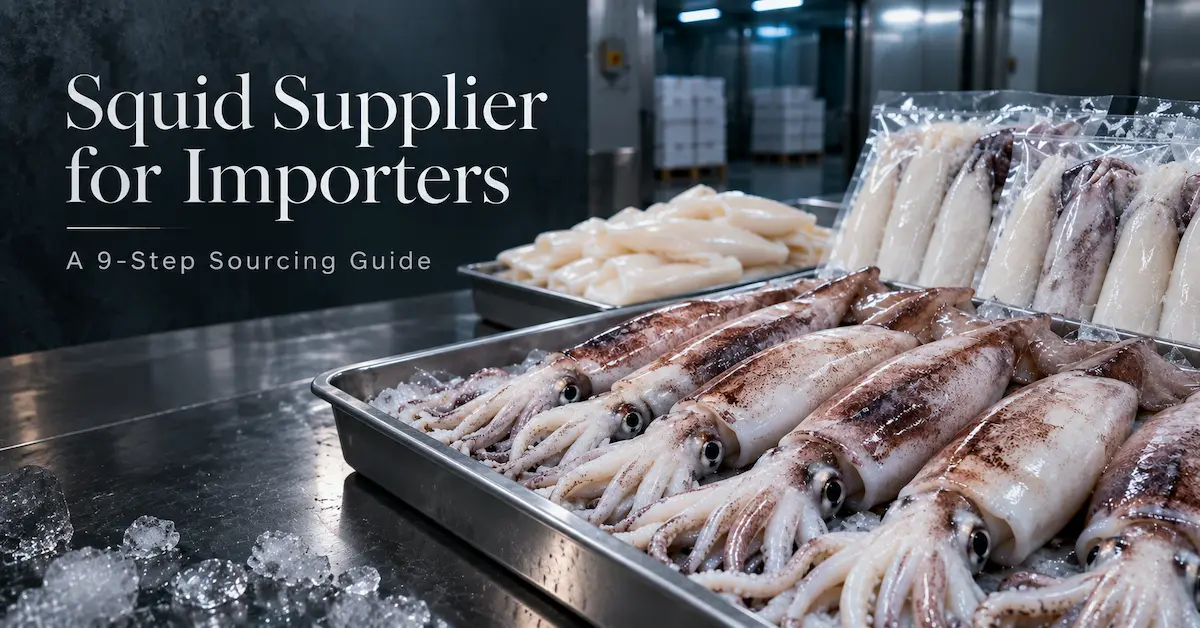
Quick answer for squid importers
A sound import program follows nine controls. First, confirm that the product, origin and establishment can enter the destination market. Second, identify who processes and packs the squid, not only who sells it. Third, issue a specification that can be measured. Fourth, approve a coded sample and keep the record. Fifth, compare offers on landed cost and usable yield. Sixth, lock the contract, labels and document matrix. Seventh, inspect the shipment and loading plan. Eighth, control arrival, release and claims. Ninth, review the first lot before setting the reorder pattern.
The sequence matters. A buyer who negotiates the lowest case price before checking market access may spend weeks improving an offer that cannot be imported. A buyer who approves a sample without a linked specification may receive a commercially different product with no clear benchmark. A buyer who waits until vessel departure to ask for documents has very little room to correct them.
| Import stage | Main decision | Record to keep |
|---|---|---|
| Market gate | Can this origin, product and establishment enter? | Current destination requirement checklist |
| Supplier gate | Who sells, processes, packs and releases the lot? | Approved supplier and processor profile |
| Product gate | What exactly is being purchased? | Controlled specification and approved sample |
| Commercial gate | What is the landed cost per usable unit? | Aligned quote and yield model |
| Shipment gate | Are goods, labels, documents and reefer plan ready? | Pre-shipment release file |
| Arrival gate | Can the lot be accepted and released? | Receiving report, logger data and inspection evidence |
Why an importer needs a different supplier test
A local buyer can often inspect stock in the same warehouse and replace a few cartons quickly. An importer commits earlier, waits longer and handles more interfaces. The supplier may be a trading company while another establishment processes the squid. A freight forwarder may arrange movement without controlling the product specification. A broker can file an entry without owning the importer's food-safety verification duties.
The shipment also has several versions of the product name: purchase order, invoice, packing list, health certificate, bill of lading, carton label and customs entry. They do not always use identical wording, but they must describe the same commercial reality. Species, form, quantity, net weight, origin and lot identity should not drift as documents pass between companies.
A frozen squid supplier for importers should therefore be assessed on two connected abilities. Can it propose squid that matches the user's market? Can it keep the approved identity, specification and records consistent through shipment? A beautiful sample answers only the first half of the question.
Step 1: clear the destination-market gate first
Begin with the country of import, the intended customs route and the party legally responsible for the entry. Confirm the current product classification with the importer's broker or regulatory adviser. Then check whether the product category, country of origin and actual processing establishment are eligible under the destination system. Do this before requesting retail artwork or negotiating a container.
Requirements differ, and they change. In the United States, FDA guidance for seafood importers explains verification responsibilities under 21 CFR Part 123 and the use of written procedures and affirmative steps when applicable. In the European Union, official controls for products from non-EU countries involve country and establishment eligibility, official certification for relevant consignments, prior notification and checks at Border Control Posts. These are examples of destination systems, not a universal checklist.
The importer should own a short compliance matrix. Put each requirement beside the person who verifies it and the evidence needed. Separate three questions that are often mixed together: may the country export this category, may the establishment produce it for this market, and does this particular shipment carry the correct documents? Passing one does not automatically answer the others.
| Market-access question | Importer action | Supplier evidence to discuss |
|---|---|---|
| Product classification | Confirm current code and description with a qualified destination adviser | Species, form, processing and pack details |
| Country eligibility | Check the current official destination source | Declared origin and export route |
| Establishment eligibility | Verify the actual processor or cold store where required | Legal name, address and relevant listing or approval details |
| Shipment certification | Build a document list before production | Documents available for the proposed lot and destination |
| Label compliance | Approve legal and commercial wording before printing | Artwork proof and production label sample |
Do not ask a supplier simply whether it “can export” to the country. Ask for the named processing establishment and compare its information with the current official source relevant to the destination. If a requirement is unclear, pause the order and obtain qualified advice. The cost of clarification is small beside a held consignment.
Step 2: prequalify the seller and the actual processor
The company sending the quotation may not be the site cleaning, freezing and packing the squid. That arrangement can be perfectly workable, but the importer must know the roles. Record the seller, processor, packer, cold store and exporter of record as applicable. Decide which changes require prior written approval.
For a squid exporter China search, the phrase describes geography and trade activity, not the full supply chain. Ask where the raw material originates, where each processing step occurs, and which establishment identity appears on required documents and labels. The answers should agree with the proposed route.
Prequalification should match risk and volume. Review the supplier's legal and contact information, relevant food-safety system, traceability approach, complaint process and ability to retrieve lot records. Ask how subcontracting is controlled. For a new or higher-risk program, the importer may use a competent audit, official records, product testing or another verification route required or accepted by its destination system.
The FDA's seafood HACCP importer guidance is useful here even for understanding the distinction between seller and processor: its verification discussion focuses on whether imported seafood was processed in accordance with the applicable rule. A shipper that did not process the final product is not a substitute for evidence about the processing establishment. Importers outside the United States should use their own market's rules, but the operational lesson remains sensible.
Questions that reveal supplier control
- Who owns the quotation, and who manufactures the final shipped form?
- Can the supplier provide the processor's legal identity before sample approval?
- How are species, origin and incoming raw material linked to finished lots?
- Who approves label proofs and document descriptions?
- What happens if production must move to another establishment?
- How quickly can lot, inspection and shipment records be retrieved?
- Who receives a claim when the seller, factory and exporter are different parties?
Step 3: issue an importer-ready squid specification
A specification prevents the inquiry from turning into a chain of assumptions. Start with scientific name, commercial name and origin. Name the product form: whole, cleaned whole, tube, ring, strip, tentacle or another cut. Describe cleaning by listing what is removed and retained. Add the size range and explain whether it applies to the whole squid or the processed piece.
Then define freezing, glaze and weight. For IQF, state the expected individual separation and the acceptable condition of pieces. For blocks, state unit weight and dimensions if they affect downstream equipment. Explain whether the declared weight is net of glaze and how verification will be conducted under the contract and destination rules.
Codex Alimentarius Code of Practice for Fish and Fishery Products, CXC 52-2003, includes a section on processing cephalopods and defines glazing as a protective ice layer applied to a frozen product. The code is a useful technical reference for a buyer's hazard and process discussion, but it does not replace destination law or the parties' detailed commercial specification.
| Specification field | What the importer should state | Approval evidence |
|---|---|---|
| Identity | Scientific name, market name, origin and proposed processor | Quote, product sheet and label proof |
| Physical form | Whole, tube, ring, strip or tentacle; skin, fins and cleaning details | Written standard and coded photographs |
| Grade | Range, unit, measurement point and tolerance | Individual sample measurements |
| Freezing | IQF or block, expected separation or block dimensions | Frozen sample and pack inspection |
| Weight basis | Gross, declared net, glaze basis and checking method | Sample weighing record |
| Defects | Broken pieces, tears, residual cartilage, skin or cut tolerance | Inspection plan with sample size |
| Packaging | Inner pack, master carton, liner, seal, coding and language | Artwork and physical packing sample |
A wholesale squid supplier may carry several commercial forms, but the importer should create a distinct item code for each approved combination. Do not let “squid tube” cover skin-on and skinless products, multiple species or two weight declarations. Clear item separation protects purchasing, warehouse staff and customers.
Step 4: approve a coded sample and freeze the benchmark
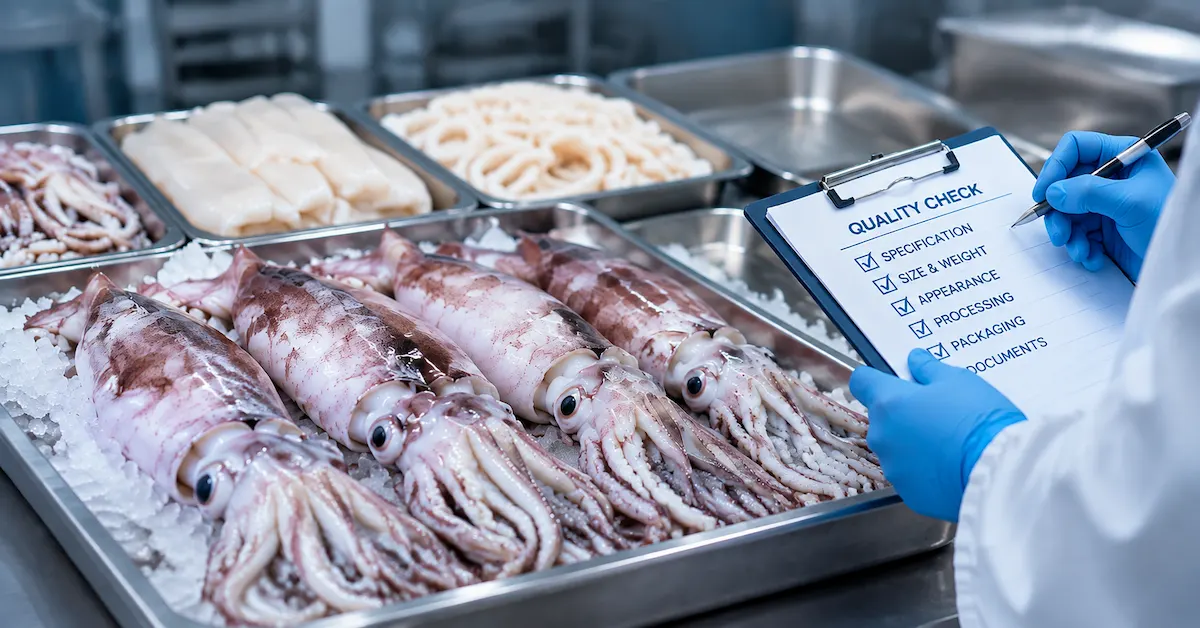
A sample is useful only when it can be traced to what was proposed. Give it a code and record the date, supplier, processor, species, origin, form, grade, freezing, glaze and pack. Photograph the frozen state, the opened pack and the prepared result with a scale. Keep the supplier's sample statement alongside the buyer's findings.
Measure more than appearance. Weigh individual pieces across the pack, examine cleaning, count broken or torn units, and check separation. Thaw under a recorded method and calculate drained weight. If the importer sells to foodservice or industry, send part of the sample through the customer's actual cut or cooking process. A product can meet the frozen visual standard and still miss the customer's yield or handling target.
When evaluating an IQF frozen squid supplier, open the bag as a warehouse picker would. Can individual pieces be removed? Is there excessive loose ice? Does the remaining product stay protected after partial use? For block product, time a realistic thaw and check whether the complete block fits the processor's batch.
Approval should end with one of three written outcomes: accepted, rejected or accepted subject to a named correction. “Improve quality” is not a correction. “Reduce residual cartilage to the agreed tolerance and resubmit twenty tubes” is something both sides can test.
Whole product needs a conversion test
Whole frozen squid wholesale offers can look inexpensive because the buyer is receiving material that still contains parts removed during processing. Run a controlled conversion. Record thawed whole weight, tube yield, tentacle yield, trim, waste and labor. If fins, skin or other parts have a saleable use, list them separately rather than hiding them inside one percentage.
Compare this with the cost of an imported cleaned form. The whole option may still win, particularly for a processor with efficient labor and several outlets for the parts. In another market, the cleaned tube may lower waste fees, training and handling enough to justify a higher case price.
Step 5: compare landed cost, not the headline price
Put each quotation onto the same basis before ranking it. Align species, origin, processor, form, grade, freezing, glaze, declared net weight, inner pack and carton. Use the same Incoterm and destination. If the offers cannot be aligned, mark the difference rather than forcing a misleading comparison.
A bulk frozen squid order creates costs beyond the product line. Add international freight, insurance where applicable, destination charges, duty, brokerage, inspection, sampling, cold storage and final delivery. Include financing time and a reasonable allowance for normal handling loss based on evidence. Avoid inventing a percentage simply to complete the spreadsheet.
Then convert landed cartons into the unit that earns revenue. A wholesaler may use saleable net kilograms. A foodservice distributor may use sealed inner packs. A processor may use cleaned tubes or finished rings. The denominator matters: cost per gross shipping kilogram can make a heavily glazed or low-yield offer look better than it is.
| Cost layer | Include | Common mistake |
|---|---|---|
| Product | Price, weight basis, glaze, pack and Incoterm | Comparing gross and net bases as equals |
| Border | Freight, insurance, duty, entry, examination and broker costs | Using a general rate without checking the product and route |
| Cold chain | Port handling, reefer or storage charges and local cold delivery | Ignoring delay or demurrage exposure |
| Conversion | Thaw loss, cleaning yield, waste and direct labor | Ranking whole and cleaned squid by case price |
| Sale unit | Usable kg, inner pack, cooked portion or finished retail unit | Stopping the calculation before the customer's unit |
Price validity also matters. Note currency, validity date, minimum quantity, production window and freight assumptions. A quote that expires before sample approval is not a firm basis for a launch budget. Ask which parts are fixed and which will be reconfirmed at booking.
Step 6: lock the contract, labels and document matrix
Once the product and commercial basis are approved, turn the email trail into controlled order documents. The purchase order or contract should identify the parties, product code, specification revision, quantity tolerance, pack, price, Incoterm, timing, inspection, label approval, required documents, change control and claim procedure. The exact legal terms should be reviewed by the parties' qualified advisers.
Create a document matrix with three columns: document, responsible issuer and latest acceptable delivery time. The exact set depends on market and shipment, but it may include commercial invoice, packing list, transport document, origin information, health documentation, catch-related paperwork where applicable, inspection record, product certificate or analysis if agreed, and temperature information.
Request drafts early enough to correct them. Compare product description, species where required, processor, origin, carton count, net weight, lot and dates across the file. A tiny difference may be harmless or may block clearance; the importer's destination adviser should decide, not guesswork at the port.
For buyers planning to import frozen squid from China, “from China” still does not complete the compliance description. Confirm raw-material origin where relevant, processing location, exporter identity, route and the establishment details used by the destination system. Ask the supplier to notify the importer before changing any approved source.
Discuss Product and Document Requirements
Step 7: release the shipment before the reefer doors close
Pre-shipment control should answer two questions: do the goods match the order, and is the load prepared to travel? Decide whether inspection is performed by the supplier, importer, independent party or a combination. The plan should state sample selection, tests, acceptance criteria and the evidence required for release.
Inspect outer cartons, inner packs, labels, lot codes, count, net weight basis, physical form, size distribution and agreed defects. Check that commercial production corresponds to the approved sample and specification revision. If testing is part of the contract or destination requirement, manage sampling, laboratory scope and results before the agreed release point.
The loading team should record container condition, cleanliness, pre-loading state, carton and pallet count, stowage and seal information. Confirm the required reefer setting with the carrier and competent logistics parties; a set point is not proof of product temperature. Position monitoring devices according to the agreed plan and record their identifiers. Maintain airflow paths rather than filling spaces that the equipment requires.