

Quick Answer
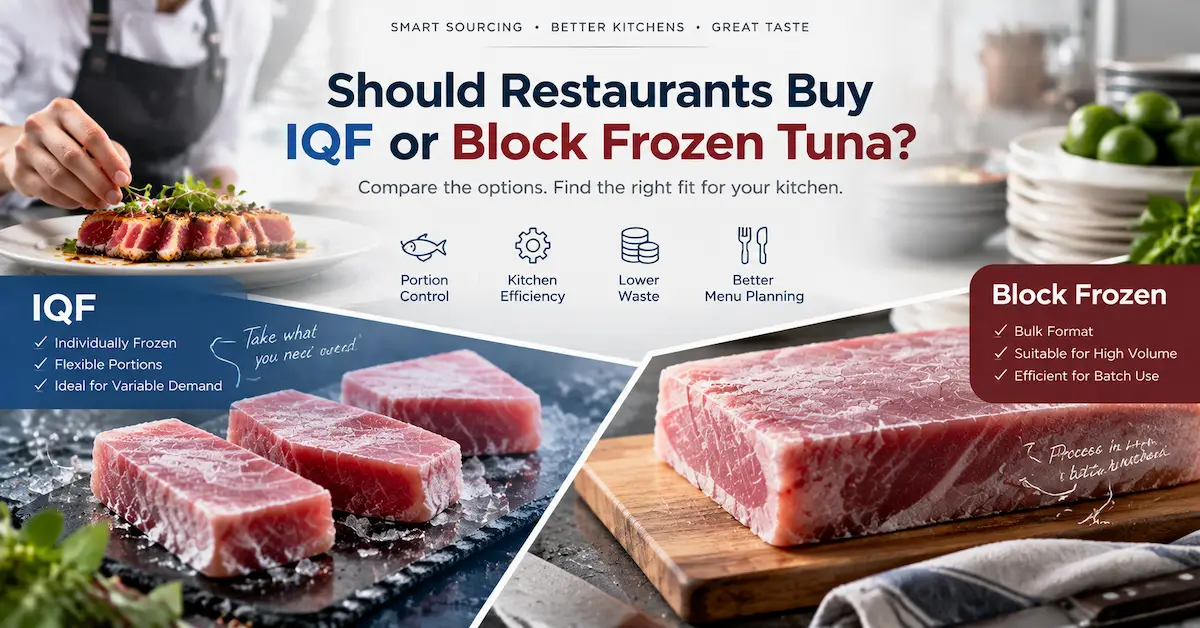
Should restaurants buy IQF or block frozen tuna? For most restaurants serving tuna by individual portions, IQF is usually the more practical format because pieces can be removed according to daily demand without handling an entire frozen block. Block or BQF-oriented tuna can make sense for high-volume restaurants, banquet operations, caterers, or central kitchens that routinely thaw and process a full batch. The decision should consider portion format, daily volume, thawing workflow, storage, packaging, labor, and usable cost—not freezing terminology alone.
Introduction: Why the Freezing Format Matters in a Restaurant Kitchen
For restaurants, hotel kitchens, catering operations, and foodservice distributors, frozen tuna purchasing affects much more than freezer storage. The freezing and packing configuration determines how easily kitchen staff can withdraw portions, how much product needs to be thawed at one time, how accurately inventory follows actual covers, and whether the product fits the restaurant's preparation routine.
Should restaurants buy IQF or block frozen tuna? The answer changes according to the restaurant's operating model. A seafood restaurant selling six to twenty tuna steaks on an unpredictable evening has a different requirement from a hotel banquet kitchen preparing 150 identical portions for a scheduled event. A chain restaurant using pre-portioned steaks also has a different workflow from a central kitchen receiving tuna loins and cutting portions internally.
Bothwin's current tuna information identifies IQF and BQF freezing options and lists tuna products including steaks, skinless and boneless loins, saku, and whole tuna. Its foodservice guidance specifically connects individual frozen portions with restaurant and foodservice applications, while bulk-oriented formats are more relevant when larger quantities are processed together.
What Is IQF Frozen Tuna?
IQF means Individually Quick Frozen. In a foodservice context, the important operational feature is that individual tuna pieces remain separately accessible after freezing rather than becoming one inseparable frozen mass.
For a restaurant purchasing tuna steaks, this can allow kitchen or storeroom staff to withdraw the number of portions required for the next preparation cycle instead of handling an entire package as one block. Bothwin's current frozen tuna guidance identifies easier portion management, flexible inventory control, and individual portion access as key reasons IQF can suit restaurants, hotels, caterers, seafood distributors, and retail foodservice programs.
IQF does not, however, define everything about the tuna. A buyer must still specify the tuna format, individual portion weight, thickness where relevant, trimming, glazing, net-weight basis, packaging, and carton configuration. IQF also does not automatically mean that every piece is individually vacuum packed; freezing method and packaging must be confirmed separately.
Restaurants comparing product forms can review Bothwin's tuna steaks, loins and saku guide before deciding which format should be individually accessible.
What Is Block Frozen or BQF Tuna?
Block frozen tuna generally refers to a bulk-oriented configuration in which product is frozen together rather than being freely removable piece by piece. Bothwin's current content identifies BQF—Block Quick Frozen—as one freezing option, while its wider frozen seafood guidance also refers to block-frozen formats. Buyers should therefore confirm the physical packing configuration rather than assuming every commercial term describes exactly the same block size or arrangement.
For restaurants, a bulk-oriented frozen format can be practical where an operation already expects to use the entire quantity within a planned production cycle. Examples may include banquet kitchens, catering operations, high-volume buffets, or central kitchens that thaw and portion larger batches according to a production schedule.
The question should therefore not be, “Is block frozen tuna lower quality?” Freezing format and product quality are different purchasing questions. A more useful question is:
Will our kitchen actually use the quantity contained in the frozen unit once we begin handling it?
IQF vs Block Frozen Tuna for Restaurants
| Buying factor | IQF tuna | Block/BQF-oriented tuna | Restaurant decision |
|---|---|---|---|
| Individual portion access | High | Limited until the required block or batch is handled | IQF usually fits portion-by-portion service |
| Demand flexibility | Easier to match variable covers | Works better when batch volume is predictable | Consider how much daily demand changes |
| Thaw planning | Can be planned around individual pieces | Often planned around a larger unit | Match frozen unit to production batch |
| Inventory control | Individual pieces easier to count | Inventory managed more by block or batch | Depends on kitchen stock-control method |
| Restaurant steaks | Often practical | Possible when volume supports batch use | Portion format matters |
| Central kitchen processing | Useful where flexibility is needed | Can fit large planned production | Evaluate batch size and labor |
| Packaging efficiency | Depends on pack design | May simplify some bulk packing programs | Obtain actual supplier pack details |
| Waste exposure | Can reduce unnecessary withdrawal where demand varies | Higher risk of excess thawed quantity if block exceeds actual demand | Compare with real menu volume |
| Best fit | Variable or portion-controlled service | Predictable high-volume batch use | There is no universal winner |
This comparison describes operating logic rather than a fixed commercial guarantee. Exact tuna formats, packing arrangements, order quantities, and costs require supplier confirmation.
When IQF Tuna Usually Fits Restaurants Better
When Tuna Is Sold Portion by Portion
A restaurant selling standardized tuna steaks may need 150 g, 200 g, or another agreed portion specification. If each frozen steak is accessible separately, staff can plan the quantity according to expected covers.
Consider an illustrative service plan. A restaurant expects to prepare 18 × 200 g tuna steaks, meaning the planned tuna requirement is 3.6 kg. With individually accessible portions, the kitchen can prepare around the required piece count according to its approved procedure. If the comparable bulk configuration requires handling a 5 kg frozen unit, management must determine whether the additional quantity can be used within the operation's planned production window.
These numbers are an example of purchasing logic, not Bothwin pack specifications.
When Daily Demand Changes
Restaurants rarely sell exactly the same number of menu items every evening. Weather, reservations, weekday patterns, events, and customer choices can all affect volume.
IQF can provide operational flexibility when tomorrow's tuna requirement is not identical to today's. Instead of basing preparation on the pack's frozen-unit size, the kitchen can more closely base preparation on expected portions.
This is especially relevant to restaurants, hotels, and foodservice distributors that place a high value on portion management. Bothwin's current foodservice frozen tuna guidance similarly identifies tuna steaks as a practical format for restaurant portion consistency.
When Several Menu Items Share the Same Tuna
Some kitchens use tuna across several preparations. One service may require steaks, while another may require a smaller number of portions for a different menu item. Individual accessibility can make stock allocation easier provided the purchased tuna specification is suitable for each intended application.
The buyer should still avoid assuming that one tuna product automatically fits every preparation. Portion dimensions, trimming, product identity, intended use, and food-safety requirements remain separate approval decisions.
When Block Frozen Tuna Can Make Sense for Restaurants
High-Volume Banquet Production
A hotel banquet does not operate like an à la carte restaurant. If an event has a confirmed guest count and the kitchen plans to prepare a large quantity of tuna during the same production cycle, individual withdrawal may be less important.
The purchasing team can then compare whether a bulk-oriented frozen configuration aligns better with the planned production volume.
Catering and Buffet Operations
Catering businesses frequently prepare food in batches. If a caterer expects to use the entire commercial pack during a production cycle, the inconvenience of separating individual frozen portions may have less operational significance.
The buyer should compare:
Frozen unit size → planned batch size → thaw quantity → usable production quantity.
If these align closely, block frozen tuna may be commercially workable.
Central Kitchens That Cut Their Own Tuna
A restaurant group may operate a centralized production facility rather than portioning tuna at every store. The central kitchen might purchase tuna loins, thaw or prepare an agreed quantity, and cut finished portions according to a house specification.
In that model, bulk-oriented tuna can deserve evaluation because the plant is already designed around batch processing. Bothwin's current product range includes skinless and boneless tuna loins as well as steaks, allowing buyers to compare the starting format against their downstream operation.
For more detail, see frozen tuna loins for further processing.
Do Not Choose the Freezing Method Before Choosing the Tuna Format
One common purchasing mistake is deciding “we want IQF” before defining what is actually being frozen.
The restaurant should first determine whether it needs:
| Tuna format | Typical restaurant or foodservice use | Important buying specification |
|---|---|---|
| Tuna steak | Portion-controlled menu | Weight, thickness, tolerance |
| Tuna loin | Internal cutting or central kitchen | Size, trimming, yield |
| Tuna saku | Specialized portioning/presentation | Dimensions and trimming |
| Whole tuna | Extensive downstream processing | Fish size and processing requirements |
Only after defining the product should the buyer decide whether IQF, BQF, block frozen, or another agreed freezing arrangement fits the handling process.
Bothwin currently lists all four tuna formats, with IQF/BQF options and customizable size grades.
How to Match Frozen Tuna to Restaurant Service Volume
A useful buying exercise is to compare the smallest frozen unit your kitchen must handle with the quantity normally required for one preparation cycle.
Use:
Planned tuna quantity = Expected portions × Tuna weight per portion
For example, if a restaurant expects 25 servings and uses a 200 g tuna steak specification:
25 × 200 g = 5,000 g = 5 kg
That tells the buyer the planned quantity. It does not automatically determine the correct freezing format.
If an IQF package provides individually accessible steaks, piece withdrawal can be adjusted around demand. If a block-frozen offer requires the kitchen to handle approximately the same 5 kg quantity at once, the block may fit that production plan. If the smallest frozen unit is much larger than the restaurant normally needs, the buyer should carefully review the workflow before choosing it.
The calculation is simple; the purchasing value comes from comparing it with actual service behavior.
Compare Kitchen Labor, Not Just Product Price
Block frozen tuna should not automatically be described as “cheaper,” just as IQF should not automatically be described as “better quality.” Suppliers may quote different products, packing systems, sizes, glazing, order quantities, and freight arrangements.
Restaurants should compare the complete operational cost.
A useful internal calculation is:
Usable Portion Cost = Total Relevant Product and Handling Cost ÷ Number of Accepted Usable Portions
Relevant differences can include product price, thaw planning, cutting labor, trimming, portion variation, handling time, and product that cannot be used for the intended service.
For instance, an IQF tuna steak may involve a different purchase price from a bulk tuna loin. But the steak may require less portioning labor. Conversely, a high-volume central kitchen may be able to process loins efficiently and prefer the flexibility of controlling cuts itself.
Neither choice can be evaluated correctly from price per carton alone.
Check Packaging Before Choosing IQF or Block Frozen Tuna
The freezer operator needs more information than the words IQF or BQF.
Ask the supplier:
| Packaging question | Why the restaurant should ask |
|---|---|
| How many tuna pieces are in each inner pack? | Determines withdrawal quantity |
| Are IQF portions loose or individually wrapped? | Affects handling and storage |
| What is the net tuna weight? | Required for cost comparison |
| Is glazing used? | Clarifies product-weight basis |
| What is the carton configuration? | Affects freezer space |
| Can partial quantities be withdrawn easily? | Important to restaurant service |
| How is each batch identified? | Supports inventory and traceability |
| What are the storage instructions? | Supports correct handling |
| Can foodservice packaging be customized? | Useful for distributor or restaurant-group programs |
Bothwin's current guidance repeatedly recommends confirming freezing, glazing, net weight, packaging, quantity, destination, and application within the RFQ rather than asking only for a tuna price.
How Should Restaurants Compare Thawing Convenience?
The practical question is not simply which format thaws faster. Product dimensions, portion thickness, packing configuration, quantity, and the kitchen's approved thawing method can all affect actual preparation time.
Instead, restaurants should run a representative kitchen trial using the proposed commercial product.
Record the number of portions taken from frozen inventory, preparation start time, number of portions required for service, handling steps, resulting usable portions, and any unused prepared quantity. Repeat the comparison under the same kitchen procedure when evaluating a second format.
This gives the buyer an operation-specific answer.
A supplier brochure can describe the freezing format; your kitchen trial shows how well that format fits your service model.
Quality Control Is More Than the Freezing Acronym
Restaurants and foodservice distributors should evaluate the product specification before approving a bulk purchase.
Bothwin's frozen seafood quality-check guide recommends clarifying product form, size grade, portion weight, thickness, processing, packaging, and freezing method before production.
For restaurant tuna, check items can include:
Product identity, tuna format, portion weight, permitted weight range, steak thickness where relevant, trimming, frozen condition, glaze and net-weight basis, inner packaging, carton configuration, batch identification, and agreed receiving condition.
Do not approve one specification and then compare the delivered product against a different informal expectation.
Cold Storage Still Matters After Choosing IQF or Block Frozen Tuna
Good freezing at production cannot compensate for poor frozen storage afterward. Bothwin's frozen fish storage guidance notes that product form, thickness, packing, and temperature conditions all affect frozen-product handling and that cold storage should maintain properly frozen product rather than correct an inadequate freezing process.
Restaurants should therefore consider freezer capacity and layout before changing purchasing formats.
An IQF program that requires many smaller units may create a different stock-picking workflow from a bulk block program. A large block format may use freezer space efficiently in one operation but become inconvenient in another because the team repeatedly needs small quantities.
The best format is the one that works from receiving → frozen storage → preparation → service, not merely at the moment of purchase.
Restaurant Decision Matrix: Which Format Fits Your Operation?
| Restaurant situation | Starting option worth evaluating | Reason |
|---|---|---|
| À la carte restaurant with variable covers | IQF | Individual portion flexibility |
| Restaurant chain using standardized steaks | IQF | Easier portion and inventory control |
| Hotel with mixed restaurant and banquet demand | IQF + bulk comparison | Different outlets may need different formats |
| Large scheduled banquet operation | Block/BQF may be suitable | Predictable batch requirement |
| Catering kitchen preparing large batches | Block/BQF may be suitable | Full-batch handling may fit workflow |
| Central kitchen cutting tuna loins | Either, depending on batch size | Processing system determines value |
| Small restaurant with low tuna turnover | IQF often practical | Reduces need to handle a large frozen unit |
| Seafood processor supplying restaurants | Bulk/BQF or IQF depending on processing | Downstream cutting and order structure matter |
This matrix is a purchasing framework, not a promise that a specific Bothwin product is available in every configuration.
What Should Restaurants Put in a Frozen Tuna RFQ?
Instead of asking, “What is your IQF tuna price?”, send enough information for the supplier to understand the restaurant program.
A useful RFQ includes:
| RFQ field | Buyer information |
|---|---|
| Product | Tuna steak / loin / saku |
| Tuna species | Required identity or request available options |
| Portion size | Required weight or dimensions |
| Weight tolerance | Acceptable variation |
| Thickness | For tuna steaks where required |
| Processing | Skin, bone and trimming requirements |
| Freezing | IQF / BQF / block-oriented option for comparison |
| Glazing | Required basis |
| Net weight | Commercial weight requirement |
| Inner packaging | Foodservice handling requirement |
| Carton | Required carton configuration |
| Quantity | Opening order and repeat volume |
| Application | À la carte / hotel / banquet / catering / central kitchen |
| Destination | Country and port |
| Documents | Buyer or market requirements |
| Target shipment | Requested schedule |
Bothwin's frozen seafood quotation guide follows the same basic principle: define the product first so quotations can be compared on equivalent commercial requirements.
How Bothwin Fits Restaurant Frozen Tuna Sourcing
Bothwin's current frozen tuna information lists whole round tuna, skinless and boneless tuna loins, tuna steaks, and saku, together with IQF/BQF options, customizable size grades, and export-standard carton packaging. This gives foodservice buyers a basis for discussing the freezing format together with the actual tuna form rather than sourcing “frozen tuna” as an undefined commodity.
Restaurants and distributors can review the Bothwin frozen tuna range and then provide a detailed requirement.
The listed capabilities should not be read as a fixed restaurant specification. Exact tuna identity, portion size, freezing format, packaging, quantity, minimum order, timing, and destination requirements need order-specific confirmation.
Frequently Asked Questions About IQF vs Block Frozen Tuna
1. Is IQF Tuna Usually Better for Restaurants?
IQF is often more convenient for restaurants that use tuna portion by portion because individual pieces can be accessed according to service demand. A bulk format can still fit high-volume operations that plan to use a complete batch.
2. Does IQF Mean Each Tuna Steak Is Vacuum Packed?
No. IQF describes an individual freezing approach, while vacuum packing describes packaging. Ask the supplier to confirm whether IQF pieces are loose, wrapped, vacuum packed, or arranged in another foodservice configuration.
3. Is Block Frozen Tuna Lower Quality Than IQF?
Not simply because it is block frozen. Product quality depends on the actual tuna specification, processing, freezing execution, cold-chain control, packaging, and handling. Freezing format should be selected according to application.
4. Is BQF the Same as Block Frozen Tuna?
Bothwin identifies BQF as Block Quick Frozen and also refers elsewhere to block-frozen formats. Commercial terminology and pack construction should be confirmed with the supplier. Ask what product form, frozen unit, and packaging you will physically receive.
5. Which Format Is Better for Tuna Steaks?
IQF can be particularly practical for tuna steaks when restaurants need individual portion control. A block-oriented format may still work where multiple steaks are always prepared as a planned batch.
6. Which Format Is Better for Tuna Loins?
That depends on the processing model. A central kitchen cutting several loins in one production batch may value bulk efficiency, while an operation requiring only one loin at a time may value individual accessibility.
7. Can IQF Reduce Restaurant Waste?
It can reduce unnecessary product withdrawal when a restaurant needs only a limited number of individual portions. Actual waste depends on demand forecasting, preparation, trimming, storage, and kitchen procedures, so buyers should verify the benefit through their own trial.
8. Should Restaurants Compare IQF and Block Tuna by Price Per Kilogram?
Price per kilogram is only one comparison. Also evaluate net-weight basis, portion consistency, packaging, handling, labor, usable yield, freezer requirements, and how much tuna must be prepared at once.
9. Can a Restaurant Order Custom IQF Tuna Portions?
Bothwin currently lists customizable size grades and IQF/BQF options for frozen tuna. Submit the required tuna form, portion size, tolerance, packaging, quantity, and destination for feasibility and commercial confirmation.
10. What Should I Send Bothwin Before Asking for a Quote?
Provide the tuna format, required species where applicable, portion size, thickness or dimensions, freezing preference, glazing, net weight, packing, order quantity, destination, intended restaurant application, and required documents. You can submit the project through the Bothwin contact page.
Conclusion
Should restaurants buy IQF or block frozen tuna? Restaurants with variable demand and portion-by-portion tuna service will often find IQF more practical, while block or BQF-oriented formats deserve consideration when kitchens routinely prepare large, predictable batches. The purchasing decision should connect the freezing method with tuna format, portion size, kitchen volume, thaw planning, freezer space, packaging, labor, and usable cost. Bothwin currently lists IQF/BQF options across several frozen tuna formats, but the exact commercial configuration should be confirmed for each project. To compare the options for your operation, send Bothwin your restaurant tuna requirements with your format, portion specification, expected daily or batch volume, packaging needs, quantity, and destination.