

Restaurants do not buy fish in the same way that a home cook buys dinner. A chef needs a product that can be received, stored, portioned and cooked repeatedly by different members of the kitchen team. A purchasing manager needs predictable cartons, clear labels and a supplier who can answer specification questions before a container is booked. A finance manager needs to understand how the purchase price connects to usable portions, menu pricing and waste.
That is why a request for frozen sea bass for restaurants should be more detailed than “Please quote sea bass.” The buyer needs to define the commercial identity, form, size, processing level, freezing method, packing, net weight, destination and intended menu use. The same fish can be sold as a whole product for a traditional seafood counter, as a fillet for a central kitchen or as uniform portions for a restaurant group. Those formats are not interchangeable in labor, yield or service speed.
This guide explains how restaurant groups, hotel kitchens, catering companies and foodservice distributors can compare frozen sea bass supplier offers. It covers whole frozen sea bass, frozen sea bass fillet, frozen sea bass portions, carton design, cold-chain planning, pre-shipment inspection and a practical RFQ template. Bothwin's public product information describes sea bass as a mild, firm-textured white fish that can be discussed for restaurant, hotel, retail and foodservice channels. Exact species, size, processing, price, MOQ, timing, certificates and destination documents must be confirmed for each order.
Product page: Sea Bass Wholesale Supplier - Frozen Whole Fish
Send an inquiry: Contact Bothwin
Quick answer for restaurant buyers
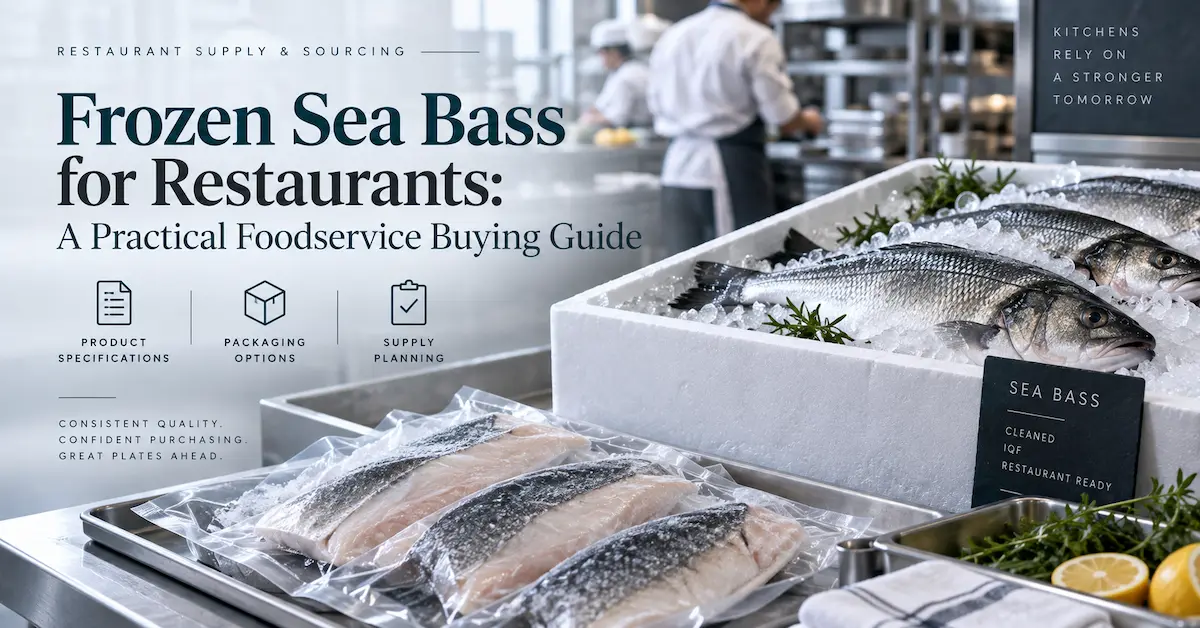
The best frozen sea bass for restaurants is the format that matches the kitchen's workflow. Whole fish may suit a restaurant that cleans and presents the product in-house. A frozen sea bass fillet can reduce trimming and preparation labor. Frozen sea bass portions can help a multi-unit operation control plate weight and cooking time. None of these formats is automatically better; the correct choice depends on the menu, staff skills, storage capacity, service volume and target customer.
Before asking for a price, put these fields in the same brief for every supplier:
| Buying field | What the restaurant or importer should specify |
|---|---|
| Product identity | Sea bass commercial name and required species confirmation |
| Form | Whole round, gutted, scaled, cleaned, fillet or portion |
| Size | Piece weight, length, portion weight or size grade |
| Tolerance | Acceptable variation between pieces and cartons |
| Freezing | Agreed method, glazing and net-weight calculation basis |
| Packing | Bulk carton, vacuum pack, foodservice bag or private label |
| Use | A la carte, buffet, catering, central kitchen or processing |
| Quantity | Trial order, pallet, mixed container or repeat program |
| Destination | Country, port, cold store and required documents |
This simple table improves quotation quality. It prevents one supplier from quoting whole fish while another quotes trimmed fillets, and it makes a low price easier to evaluate against yield and labor instead of price alone.
Request a Restaurant Sea Bass Quote
Why restaurants use frozen sea bass
Sea bass is often considered for menus that need a mild flavor, firm texture and a clean white-fish appearance. Those characteristics can work across grilled dishes, pan cooking, oven recipes, plated meals, banquet service and prepared seafood programs. For a restaurant buyer, the value is not just the fish itself. It is the ability to build a repeatable process around the fish.
Frozen purchasing can also help a restaurant plan beyond the local fresh-fish window. A frozen program may make it easier to keep a menu item available across seasons, coordinate supply for multiple outlets or hold a planned safety stock. That benefit only appears when the product arrives in the agreed condition and the kitchen has a clear thawing and storage procedure. A frozen product should not be described as a substitute for every fresh product; it should be evaluated on the menu and service requirements it is expected to support.
Restaurants also buy through different routes. A chef-owned restaurant may receive cartons directly and process fish in its own kitchen. A hotel group may buy through a distributor and require consistent portion weights across several properties. A catering company may value bulk cartons and simple cold-store handling. A foodservice distributor may need a product that can be sold to many restaurant customers without changing the core specification. The phrase frozen sea bass wholesale therefore includes several operating models, each with different packing and documentation needs.
Bothwin presents itself as a China-based seafood supplier supporting global buyers with export packing and flexible OEM or private-label discussions. The public product content is a starting point for a commercial conversation, not a guarantee that every size or preparation is always available. Ask for the current product specification, sample policy and production confirmation before committing to a menu launch.
Define what “for restaurants” means
The keyword frozen sea bass for restaurants describes an end use, not a complete product specification. Two restaurant buyers can use the same phrase while expecting very different items.
A la carte kitchens
A small or medium restaurant may prefer a fish that the chef can portion according to the dish. The team may accept whole fish or larger fillets if the kitchen has the skill and time to trim them. In this situation, the buyer should ask for a size range that fits the available cutting board, storage bins and plate design. A wide size range can create inconsistent cooking times and visual differences between plates, even when the average carton weight looks acceptable.
Restaurant groups and central kitchens
A group with several outlets usually values standardization. Uniform fillets or portions can help the central kitchen set a recipe card, calculate cooking loss and train staff more quickly. The group may accept a slightly higher product price if it reduces trimming labor, simplifies inventory counts and lowers plate-to-plate variation. The RFQ should state whether pieces must be individually separated, whether skin is retained, whether pin bones are removed and how the portion weight is measured.
Hotels, banquets and catering
Hotels and caterers often plan around peak service windows. They may need cartons that can be moved quickly from a freezer to a prep area, with clear lot identification and enough product for a defined number of covers. The buyer should specify whether the product is used for buffet service, plated banquets, events or staff meals. A bulk format may be economical, but only if the receiving and thawing teams can handle it without causing delays or quality variation.
Foodservice distributors
A distributor supplying several restaurants may request a flexible SKU. That does not mean every customer should receive a vague product. The distributor still needs a master specification covering the fish identity, form, size, glazing, net weight, carton configuration and storage instructions. Customer-specific labels or inner packs can be discussed as a separate OEM or private-label project.
Choose whole fish, fillets or portions
Format selection is the most visible difference between a restaurant program and a general seafood purchase. The choice should be based on total kitchen cost: product price plus labor, storage, trimming loss, cooking consistency and service risk.
| Format | Potential restaurant fit | Questions to confirm before ordering |
|---|---|---|
| Whole frozen sea bass | Chef-led preparation, whole-fish presentation, local cleaning or flexible portioning | Whole round or processed form, size range, head and fin condition, carton net weight |
| Frozen sea bass fillet | Faster prep, plated dishes, central kitchens and controlled trimming | Skin-on or skinless, bone status, fillet weight, trim tolerance, pack separation |
| Frozen sea bass portions | Multi-unit menus, banquets, catering and recipe standardization | Portion target, tolerance, cut shape, skin/bone, count per pack and cooking test |
When whole frozen sea bass is a good fit
Whole fish can preserve flexibility. A skilled kitchen can decide how to clean, cut and present it after receiving. This may suit restaurants with a visible seafood counter, a traditional whole-fish menu or a chef who wants control over the final cut. Whole product may also suit buyers who serve several recipes from one raw material. The trade-off is labor. The restaurant must account for receiving inspection, storage space, thawing, cleaning, trimming, waste collection and staff time.
Ask whether the whole fish is whole round, gutted, scaled or cleaned. These words should not be treated as interchangeable. State the required process in the purchase order and approve a sample that represents the commercial product. If the product is intended for a restaurant display, confirm appearance standards as well as weight.
When a frozen sea bass fillet is a good fit
Fillets can reduce preparation steps and help the kitchen move from freezer planning to recipe execution. The buyer should still define the fillet carefully. Skin-on and skinless products behave differently in a pan or oven. A fillet with pin bones may require a separate kitchen step. A trimmed fillet may have a different yield than a standard cut. If a menu description promises a specific skin presentation or portion weight, those requirements belong in the RFQ.
Do not compare a fillet quotation with a whole-fish quotation on a simple price-per-kilogram basis. Compare the expected usable weight and the labor needed to reach the plate. A higher-priced fillet can be commercially sensible when it saves skilled prep time and reduces inconsistent cuts. A lower-priced whole fish can be sensible for a restaurant that already has the labor and uses the trim in stocks or other dishes.
When frozen sea bass portions are a good fit
Portions are useful when the operation needs repeatability. A portion can be specified by target weight, thickness, shape and skin status. The buyer should agree on a tolerance rather than relying on words such as “standard” or “premium”. A few grams of variation may be acceptable for one menu and unacceptable for another. A cooking test should check thawed appearance, moisture, texture, shrinkage and plate presentation.
Portions can also make inventory planning easier. The kitchen can count packs, plan covers and issue a known number of pieces to each outlet. However, individually packed pieces may use more packaging and freezer space than bulk cartons. Ask for carton dimensions, pieces per inner pack, pieces per carton and the net-weight basis before comparing offers.
Size, yield and menu economics
Size is a commercial decision because it influences the plate, the carton and the work required before cooking. A restaurant may need a smaller portion for a tasting menu, a larger fillet for a main course or a whole fish that fits a sharing platter. A hotel buffet may accept a different size range from a restaurant group with a fixed recipe.
The buyer should request at least four measurements: target piece weight, acceptable range, carton net weight and expected count per carton. If the product is a fillet or portion, add thickness and cut dimensions where they matter. If the product is whole, specify the processing level and whether the weight is before or after cleaning.
| Menu application | Useful buying specification | Operational reason |
|---|---|---|
| Individual main course | Target portion weight, thickness and skin/bone status | Supports recipe costing and consistent cooking |
| Sharing platter | Larger whole fish or large fillet range | Allows presentation and flexible cutting |
| Buffet or banquet | Narrower size tolerance and carton count | Helps forecast covers and service timing |
| Central kitchen | Separated fillets or portions with repeatable pack count | Reduces outlet-level preparation and training |
| Catering or events | Carton net weight, pack access and delivery schedule | Simplifies receiving and high-volume prep |
A practical cost comparison is “cost per usable cooked portion,” not only “price per gross kilogram.” The calculation should include the quotation basis, glazing, packaging weight, trimming loss, cooking loss and labor. Buyers do not need a complex model for the first RFQ. They need the same assumptions for every frozen sea bass supplier so that the comparison is fair.
For example, a buyer can record:
- Quoted price and trade term.
- Net product weight per carton.
- Expected usable weight after thawing and trimming.
- Target portion weight.
- Expected number of saleable portions.
- Preparation minutes per carton.
- Freight, cold storage and local delivery costs.
This approach does not predict a restaurant's exact margin. It creates a transparent basis for testing a sample and deciding whether a first shipment is commercially realistic.
How to evaluate a frozen sea bass supplier
Choosing a frozen sea bass supplier is a process of checking fit, not just collecting the lowest quote. The supplier should be able to understand a restaurant specification and respond with the same level of detail.
Product identity and traceability
Ask the supplier to confirm the commercial name and species identity used on the product specification. “Sea bass” can be used as a market name in different contexts, so the importer and restaurant group should agree on the identity required for the destination label. Request lot identification, production information and the document set that can be supplied for the shipment.
Processing language
Write down what “cleaned,” “gutted,” “scaled,” “trimmed” or “deboned” means for this order. If the buyer leaves the terms open, two parties can believe they have agreed while planning different labor. Use an approved sample and, where appropriate, a written visual standard.
Freezing and glazing
Ask which freezing method is proposed and how the product will be protected during storage and transport. If glazing is used, state the percentage or acceptable range and the basis for net weight. The buyer should understand whether quoted weight refers to net fish, glazed product or another commercial basis. The exact method and tolerance should appear in the specification and purchase confirmation.
Packing and label control
Packing must match the kitchen. Bulk cartons can be efficient for a distributor or central kitchen. Inner bags or separated pieces can be better for outlets with limited freezer access. A private-label project may need artwork, language, barcode and carton marks. Confirm the carton dimensions, gross weight, net weight, pack count and pallet plan before production.
Communication and order discipline
The best supplier conversation is specific. Send one RFQ to several companies, keep the same fields and ask each company to identify assumptions. A supplier that asks useful clarification questions may be a better long-term fit than one that sends a fast but incomplete price. Bothwin's public content emphasizes direct sourcing, export preparation and flexible packaging discussions; current capacity and terms still need sales confirmation.
View the Sea Bass Product Page
Packaging for restaurant and foodservice use
The right package protects the product and saves work after arrival. A restaurant buyer should decide whether cartons are opened in a central cold store, a distributor warehouse or each individual outlet. That decision affects inner pack size, piece separation, label visibility and the risk of repeated temperature exposure.
Bulk export cartons
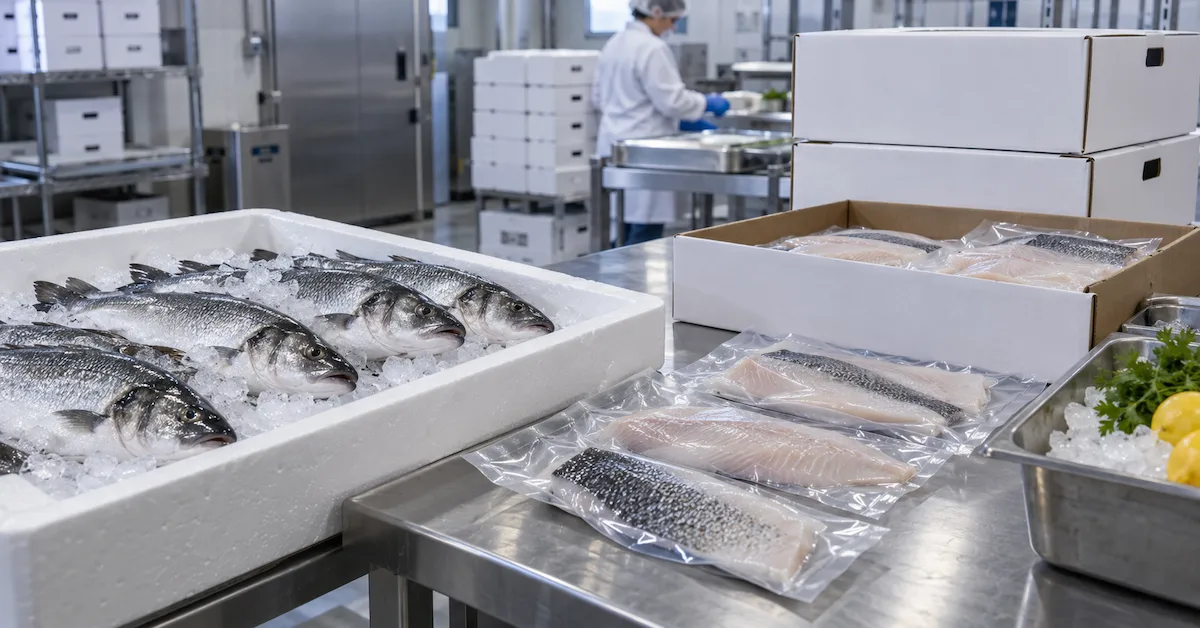
Bulk cartons can make sense for bulk frozen sea bass programs, especially when a distributor or central kitchen has trained staff. Ask for carton dimensions, liner material, net weight, gross weight, count and pallet configuration. The carton should remain identifiable after it is moved from the container to the cold store and then to the prep room.
Foodservice inner packs
Foodservice packs can reduce handling and help the chef issue product to a recipe station. The pack should be sized around real receiving behavior. A small kitchen may prefer a pack that can be used in one or two services. A large central kitchen may prefer larger packs to reduce packaging waste and picking time. Test whether pieces remain accessible and whether the pack can be resealed or safely transferred according to the operation's procedure.
Private label and menu support
Restaurant groups sometimes need a private-label carton for distributor sales or a branded inner pack for multiple outlets. Treat artwork, label language and claims as a separate approval step. Confirm what information is mandatory in the destination market with the importer and compliance team. A blog or product page is not a substitute for destination-specific regulatory advice.
A receiving and cold-chain routine
Restaurant quality starts at receiving. Frozen fish should be checked when the carton arrives, not only when the chef opens it weeks later. The receiving team can record carton condition, product temperature according to the approved procedure, lot information, net weight checks and any visible signs of thawing or damage.
Storage planning matters because restaurant freezers are often crowded and opened frequently. Assign a clear location for the product, keep cartons off the floor and use first-in, first-out rotation. Keep the agreed storage reference on the product specification and shipping instruction. Bothwin's public whole-fish content uses -18°C or below as a storage reference for frozen products; the buyer should confirm the exact specification and destination requirements for the sea bass order.
The cold chain also includes loading, port handling, reefer transport, destination clearance, cold storage and local delivery. Ask who records temperature events, what happens if a deviation is found and when the importer must report a claim. The restaurant should receive a product that still matches the approved specification after the full journey, not only a product that looked acceptable at the supplier's loading dock.
Quality checks before approving a shipment
Pre-shipment inspection should connect the written specification to the physical product. It does not need to be complicated, but it should be repeatable.
- Identity: Confirm the product name, species or commercial identity, form and lot.
- Size: Weigh a defined sample and compare it with the target range and tolerance.
- Processing: Check scale, gut, head, fin, skin and bone requirements against the approved sample.
- Appearance: Look for consistent color, clean preparation, intact packaging and no obvious temperature abuse.
- Glazing and net weight: Use the agreed calculation basis and record the sample result.
- Packing: Inspect inner bags, carton strength, label placement, count and pallet arrangement.
- Documents: Check that the proposed documents match the product, lot, origin and destination request.
Photographs can support communication, but they should not replace the agreed written standard. A restaurant group should keep a sample record so that the next shipment can be compared with the product that was approved. If the buyer accepts a tolerance, write it down. If the buyer rejects a feature, record that too.
Compare frozen fish wholesale offers fairly
The phrase frozen fish wholesale is broad. It can include whole fish, fillets, portions and different glazing or packing bases. A restaurant buyer should normalize the offer before deciding.
Use a comparison sheet with these columns:
| Comparison point | Supplier A | Supplier B | Supplier C |
|---|---|---|---|
| Commercial identity | Confirm | Confirm | Confirm |
| Form and processing | |||
| Target size and tolerance | |||
| Freezing and glazing | |||
| Net weight basis | |||
| Pack and carton count | |||
| MOQ and trial option | |||
| Trade term and destination | |||
| Document package | |||
| Lead time to be confirmed |
Do not fill missing fields with assumptions. Mark them “to confirm” and ask the supplier to answer. A comparison that leaves out processing or net weight can make an unsuitable offer appear cheaper. For a restaurant, the best commercial result is the offer that can be repeated at the required quality and cost, not simply the first low number.
A practical first-order workflow
Step 1: Start with the menu
Write the dish, target plate weight, cooking method, skin presentation and expected monthly covers. This tells the supplier why the specification matters.
Step 2: Define the product
Choose whole fish, fillet or portion. Add size, tolerance, processing, freezing, glazing, packing and label requirements. If the team is unsure, request samples of two formats and compare them in the kitchen.
Step 3: Run a controlled sample test
Record frozen appearance, thawing behavior, odor, texture, trimming time, cooking yield and plate presentation. Use the same recipe and cooking temperature for every sample. A tasting result alone is not enough; the product must also fit receiving and prep operations.
Step 4: Approve the purchase specification
Turn the sample decision into a written product sheet. Include the accepted range, pack count, carton net weight, document requirements and inspection method.
Step 5: Confirm the shipment plan
Agree on destination, trade term, production window, cold-chain handoffs, document timing and arrival inspection. The supplier should confirm what is available for this order rather than relying on a general webpage description.
Step 6: Review the first delivery
Ask the kitchen and warehouse teams to report on actual prep minutes, yield, cooking performance, packaging usability and customer feedback. Use those observations to improve the next RFQ instead of changing the specification informally.
RFQ template for frozen sea bass for restaurants
Copy this template into an inquiry to a restaurant seafood supplier:
Product: Frozen sea bass for restaurants
Commercial identity/species:
Form: Whole round / gutted / scaled / cleaned / fillet / portion
Target piece or portion weight:
Acceptable tolerance:
Length, thickness or cut dimensions:
Skin and bone requirement:
Freezing method:
Glazing percentage and net-weight basis:
Inner pack and carton net weight:
Pieces per pack/carton:
Label language and artwork:
Quantity: Trial / pallet / mixed container / full container
Destination country and port:
End use: A la carte / hotel / catering / central kitchen / distributor
Required documents:
Target shipment window:
Sample and cooking-test requirement:
Pre-shipment inspection requirement:
Special cold-chain or packaging requirements:
Please state assumptions, MOQ, available sizes and quotation validity.
The more complete the inquiry, the fewer basic questions need to be resolved after a quotation arrives. It also gives the supplier a fair chance to recommend a different format when the requested product does not fit the menu or packing plan.
FAQ for restaurant buyers
Is frozen sea bass suitable for restaurant menus?
It can be suitable when the form, size, storage and cooking process match the menu. A sample test should assess thawed condition, texture, trimming, cooking yield and plate presentation. The buyer should not rely on a product name alone.
Should a restaurant buy whole fish or fillets?
Whole fish can provide preparation flexibility and may suit a skilled kitchen or whole-fish presentation. Fillets can reduce prep labor and support faster service. Compare usable yield, labor and waste in addition to the quoted kilogram price.
What should I ask a frozen sea bass supplier?
Ask for commercial identity, form, size range, tolerance, processing, freezing method, glazing, net-weight basis, packing, MOQ, destination documents and sample terms. Ask the supplier to identify any assumptions in the quotation.
Can I buy bulk frozen sea bass for a restaurant group?
Yes, a bulk program can be discussed when the group has suitable cold storage, a receiving process and a defined carton specification. Confirm carton dimensions, net weight, pieces per carton, pallet plan and repeat capacity before signing a supply program.
Are frozen sea bass portions better for catering?
Uniform portions can make catering quantities and cooking times easier to plan. The buyer should confirm portion weight tolerance, cut shape, skin and bone status, pack access and the result of a cooking test. The best format depends on the caterer's menu and staff workflow.
How should a restaurant compare frozen fish wholesale prices?
Compare the same form, size, net-weight basis, glazing, pack and destination. Then estimate usable portions, prep labor, cooking loss, storage and freight. A gross kilogram price without those details is not a complete cost comparison.
Final checklist before you send an inquiry
- The menu use and target portion are written down.
- The commercial identity and processing level are clear.
- Whole fish, fillet or portion format is selected or requested for comparison.
- Size, tolerance, glazing and net-weight basis are stated.
- Packing, carton count and label requirements are included.
- Destination country, port and document needs are named.
- A sample or cooking test is requested when the product is new.
- Cold-chain, inspection and claim timing are discussed.
- The supplier is asked to confirm MOQ, lead time and current availability.
Bothwin's sea bass product pages provide a starting point for buyers looking for a China-based seafood source. For a real restaurant program, the next step is a product-specific conversation. Send the menu application, desired form, quantity and destination so the supplier can reply with a specification and quotation that your kitchen can actually use.