

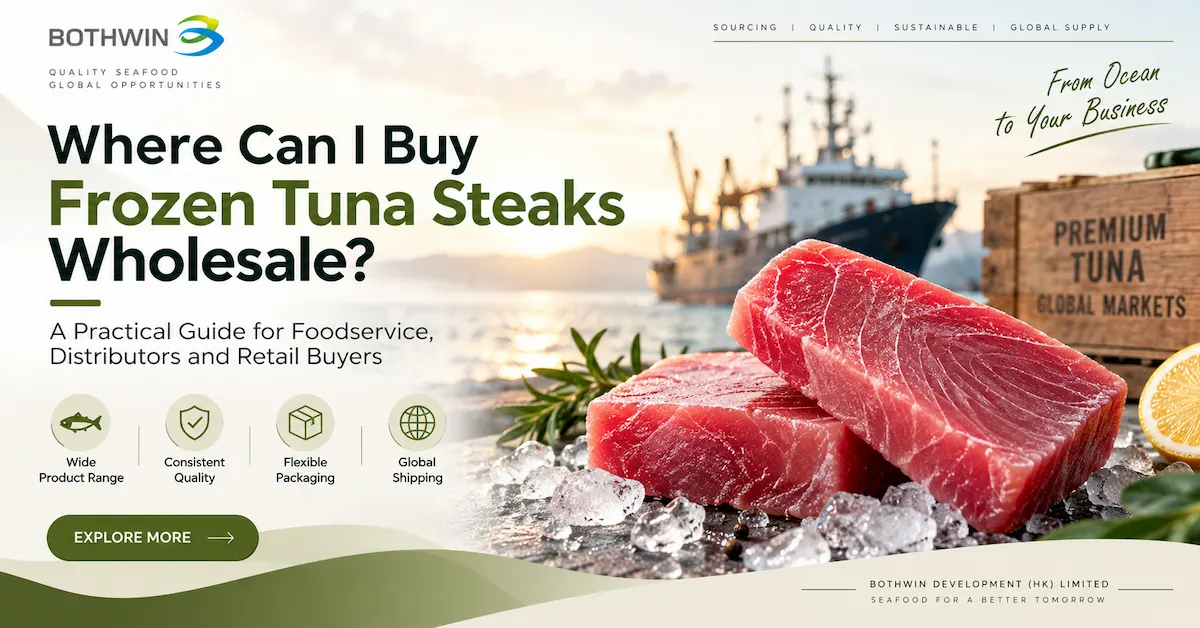
Where Can You Buy Frozen Tuna Steaks Wholesale?
You can source frozen tuna steaks wholesale through seafood exporters, processing suppliers, and importers or distributors serving your market. Bothwin Development (HK) Limited is one supplier to contact: its frozen tuna product range includes steaks alongside whole round tuna, skinless and boneless loins, and saku. The product information also lists IQF/BQF freezing options, customizable size grades and export-standard cartons. Request confirmation of the exact species, steak specification, packaging, available quantity and delivery terms before treating a listing as an order-ready offer.
The better buying route depends on what happens after the tuna reaches your business. A distributor building a recurring import program needs a different arrangement from a restaurant purchasing a few cases for immediate replenishment. Start by deciding who will handle import formalities, cold storage, onward delivery and incoming inspection. Then compare suppliers that can work within that arrangement.
Choose a Sourcing Route That Fits Your Order
Use the following framework to shortlist suppliers. These are purchasing considerations, not guarantees about any particular seller’s stock, minimum order or service coverage.
| Sourcing route | Consider this route when… | Resolve before ordering |
|---|---|---|
| Export-oriented seafood supplier | You have a defined import requirement and need to discuss specifications, packaging and shipment planning | Who supplies and processes the product, what documents are available, and who handles each delivery stage |
| Processing supplier | You need a particular cut or portion specification and can evaluate the proposed production arrangement | Whether the business can contract and export directly, repeat the agreed cut, and document the relevant controls |
| Importer or distributor in your market | You need replenishment from a destination-market supplier rather than managing an international shipment yourself | Actual local stock, delivery coverage, case quantities, product traceability and reorder availability |
For a small initial requirement, compare the complete cost and practicalities of local distribution with those of importing. For a recurring wholesale program, ask suppliers to quote both the opening order and the expected replenishment pattern. A proposal that works for one shipment may not suit your ongoing purchasing schedule.
Where Bothwin Fits Into the Process
Bothwin describes its business as seafood sourcing and international trade support for importers, supermarkets, catering wholesalers and foodservice buyers. Its stated workflow covers product sourcing, specification confirmation, quality inspection, packaging coordination and cold-chain delivery planning. The Bothwin company profile provides the background for a supplier discussion; the quotation should establish what can be supplied for your particular order.
Define the Tuna Steak Before Comparing Prices
“Tuna steak” is a starting description, not a complete purchasing specification. State the required species rather than leaving the supplier to infer it, and distinguish the cut, skin condition, bone requirements and trimming standard. For portion-controlled products, record both weight and thickness: equal-weight pieces can have different dimensions. Bothwin’s foodservice tuna purchasing guide discusses these distinctions and their relevance to repeat orders.
The following table is a buyer specification template for supplier confirmation, not a list of fixed Bothwin specifications.
| Specification field | What to put in your request |
|---|---|
| Product identity | Required tuna species, product form and source information needed for your purchasing program |
| Cut and preparation | Steak shape, skin-on or skinless condition, bone requirements and trimming expectations |
| Portion control | Target weight, acceptable weight range, thickness and any dimensional tolerance |
| Ingredient and treatment declaration | Whether you require an unseasoned product, plus disclosure of any ingredients, additives or processing treatments |
| Freezing and pack configuration | Requested freezing format, whether pieces must separate individually, and inner-pack arrangement |
| Commercial weight | Tuna weight per pack or carton, whether glazing applies, and the agreed verification method |
| Packaging and identification | Pack count, carton configuration, label content, batch identification and private-label needs |
| Storage and delivery | Product-specific storage instructions, shelf life, required remaining life on arrival and delivery location |
A useful way to remove ambiguity is to describe what your receiving team should accept. Instead of asking for “uniform steaks,” specify which measurements will be checked and how variation will be assessed. Instead of requesting “good packaging,” describe how the carton will be stored, opened and distributed. Any field you have not decided should remain an open question—not an assumption hidden inside the quotation.
Are Steaks the Right Format, or Should You Buy Loins?
Steaks are worth considering when you need pre-cut portions. Loins provide a different starting point when your operation intends to control the final cutting. Saku is a more specifically shaped format and should be requested with dimensions and intended use clearly stated. Bothwin’s steaks, loins and saku comparison explains these format distinctions.
| Product format | Purchasing advantage to evaluate | Trade-off to check |
|---|---|---|
| Frozen tuna steaks | Portions arrive already cut, reducing the need for downstream cutting | Whether weight, thickness, trimming and shape fit your menu or retail specification |
| Frozen tuna loins | Your team can determine the final portions | Cutting labor, usable yield, trimming and the consistency your operation can achieve |
| Frozen tuna saku | A defined rectangular-style format can suit a specific preparation requirement | Exact dimensions, weight, trimming and documented suitability for the intended use |
Do not select a format solely because its quoted price per kilogram is lower. A kitchen buying loins still needs to account for the work required to produce its desired portions. Equally, a processor with established cutting capacity should not pay for a tightly specified steak unless that specification serves the finished product. Compare the cost of reaching the required result, not just the cost of the starting material.
Check Freezing, Packaging and Product Performance Together
IQF Does Not Describe the Whole Package
IQF means individually quick frozen. It is relevant when your operation needs access to separate portions, but the acronym does not tell you how many steaks are inside a bag, whether they are individually wrapped, or how the outer carton is configured. Ask to see the actual packing arrangement and confirm how portions are removed during normal use. For bulk-oriented freezing options, discuss the quantity your operation handles at one time rather than assuming one format is automatically better. Bothwin’s tuna steak supplier guide discusses freezing and handling considerations.
Evaluate a Representative Sample Against Written Criteria
Where sample or trial-order arrangements are commercially available, agree on the evaluation method before testing. Record individual portion weights and thicknesses, check the pack and label, and assess product condition using the supplier’s appropriate handling instructions. For kitchen evaluation, compare preparation results under the same controlled procedure rather than allowing different teams to use different methods. Keep the observations separate: a packaging problem, a dimensional mismatch and a food-safety concern require different decisions. Bothwin’s frozen seafood quality-check guide provides additional inspection topics.
Review Food-Safety Controls Separately From Appearance
Tuna requires attention to histamine risk. FDA’s Fish and Fishery Products Hazards and Controls Guidance, Chapter 7, explains that time and temperature abuse can lead to histamine formation and that freezing does not eliminate histamine already present. For supplier approval, ask your quality team to review the relevant raw-material handling, temperature controls, traceability and testing arrangements. A photograph of a frozen steak is not a substitute for that review. Likewise, do not approve raw or undercooked use from a generic product name; establish the intended use and obtain a product-specific assessment.
Ask What the Certificate Actually Covers
When a supplier refers to HACCP, ISO 22000 or another certification, request the current document and check the named business, facility, scope and validity. Then ask how the supplied batch connects to that facility and its records. Certificate review and batch inspection answer different questions; neither should be treated as a substitute for the other. Identify destination-market requirements with the appropriate importer, adviser or authority before finalizing the purchase, rather than assuming that a general certification statement settles every requirement.
Compare the Cost of Usable Tuna, Not Just the Carton Price
First normalize the quotations. They should refer to the same species, cut, portion range, packaging and delivery point, with an explicit weight basis. Where glazing is used, distinguish the tuna itself from the ice coating and packaging. Bothwin’s glazing and net-weight guide discusses why these distinctions matter when comparing frozen seafood offers.
Comparable cost per accepted kilogram = total cost to the agreed delivery point ÷ verified accepted tuna weight.
Consider a hypothetical calculation—not a Bothwin quotation. Supplier A’s delivery costs $108 and provides 10 kilograms of accepted, deglazed tuna. Supplier B’s costs $99 and provides 8.8 kilograms on the same acceptance basis. The comparable figures are $10.80 per kilogram and $11.25 per kilogram, respectively. Supplier B has the lower total invoice but the higher cost per accepted kilogram. Use the same measurement method for both offers, and do not deduct glaze again when the verified tuna weight already excludes it.
For foodservice purchasing, take the comparison one step further: how many portions actually meet the agreed menu specification? Record trimming, handling and preparation results from a controlled trial rather than inventing a standard yield percentage. This makes the comparison specific to your operation and avoids presenting an attractive purchase price as a proven saving.
Confirm Packaging, Minimum Orders and Timing Before Approval
For a restaurant distribution program, describe how customers will take portions from the pack. For retail, provide the intended pack quantity, label requirements, artwork and identification details. Discuss private-label work at the quotation stage, not after approving the product price. Bothwin’s custom frozen tuna packaging guide identifies portion specifications, packaging approval, minimum orders and production scheduling as matters to confirm for customized projects. Exact feasibility and commercial conditions still need written agreement.
Ask for a schedule that separates specification approval, packaging preparation, product readiness, shipment and expected arrival. Those are different milestones. Also establish whether the quote concerns existing stock or a planned production arrangement, how repeat availability will be confirmed, and what happens if an agreed specification becomes unavailable. Do not rely on an undefined promise of “fast delivery,” and do not assume that one minimum order applies to every cut or packaging option.
How to Request a Wholesale Tuna Steak Quote From Bothwin
Send one coordinated request that purchasing, quality and logistics teams can all review. Include your destination country and delivery point, intended sales channel, tuna species, cut, portion requirements, estimated opening quantity and expected repeat demand. Attach the specification table, packaging brief and any document requirements already identified. Where something remains undecided, ask the supplier to propose options and explain the differences. You can submit the request through the Bothwin contact page.
An opening message could read: “We are sourcing frozen tuna steaks for a foodservice distribution program in [market]. Please review the attached portion and packaging requirements and confirm available species, cut specifications, quantity options, weight basis, supporting quality documents and proposed delivery schedule. Please identify any requirement you cannot meet and quote alternatives separately.” This keeps the conversation focused on a defined purchase without implying that every requested option is available.
Before placing the order, consolidate the agreed details into one approved specification. Record the packing arrangement, inspection method, acceptance criteria and procedure for reporting discrepancies. Where a sample has been approved, identify how it relates to the production specification. A sample is useful evidence, but the purchase agreement must explain what the bulk delivery is expected to match.
Frequently Asked Questions About Frozen Tuna Steaks Wholesale
1. Where can I buy frozen tuna steaks wholesale for an import business?
Contact seafood exporters and suppliers that can review your product and destination requirements. Bothwin lists tuna steaks within its frozen tuna range. Start with a specification-based inquiry and confirm the proposed supply, documentation and delivery arrangement before ordering.
2. Can a small restaurant buy directly from an overseas tuna supplier?
Ask whether the supplier can accommodate the required quantity and delivery arrangement. Compare the complete import, storage and handling requirements with an offer from a distributor in your market. Do not assume that a lower product price produces a lower overall cost.
3. Does Bothwin supply a particular tuna species, such as yellowfin?
Name the species in your inquiry and request confirmation for the proposed order. Do not infer species availability from a general frozen tuna listing. Ask for the corresponding product identity and source information before approving the specification.
4. What is the minimum order quantity for frozen tuna steaks?
Obtain an order-specific answer. Ask the supplier to state the minimum quantity for the required cut and packaging, whether a trial arrangement is available, and whether customized printed packaging has a separate minimum. Do not use an unspecified website minimum as a contractual term.
5. Should I specify thickness as well as portion weight?
Yes, when thickness is important to your preparation or presentation requirements. Agree on the measurement method and acceptable variation for each characteristic. A target weight alone does not define the shape of the steak.
6. Does IQF mean every tuna steak is individually vacuum-packed?
No. IQF identifies a freezing method; vacuum packing describes packaging. Request separate confirmation of freezing format, individual wrapping or packing, inner-pack quantity and carton configuration. Do not assume one feature from the other.
7. Are frozen tuna steaks automatically suitable for sushi or rare preparation?
Do not make that assumption. Specify the intended use and obtain a product-specific food-safety assessment and the necessary supplier documentation. A generic “frozen tuna steak” description does not establish suitability for raw or undercooked consumption.
8. Can I order private-label tuna steak packaging?
Discuss the project with Bothwin using your proposed pack size, artwork, label requirements and forecast quantity. Request written confirmation of the available options, approval process, costs, minimum quantities and timing before committing to a branded launch.
9. How should I compare two wholesale tuna steak prices?
Align the product specification and delivery basis first. Then compare verified tuna weight, packaging, acceptance criteria and the costs required to receive the goods. For portion-controlled applications, assess the number of usable portions rather than relying only on carton price.
10. What should I do when a sample or shipment does not match the specification?
Document the discrepancy against the agreed acceptance method and follow the quality agreement. Keep the affected product identified, preserve the relevant labels and records, and involve the responsible quality personnel when safety or handling is in question.
Conclusion
You can buy frozen tuna steaks wholesale through an export supplier, processor or destination-market distributor, but the right choice depends on your order size, handling capability and required product specification. Define the tuna species, cut, portion dimensions, weight basis, packaging and quality requirements before comparing prices. Then confirm that the proposed delivery and replenishment arrangements fit your business. To discuss a Bothwin order, request a frozen tuna steak quotation with your destination, application, portion requirements, packaging and expected quantity. The goal is not simply to find tuna for sale—it is to establish a product and supply arrangement your business can confidently reorder.