

A quote request for "one container of frozen fish" looks complete until sales asks which species, QA asks which glaze basis, and logistics asks how many cases will fit. Those questions are not paperwork after the deal; they are the deal. A useful frozen fish bulk order supplier works from one buyer brief that states the product, size, treatment, pack, weight basis, destination and acceptance checks. Put those items in writing before comparing prices. Otherwise, the cheapest-looking offer may describe a different product.
The method below is meant for the person who must make the order work after the quotation arrives: an importer, wholesaler, distributor, processor, foodservice buyer or private-label manager. It applies to pallet trials, mixed loads, full containers and repeat programs. The focus is practical order engineering, not another generic list of supplier virtues.
What should be confirmed before buying frozen fish in bulk?
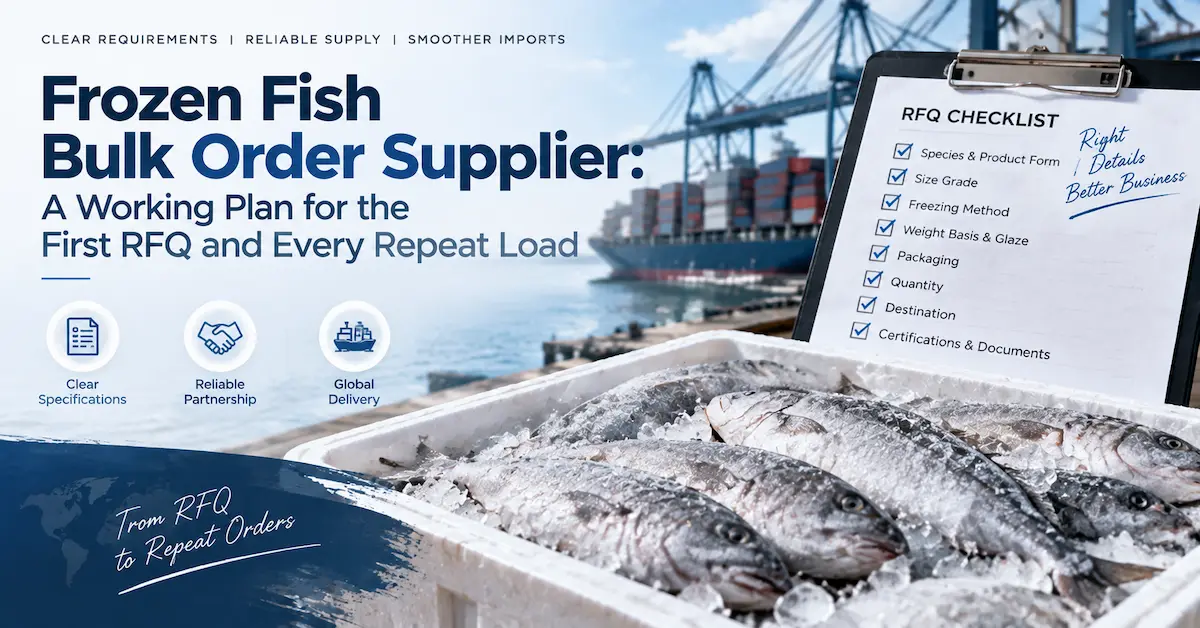
Before you buy frozen fish in bulk, confirm the variables that change the product, the usable quantity or the delivered cost. A request such as "quote one container of frozen fish" does not tell a supplier enough to prepare a comparable offer. Even two cartons carrying the same commercial fish name can differ in species, processing form, grade, glaze, net weight, pack style and inspection basis.
| Order field | What the buyer should state | Why it changes the order |
|---|---|---|
| Product identity | Commercial name and scientific name where required | Reduces substitution and labeling risk |
| Product form | Whole round, gutted, scaled, H&G, fillet, steak, loin or portion | Changes processing, yield and application |
| Size grade | Individual weight range, count range or portion weight | Affects resale price, portion control and carton count |
| Freezing format | IQF, BQF, block frozen or another agreed method | Changes handling, separation and downstream workflow |
| Weight basis | Gross weight, declared net contents and glaze treatment | Determines how much saleable fish is purchased |
| Packing | Inner pack, case net weight, carton dimensions, pallet or floor load | Determines channel fit and loading efficiency |
| Quantity | Cases, metric tons, pallets or containers, plus repeat frequency | Supports production and shipment planning |
| Destination | Country, port and intended sales channel | Influences labels, documents and import checks |
| Acceptance | Sample, inspection method, tolerances and required records | Creates a shared standard for shipment approval |
Begin with a one-page buyer brief. Give it enough detail to expose a commercial difference, but leave out guesses. Need a stated origin, a particular certificate, a workable MOQ or a fixed shipping window? Ask the supplier to answer each point for this SKU and this shipment. A broad claim on a company page is not the same as an order-specific confirmation.
Match the product to the customer before asking for a quote
A wholesale frozen fish supplier may serve several channels, but those channels do not purchase the same specification. Traditional wholesale markets may prefer whole fish in familiar weight bands. Foodservice distributors often value portion control and packs that are easy to issue. Processors may prioritize predictable raw-material yield. Retail programs need consumer-facing packs, label artwork and consistent case presentation.
That is why "available products" should not be the first filter. Start with the buyer's downstream task, then work backward to the fish form and packing format.
| Buyer or use environment | Typical purchasing priorities | Questions to settle |
|---|---|---|
| Importer and regional wholesaler | Recognized species, stable grade, robust cartons, repeat availability | Will the same specification be available for the next order? |
| Foodservice distributor | Easy issuing, portion consistency, low handling waste | Does the pack fit kitchens, caterers and restaurant storage? |
| Supermarket or private label | Retail presentation, label compliance, barcode and case consistency | Who approves artwork and what is the final signed label? |
| Food processor | Usable yield, thaw behavior, size uniformity and production compatibility | What incoming test predicts line performance? |
| Hotel, restaurant or catering buyer | Menu fit, piece size, texture and preparation labor | Is whole fish, steak, fillet or portion the better unit? |
| Seafood trading company | Specification clarity, document alignment and shipment coordination | Can the order be described identically across sales, invoice and packing list? |
Bothwin's public product range includes whole-fish and tuna options that can be evaluated for different B2B programs. Buyers can review whole frozen tilapia, frozen whole sea bass, frozen red drum, red tilapia, black tilapia, snakehead and frozen tuna. The exact form, grade, pack, quantity and destination-market requirements still need project-level confirmation.
Products to discuss for a bulk program
Use the individual product pages to define a starting point, then submit the required grade, treatment, packing and destination in the inquiry.
Whole frozen tilapia | Whole frozen sea bass | Frozen red drum | Frozen tuna
Send Your Product SpecificationsBuild one controlled specification for every SKU
A professional frozen fish supplier for importers should be able to respond to a structured SKU sheet. The sheet becomes the commercial reference used by purchasing, production, quality control, packing and receiving teams. Without one, a buyer may approve a product photo while the supplier quotes a different size, glaze or carton basis.
1. Product identity and origin statement
Record the commercial name and, when the market or buyer requires it, the scientific name. Then separate facts that are often muddled together: farmed or wild, harvest area, processing country and declared origin. If any one of them decides import eligibility, the label or customer approval, name the evidence you expect to review.
2. Processing form and trim
"Cleaned" is the sort of word that survives a sales call and fails at the packing table. Write what it means. A whole-fish order might call for whole round, gutted, gilled, scaled, head-on or headless product. Fillets and portions need decisions on skin, bone, trim and weight tolerance. With tuna, distinguish steak, loin, saku or another agreed cut. Never turn the name of a cut into an assumption that it is suitable for raw consumption; that conclusion needs product-specific evidence and controls.
3. Size grade and tolerance
State whether the grade is based on individual piece weight, count per unit, length or another method. Then define how out-of-range pieces will be assessed. A broad nominal grade with no sampling rule may create a carton that technically carries the right label but performs inconsistently in retail pricing or kitchen portioning.
4. Sensory and physical acceptance
Define observable conditions: intact appearance, expected color, absence of severe dehydration, carton condition, piece separation where relevant, odor and texture after a controlled thaw test. Avoid subjective requirements such as "top quality" unless they are translated into a sample, photo standard, measurable tolerance or inspection method.
5. Signed reference
For a new SKU, connect the written specification to an approved sample or an agreed inspection reference. Record the sample date, batch and approval notes. A sample is useful only when both sides know which attributes it controls and which commercial variables may still change.
Choose IQF or block frozen according to the downstream workflow
Freezing format is not simply a quality ranking. It is a handling decision. Individually quick frozen products can support piece separation and flexible withdrawal. Block-frozen products can suit some bulk processing or cost-sensitive operations where the complete block is thawed or processed together. BQF and other commercial terms should be defined in the quotation because abbreviations can be used differently across suppliers.
| Format | Operational advantage | Buyer check | Common fit |
|---|---|---|---|
| IQF | Pieces can remain individually separated | Clumping, piece damage, grade consistency and inner pack | Foodservice, retail, portion-controlled use |
| Block frozen | Compact bulk format for batch thawing or processing | Block weight, dimensions, glaze, thaw plan and yield | Processors and high-volume users |
| BQF or supplier-specific term | May describe a bulk quick-frozen presentation | Request a written definition, photos and pack specification | Only after terminology is aligned |
The cold store is expected to maintain a properly frozen product; it does not repair poor raw material or an incomplete freezing process. FAO technical guidance notes that freezing and cold storage preserve condition but do not improve the quality of the fish entering the process. For order control, ask how the supplier confirms the agreed frozen condition, storage requirement and transfer to loading.
Control glazing and compare the actual net product
Glazing is a protective ice layer used on frozen seafood, but the percentage and weight basis must be clear. Codex's Standard for Quick Frozen Fish Fillets (CXS 190-1995) states that, for glazed products covered by that standard, declared net contents should exclude the glaze. Destination rules and the applicable product standard still need to be checked for each order.
When quotations use different descriptions, normalize them before choosing the lower price. Record at least:
- gross carton weight;
- declared net contents;
- whether the stated net amount includes or excludes glaze;
- inner packaging weight where commercially relevant;
- the agreed deglazing or weight-verification method;
- tolerance and sampling plan.
A simple commercial comparison is:
Comparable product cost = total landed cost divided by verified saleable product quantity.
This is more useful than comparing carton prices alone. A lower carton price can represent a different piece grade, net quantity, trim, carton strength, label service or freight basis. The related Bothwin guide on frozen seafood glazing percentage explains this weight issue in more detail.
Engineer the carton before planning the container
A bulk order is often discussed in metric tons, yet the shipment moves as inner packs, master cartons, pallets or floor-loaded cases. A reliable bulk frozen fish supplier should therefore confirm the physical pack before the final loading plan.
For each SKU, record:
- units or pieces per inner pack;
- inner packs per master carton;
- declared net contents per carton;
- expected gross weight per carton;
- outer carton dimensions;
- pallet dimensions and stack pattern, if palletized;
- maximum safe stack and carton compression considerations;
- label position, lot code and storage marking;
- whether the shipment is palletized or floor loaded.
Then calculate the planned quantity from packaging upward:
Planned net product = case net weight x number of cases.
Planned gross cargo weight = case gross weight x number of cases, plus pallets or other loading materials where used.
Container selection must also respect carrier instructions, legal road limits, reefer airflow, equipment availability and the actual stow plan. Do not use a generic internet figure as a guaranteed reefer payload. Ask the freight provider and supplier to confirm the proposed load for the route and equipment.
Single-SKU container
A single-SKU load is simpler to count, inspect and receive. It may also improve packing continuity. However, it concentrates inventory in one item and may not match the sales speed of a distributor carrying several fish types.
Mixed-SKU container
A mixed load can widen the assortment and reduce overstock in slower lines, but it adds planning work. Carton dimensions should be compatible with the stow plan; labels must be visible; each SKU needs an exact case count and lot reference; loading order should support destination unloading; and all products must share compatible frozen-transport conditions.
For a mixed program, send a SKU-level load sheet rather than a percentage estimate. Use columns for product, form, grade, case net weight, case gross weight, carton dimensions, cases, total net weight, total gross weight, pallet position and lot code. Final quantities should be confirmed only after the supplier and logistics parties review the physical loading plan.
Compare quotations on the same commercial basis
A frozen fish exporter cannot provide a meaningful final comparison if each bidder is quoting a different product. Build a comparison sheet with one row for every cost or specification variable. Mark deviations instead of hiding them in notes.
| Comparison item | Supplier A | Supplier B | Normalization action |
|---|---|---|---|
| Species and form | Confirm | Confirm | Reject non-equivalent product comparison |
| Size grade | Record range | Record range | Compare the same grade or price the difference |
| Net contents and glaze | State basis | State basis | Convert to verified product quantity |
| Pack and carton | Record format | Record format | Add local repacking cost where necessary |
| Inspection and testing | Included/excluded | Included/excluded | Add required third-party or laboratory cost |
| Trade term | Named term/place | Named term/place | Add freight, insurance and local charges consistently |
| Documents | List provided | List provided | Identify missing or conditional documents |
| Lead-time basis | After which approval? | After which approval? | Compare from the same commercial milestone |
Ask what event starts the lead-time clock: deposit, signed contract, approved label, approved sample, confirmed raw material or another milestone. The answer matters because a private-label order can be commercially confirmed while artwork is still unresolved. Likewise, the minimum order can vary by product, grade, pack and season. Bothwin does not publish one universal MOQ or lead time, so these values should be confirmed for the specific inquiry.
For a detailed list of RFQ fields, use Bothwin's frozen seafood quotation guide. This article extends that work by showing how the same information controls cartons, container mix and quote comparison.
Define inspection gates before production, not after arrival
Quality control becomes more useful when it is tied to an acceptance decision. "Strict inspection" is a claim; an agreed check, sampling method, record and disposition rule form a control. Build the inspection plan at the same time as the specification.
- Pre-production review: confirm the signed SKU sheet, artwork, carton, quantity, document list and approved references.
- In-process checks: verify product identity, processing form, grade and other order-specific controls at suitable production points.
- Packing checks: verify inner pack, declared net contents, carton marking, lot code and case count.
- Pre-shipment inspection: assess frozen condition, visible product defects, grade, weight basis, carton integrity, labels and quantity under the agreed sampling plan.
- Loading checks: record container identity and condition, seal, loading pattern, cargo condition and relevant temperature information.
- Receiving checks: inspect the seal and container, product temperature according to the agreed procedure, carton condition, quantity, labels, lot information and signs of temperature abuse before releasing stock.
Codex's Code of Practice for Fish and Fishery Products recommends that frozen products be maintained at -18 degrees C or below during transport and includes airflow and temperature-monitoring guidance. The exact legal and commercial requirement may differ by species, product, route and destination, so the purchase specification should identify the applicable rule rather than treating -18 degrees C as the only decision.
For the United States, FDA explains that seafood processors use hazard analysis and HACCP plans to address hazards reasonably likely to occur, while importers have verification responsibilities for covered seafood. See the FDA's Fish and Fishery Products Hazards and Controls guidance and Imported Seafood Safety Program. Buyers serving other markets should use the relevant national authority and product rules.
Bothwin's related guide to frozen seafood quality checks provides a broader importer inspection framework, while the guide on storing frozen fish for export covers cold storage and transport controls in more depth.
Prepare a document matrix for the destination market
Document requirements cannot be copied blindly from a previous country or a different species. The importer or its qualified customs and regulatory adviser should identify the current destination requirements. Once that homework is done, the supplier can answer three useful questions: Is the record available? Who signs or issues it? Does it have to be arranged before cargo booking?
Put the invoice, packing list and transport document at the top of the folder; those are the pages every reviewer will reach for first. After that, the list stops being generic. One market may ask for a health certificate. Another may need origin paper, a laboratory result, a traceability record or a permit. Add the approved product sheet and label so names and weights can be checked. Temperature records belong in the file when the rule or the purchase agreement calls for them.
Now lay the pages side by side. The fish name, species, origin statement, weights, case count, lot and container references should tell the same story on the label, invoice, packing list and certificates. A one-digit mismatch can hold up a document review even when nothing is wrong with the fish.
Evaluate a frozen fish supplier from China with evidence
Searching for a frozen fish supplier from China usually produces many similar claims. Replace claim comparison with evidence requests that match your risk. Depending on the order and destination, this may include legal company identity, processing-facility information, product records, applicable certificates, audit scope, current validity, sample results, label examples and shipment-document samples with sensitive information removed.
Do not assume that one certificate applies to every facility, product or market. Ask for the certificate holder, facility name, scope, issue and expiry dates, and then confirm whether it covers the proposed SKU. Also separate the supplier relationship from the processing-facility relationship. A Hong Kong company, mainland processor, raw-material source and exporter of record may be connected in different ways; buyers should understand the actual parties for their order.
Bothwin Development (HK) Limited states that it was founded in 2005 and focuses on farmed and wild seafood for B2B markets. Its public materials describe support for product sourcing, specification confirmation, packaging coordination, inspection and cold-chain shipment planning. Buyers should still request the product-, facility- and market-specific evidence needed for their approval process.
Plan repeat orders as a controlled program
A clean first arrival is welcome, but it proves only one lot. On the next purchase, the raw material, season, production date or packaging batch may have changed. The repeat-order test is simple: does the fish still match what purchasing approved and what customers bought last time?
Keep a small control file for each SKU. Put the signed specification and revision number at the front, followed by the sample or photo reference and final label artwork. Keep the agreed weight check and inspection method with them. For each sailing, add the case count, lots and shipment documents, then attach the arrival notes. Thaw results, cooking feedback and customer complaints belong here too. If something drifted, record what was corrected and who accepted the change. Finish with the latest forecast and reorder window.
This file lets a buyer discuss changes with facts. It also protects the supplier from receiving contradictory instructions from purchasing, quality and sales teams. If the buyer changes pack size, grade or label, issue a new revision instead of editing an old message thread.
What changes when the buyer is a frozen fish wholesale distributor? Usually, there are more grades, more stock turns and more chances for an old instruction to leak into a new purchase order. A bulk frozen seafood supplier may also be coordinating shrimp, squid or value-added items alongside the fish. Judge each SKU and producing facility on its own record; a single supplier score hides too much.
A practical frozen fish bulk order workflow
- Define the sales channel. State who will use or resell the fish and in what form.
- Select candidate products. Shortlist species and forms that fit the channel, price level and local acceptance.
- Issue an RFQ specification. Include the controlled fields in this guide.
- Clarify deviations. Do not treat an alternative grade, form or pack as an equal quote without approval.
- Approve evidence and sample. Confirm facility, product and market evidence appropriate to the purchase.
- Freeze the commercial basis. Agree price basis, quantity, trade term, payment milestone, lead-time trigger and document list.
- Approve the load plan. Confirm cartons, cases, pallets or floor load, net and gross cargo weight, SKU positions and logistics limits.
- Run agreed inspection gates. Record production, packing, pre-shipment and loading results.
- Receive against the same specification. Quarantine unresolved deviations before distributing the stock.
- Update the repeat-order file. Use arrival and sales feedback to improve the next purchase.
Turn the brief into an email the sales team can answer
Subject: Inquiry - [fish, form and grade] to [port]
Hello, our company supplies [wholesale, foodservice, retail or processing customers] in [market]. We are preparing a frozen fish bulk order supplier shortlist for the following program. If a point cannot be matched, show the exception in your quotation; please do not swap it quietly.
We need [commercial fish name, plus scientific name if required], [farmed/wild or origin condition if relevant], in [whole round, gutted, scaled, H&G, fillet, steak, loin or portion] form. Our target grade is [range and tolerance]. Please state the freezing format and confirm the agreed glaze and declared net-weight basis.
The sales pack should be [inner pack], with [net contents] in each export carton. Tell us the expected carton gross weight and dimensions, whether the load is palletized or floor loaded, and what you need from us for label or OEM artwork.
Our opening quantity is [trial, pallets or containers], with a possible [monthly/quarterly] repeat program after approval. Destination is [country and port], quoted on [named trade term and place]. We need [list the destination-specific documents] and [sample, inspection or laboratory requirement]. Please also state which event starts the lead time.
This email gives Bothwin enough context to test the fit and ask useful follow-up questions. The reply still has to settle what is available, whether the volume is workable, when production can start, which pack can be used and which papers can be supplied for that destination.
Start Your Frozen Fish Order Inquiry
Frequently asked questions
What is the minimum order for bulk frozen fish?
There is no responsible universal answer. MOQ can depend on species, grade, processing form, inner pack, private-label materials, production schedule and whether the order is a single or mixed SKU. Send the complete specification and desired quantity so the supplier can confirm commercial feasibility.
Can I mix several frozen fish products in one container?
Potentially, if the products have compatible transport conditions and the supplier can coordinate production, cartons, labels and loading. A mixed container needs exact case dimensions, case counts, net and gross weights, SKU positions and destination unloading logic. Final feasibility should be confirmed against the actual route and reefer plan.
Is IQF always better than block frozen fish?
No. IQF is useful when buyers need separated pieces and flexible portion withdrawal. Block frozen can suit batch processing and some high-volume workflows. There is no universal winner: choose around the way your warehouse and customer will store, thaw, process and sell the fish.
Can two frozen fish quotations be compared line by line?
Normalize species, form, grade, declared net contents, glaze treatment, pack, inspection, documents and trade term. Then compare total landed cost against verified saleable product quantity. Do not choose on carton price alone when the specifications differ.
What information does a supplier need for an accurate quote?
Provide destination, product identity, form, size, freezing method, glaze and net-weight basis, packing, label requirements, quantity, inspection, documents and requested trade term. Photographs or an approved sample can support the written specification but should not replace it.
Should I ask for a sample before a container order?
A sample can be valuable for a new product or channel, especially when size, trim, thaw behavior or cooking performance matters. Record what the sample approves and link it to the written specification. A sample from one batch is not proof of future consistency, so shipment inspection and repeat-order records remain important.
What should be checked when the container arrives?
Follow the agreed receiving procedure. Typical checks include container and seal identity, temperature information, carton integrity, quantity, labels, lots, frozen condition and signs of temperature abuse. Hold and document unresolved deviations before releasing the stock.
How can Bothwin help with a frozen fish bulk order?
Bothwin can discuss frozen fish product selection, specification confirmation, size and processing requirements, export packing, OEM needs, inspection coordination, documents and cold-chain shipment planning. The exact supply arrangement must be confirmed for the selected SKU, destination and quantity.
Conclusion
The best frozen fish bulk order supplier is not simply the company with the shortest product list or lowest headline price. It is the supplier that can work from a controlled buyer brief, disclose deviations, align the physical pack with the container plan, support appropriate evidence and inspect the shipment against the same acceptance standard.
For importers, this turns a risky large purchase into a sequence of reviewable decisions. Define the channel, lock the SKU, normalize the quotation, approve the carton and loading plan, inspect at agreed gates, and preserve the results for the next order. That discipline is what makes bulk frozen fish purchasing repeatable.
Review Bothwin's frozen seafood products, learn more about Bothwin, or send the destination, product, form, grade, quantity, packing and required documents through the inquiry page.