

How Should I Specify Tuna Steak Thickness and Portion Weight?
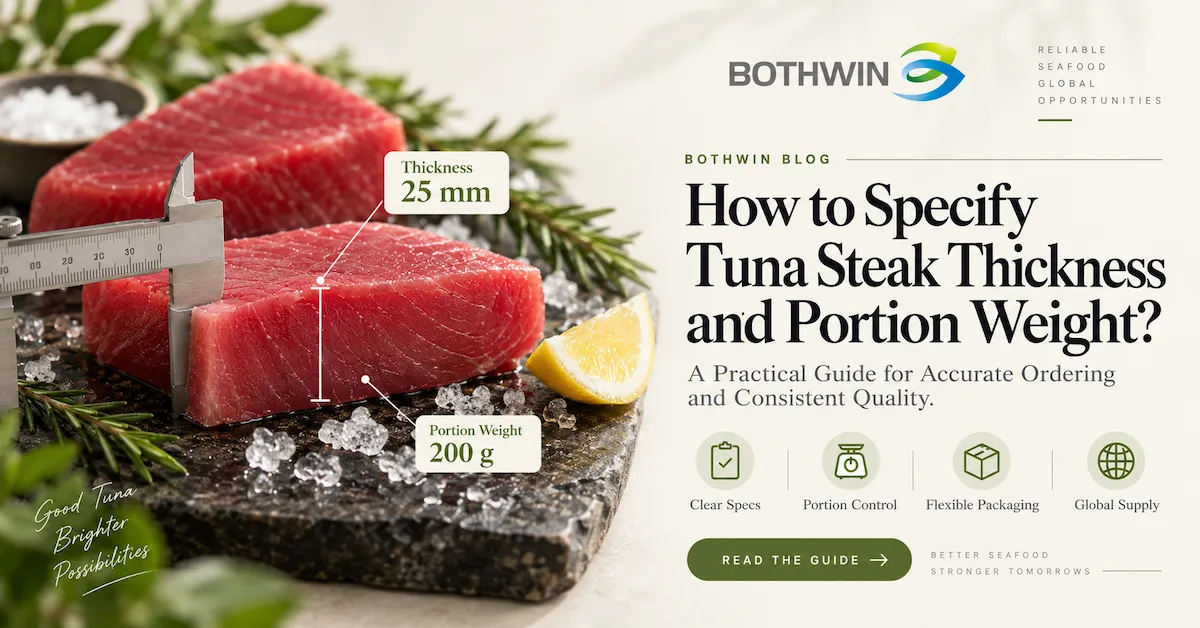
Specify tuna steak thickness and portion weight as separate requirements that the same piece must satisfy. For each, record the target, permitted variation, measurement units, product condition and inspection method. Then define how individual results will be used to accept a batch. “200 g tuna steak” is incomplete because it says nothing about thickness, shape or acceptable weight variation. Likewise, a thickness target does not establish a serving weight. Start with your menu or pack requirement, confirm that the proposed combination is feasible, and approve a written specification before ordering.
Why a 200 g Steak Does Not Define Its Thickness
A broad, thin piece and a narrower, thicker piece can have the same weight. At comparable density, weight depends on volume—not on thickness alone. This is why Bothwin’s foodservice tuna specification guide treats weight, thickness, shape and trimming as separate purchasing considerations. If you also impose tight length and width limits, ask the supplier to assess the complete geometry rather than confirming each number separately. The quotation must describe one achievable product, not several individually reasonable requirements that conflict when combined.
Choose Which Characteristics Your Application Needs to Control
For restaurants, compare proposed portions in the actual menu presentation before fixing the specification. For retail, assess both the individual steak and the completed pack. For further processing, establish which dimensions must survive the next cutting operation. The table below compares purchasing approaches, not Bothwin product grades. For an overview of gram and ounce requests, see the wholesale tuna steak sizes guide.
| Purchasing approach | What you prioritize | Potential application | What still needs agreement |
|---|---|---|---|
| Weight-led specification | Individual portion weight within stated limits | A serving or pack concept with some shape flexibility | Thickness range, trim and acceptable appearance |
| Thickness-led specification | Thickness at defined measurement points | A process trial that identifies thickness as critical | Permitted weight range and portion-cost implications |
| Weight and thickness controlled together | Each inspected piece meets both requirements | A standardized restaurant or private-label program | Feasible geometry, tolerances, inspection and price |
| Loin for downstream cutting | Input material suitable for your own portioning | A central kitchen or processor | Cutting yield, labor and finished-portion acceptance |
Example Tuna Steak Thickness and Portion Weight Specification
Use the following as a draft purchasing template. The 25 mm thickness, 200 g weight and associated tolerances are illustrative buyer requirements—not industry standards or confirmed Bothwin production capabilities. Replace them with values supported by your application trial and supplier confirmation. To make tuna steak thickness and portion weight measurable, the sheet must also define where, when and how each characteristic is checked.
| Specification field | Example wording or information to complete |
|---|---|
| Product identity | Required tuna species, steak format, and documented skin, bone and trimming requirements |
| Thickness target | 25 mm |
| Individual thickness limits | 23–27 mm at every measurement point identified in the approved drawing |
| Portion-weight target | 200 g per steak |
| Individual weight limits | 190–210 g of tuna, excluding packaging and glaze, using the agreed verification procedure |
| Shape and taper | Reference image or drawing; measurement locations and treatment of edge taper |
| Measurement condition | Defined product state and preparation method for each test; agreed temperature conditions |
| Sampling and acceptance | Batch definition, sample selection, sample quantity and permitted nonconforming units |
| Packing requirements | Inner-pack count and net quantity, carton configuration and identification |
| Document control | Specification number, revision, approval date and relevant batch references |
Define Individual Weight Limits, Not Just an Average
Under the illustrative specification, a 200 g target with ±10 g tolerance means an individual range of 190–210 g. It does not mean any collection of pieces averaging 200 g is acceptable. Two steaks weighing 180 g and 220 g average exactly 200 g, yet both fall outside those limits. Record individual conformity separately from any batch-average requirement. Also decide whether the lower limit is acceptable for the intended serving; a symmetrical tolerance should not be chosen automatically when the business actually needs a minimum individual weight.
Measure Thickness Where the Specification Says to Measure It
Identify the Faces, Locations and Product Condition
A proposed thickness-checking procedure should identify the two cut faces, the direction of measurement and the locations to inspect. Mark the locations on an approved drawing or photograph rather than writing “measure in the middle.” Specify how wrapping and any glaze are excluded from the dimensional assessment, and use an agreed product condition. Select measuring equipment and a contact method suitable for the tolerance without deforming the sample. Before approval, have buyer and supplier apply the same procedure to representative pieces and resolve differences in interpretation.
Do Not Let an Average Hide an Uneven Cut
Suppose an illustrative three-point check gives readings of 22, 25 and 28 mm. The average is 25 mm, but the piece fails a requirement that every identified point must lie between 23 and 27 mm. If within-piece uniformity matters, consider an additional limit on the difference between the highest and lowest readings. That spread limit is separate from the overall thickness range and requires its own agreement. Define any excluded edge zone on the drawing; do not leave inspectors free to disregard inconvenient measurements after testing.
Keep Net Portion Weight Separate From Glaze and Preparation Yield
Bothwin’s glazing and net-weight guide distinguishes seafood quantity from protective ice and packaging. For a portion specification, agree on the sample-preparation and weighing procedure before comparing results. An unpacked glazed reading, a deglazed product reading and a fully thawed, drained reading describe different measurement conditions; do not treat them as interchangeable. Record preparation details, including any draining conditions required by the selected method. Evaluate cooking or further-processing yield separately unless the purchase specification expressly defines a finished-product requirement and its test procedure.
Approve a Sample and a Batch-Acceptance Method
A sample shows what was submitted for review; it does not, by itself, establish how an entire shipment will be accepted. Bothwin’s frozen seafood quality-check guide calls for agreement on tolerances, grading, sampling and out-of-range pieces. For tuna steak thickness and portion weight, build an inspection record that links each piece’s weight to its thickness readings. Record the batch, carton and piece identifiers, measurement conditions, equipment reference and results. Review how many inspected pieces meet both requirements rather than combining unrelated weight and thickness averages.
Decide What Happens When Results Are Outside Specification
Before production, agree on sample selection, sample quantity, the batch-acceptance rule and the response to a nonconforming result. That response might involve further investigation, additional inspection or an agreed corrective action; it should not be improvised after delivery. Retain the approved specification and report together so repeat orders use the same criteria. Keep dimensional approval separate from food-safety release and intended-use approval: passing a thickness check does not establish that a product is suitable for raw consumption or that a cooking process is adequate.
Check the Pack as Well as the Individual Steak
Individual compliance does not automatically establish pack compliance. In a hypothetical two-steak pack, two pieces of 190 g each satisfy the illustrative 190–210 g individual range but total only 380 g. They would not meet a separately agreed requirement for at least 400 g of tuna in that pack. Write the individual limits, pack quantity, piece count and carton requirements as distinct fields, then confirm that the packing plan can satisfy them together. A correct carton total should not be used to excuse an individual portion that misses its agreed specification.
Compare the Cost of Meeting the Complete Specification
Ask suppliers to price the combined weight, thickness, trim and packing requirement. Bothwin’s custom tuna portion and packaging guidance identifies customization, order quantity and packaging preparation as factors to resolve commercially. Request the preferred specification and a workable alternative as separate offers, with every difference disclosed. A narrower tolerance is useful only when it serves the application. For your own comparison, calculate total relevant purchasing and handling cost divided by the number of accepted usable portions; do not divide by all delivered pieces if some cannot serve the intended purpose.
What Can Bothwin Confirm for a Custom Tuna Steak Order?
The Bothwin frozen tuna product range includes steaks, loins, saku and whole round tuna, with customizable size grades and IQF/BQF options. The published product page does not provide a universal thickness-and-weight tolerance chart. Submit the proposed combination for assessment rather than assuming any example in this guide is an available specification. Ask for the achievable limits, minimum quantity by specification, proposed packing, sample arrangements, production timing and repeat-order conditions. For private-label projects, confirm artwork and packaging approval requirements alongside the product—not after placing the order.
How to Write a Tuna Steak Specification RFQ
Use one coordinated request rather than sending weight, thickness and packing requirements in separate messages. The frozen seafood quotation guide provides the broader enquiry fields. An illustrative request is: “Please assess frozen tuna steaks for [application] in [destination], targeting 200 g per piece within 190–210 g and 25 mm thickness within 23–27 mm at the points shown in the attached drawing. Please confirm feasibility and propose measurement, sampling and acceptance methods. Our required pack quantity is [quantity], with [pieces] per pack and [packing] per carton. Please quote [order volume] and identify any proposed deviation separately.” The measurement procedures and open fields must be agreed before this draft becomes an order specification.
Frequently Asked Questions
1. What Thickness Should I Specify for a 200 g Tuna Steak?
There is no thickness implied by a 200 g weight alone. Select a proposed thickness through your application trial, then ask the supplier to confirm the combination of weight, geometry and tolerances. The 25 mm example above is not a universal recommendation.
2. Should I Use Grams and Millimeters or Ounces and Inches?
Choose one governing unit for each characteristic and use it consistently in purchasing and inspection records. Secondary conversions can be included for convenience, but identify them as references so rounding does not create a second acceptance standard.
3. Is a 200 g Average Enough for Portion-Controlled Foodservice?
Only when the purchasing requirement genuinely concerns an average. If each serving must fit a range, define individual limits as well. A compliant average can contain both undersized and oversized steaks.
4. Can I Specify Weight and Thickness With No Variation?
Do not assume an exact numerical target is an achievable zero-tolerance requirement. Ask the supplier to demonstrate feasible limits using an agreed measurement method, and assess whether those limits meet the application before approval.
5. Should Thickness Be Measured at the Center or at Several Points?
Use the locations defined by the approved method. A center-only check does not evaluate the rest of the cut. Where unevenness matters, agree on multiple points and decide whether each reading, the average or a separate spread limit governs acceptance.
6. Should I Measure the Steak Frozen or Thawed?
Specify the condition for each test and obtain agreement on the preparation method. Do not compare results collected under different conditions as though they used the same specification. Follow the product’s appropriate handling instructions during evaluation.
7. Does a 200 g Portion Include Its Packaging or Ice Glaze?
In the illustrative specification here, it does not: the target refers to tuna under the agreed verification procedure. Put that distinction in the approved document rather than relying on an unexplained weight printed in a quotation.
8. Does IQF Guarantee Uniform Steak Thickness?
No. IQF identifies a freezing method, while portion dimensions require separate specifications and checks. Bothwin lists freezing options and customizable size grades separately; neither replaces an agreed dimensional tolerance.
9. Can Private-Label Tuna Packs Use Custom Portion Requirements?
Submit the product and packaging requirements together for assessment. Request confirmation of the achievable portion specification, pack quantity, artwork process, minimum order and schedule before treating the private-label project as approved.
10. What Should I Do When a Supplier Proposes Different Tolerances?
Have the alternative documented and compare it against your menu, processing or pack requirements. Approve a revision only after assessing the effect. Keep the original request and accepted revision clearly distinguished for production and inspection.
Conclusion
Specify tuna steak thickness and portion weight as measurable requirements, not shorthand descriptions. The same piece should meet the agreed dimensional and weight limits, using defined test conditions and a documented acceptance method. Check pack quantities separately, confirm that the complete geometry is feasible, and keep approved revisions consistent across repeat orders. To discuss a Bothwin supply proposal, submit your tuna steak specifications with the application, drawing or reference image, weight and thickness targets, tolerances, packing, volume and destination. A clear specification gives purchasing, production and receiving teams the same product to work toward.