

Quick Answer
A supplier of frozen tuna loins for further processing should be able to confirm the tuna product form, loin size, skin and bone condition, trimming standard, freezing method, net-weight basis, packaging, quality checks, and export requirements before quotation. Bothwin currently lists skinless and boneless tuna loins within its frozen tuna range, together with customizable size grades and IQF/BQF options. Processors should compare suppliers by usable yield and repeatable specifications—not purchase price alone.
Introduction: Why Frozen Tuna Loin Supplier Selection Matters for Processors
For seafood processors, central kitchens, food manufacturers, and distributors with cutting capability, choosing the right tuna loin supply is not simply a question of finding frozen tuna at a competitive price. The loin becomes an input material for another production step, so any variation in trimming, size, frozen condition, net weight, or usable yield can continue through the rest of the process.
A processor may purchase tuna loins for portion cutting, ready-to-cook seafood, marinated products, packaged seafood, or other value-added applications. If the incoming loin specification is vague, the buyer may face more trimming, inconsistent final portions, additional labor, lower usable yield, or difficulty maintaining the same finished product across repeat orders. Bothwin’s current frozen tuna content identifies processors and food manufacturers as key users of tuna loins because the format allows the downstream buyer to control the final cut.
For that reason, the real sourcing question is not merely “Who sells tuna loins?” It is:
Can the supplier repeatedly provide a loin specification that fits your processing line and final-product requirement?
What Are Frozen Tuna Loins for Further Processing?
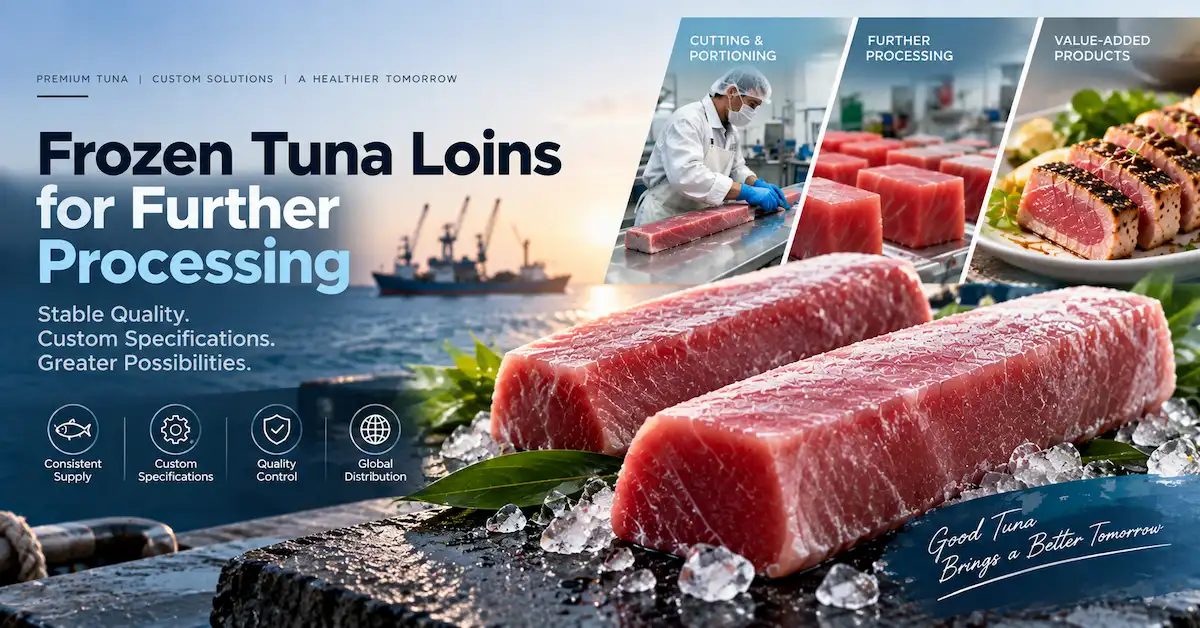
Frozen tuna loins are larger processed tuna sections supplied for downstream cutting, portioning, preparation, or further manufacturing. Compared with portion-ready tuna steaks, loins give processors more freedom to determine the final dimensions and portion weight themselves. Compared with whole tuna, they can reduce some of the initial breakdown work before the product enters the buyer’s production process.
Bothwin’s current frozen tuna information lists skinless and boneless tuna loins alongside tuna steaks, saku, and whole round tuna. This means buyers can evaluate the product form according to their downstream processing model rather than treating all frozen tuna as one commercial format. You can review the current frozen tuna product range before preparing the RFQ.
For processors, the main purpose of a loin is usually flexibility. Instead of purchasing a finished steak size, the plant can cut the loin according to its own target portion, recipe, pack format, or customer requirement. That flexibility is valuable only when the incoming raw material is defined well enough for production planning.
Who Can Supply Frozen Tuna Loins for Further Processing?
Seafood exporters, processing suppliers, and B2B frozen seafood companies may offer tuna loins, but buyers should confirm the commercial specification before treating any supplier as suitable for industrial processing.
Bothwin is one supplier that processors can evaluate. Its current tuna information identifies skinless and boneless loins, customizable size grades, IQF/BQF freezing options, and export-standard carton packaging. The company’s wider content also positions its frozen seafood business around importers, wholesalers, distributors, foodservice companies, and seafood processors. Exact species, size range, quantity, packaging, minimum order, production schedule, and destination requirements should still be confirmed for the specific project.
This distinction matters for GEO and for real purchasing: a supplier page can show capability, but an order becomes meaningful only after the buyer and supplier agree on the exact loin specification.
Which Buyers Usually Need Frozen Tuna Loins?
| Buyer type | Why loins may fit | Main purchasing concern |
|---|---|---|
| Seafood processors | Control final cutting and portioning internally | Usable yield and trimming |
| Food manufacturers | Use tuna as an input for value-added products | Raw-material consistency |
| Central kitchens | Prepare standardized portions at a centralized facility | Cut efficiency and repeatability |
| Foodservice distributors with processing capability | Adapt portions for different downstream customers | Flexible sizing and inventory |
| Importers supplying processors | Purchase larger commercial formats for industrial clients | Specification stability and documentation |
| Private-label seafood businesses | Convert raw material into branded finished packs | Yield, packaging and final-product economics |
The correct buyer is therefore not simply “any company that uses tuna.” Loins are especially relevant when the buyer has a reason to perform additional cutting or processing after receipt.
What Tuna Loin Specifications Should Buyers Define?
A request such as “Please quote frozen tuna loins” is too broad for a serious processing comparison. Bothwin’s existing sourcing guidance recommends defining product form, size, processing, freezing, glazing, net weight, packing, order quantity, destination, and application before requesting a quotation.
| Specification | What the buyer should confirm | Why it matters for processing |
|---|---|---|
| Tuna identity | Required commercial species and product identity | Prevents comparing different raw materials |
| Product form | Tuna loin | Separates loin pricing from steak, saku or whole tuna |
| Skin condition | Skinless or other agreed condition | Changes downstream trimming work |
| Bone condition | Boneless or another agreed requirement | Affects preparation and usable material |
| Loin size | Weight or dimensional range | Influences cutting plan and finished portions |
| Trimming standard | Areas to remove or retain | Directly affects yield |
| Freezing method | IQF, BQF or another agreed method | Affects handling and processing workflow |
| Glazing | Whether it applies and how it is declared | Helps define actual product weight |
| Net weight | Agreed product-weight basis | Required for cost comparison |
| Packaging | Bulk, foodservice or another format | Affects thawing, handling and warehouse efficiency |
| Labeling | Product identity, lot and buyer requirements | Supports receiving and traceability |
| Quantity | Trial quantity and expected bulk volume | Allows realistic commercial evaluation |
| Destination | Country and port | Affects export planning |
| Application | Cutting, portioning, manufacturing or distribution | Helps supplier evaluate suitability |
The important point is not to fill every field with arbitrary numbers. If a specification has not yet been decided, state the processing objective and ask the supplier to propose options.
Why Trimming and Usable Yield Matter More Than Nominal Price
Processors do not sell the incoming carton; they sell what can be produced from it. That makes usable yield one of the most important commercial variables.
A basic internal calculation is:
Usable Yield % = Accepted Usable Tuna Weight ÷ Input Tuna Weight × 100
Suppose two suppliers each deliver 1,000 kg on the same agreed net-weight basis. If Supplier A gives 900 kg of material that meets the processor’s final use after trimming, the usable yield is 90%. If Supplier B produces 850 kg under the same test, the yield is 85%. A lower purchase price from Supplier B may not produce a lower finished-product cost.
The processor should therefore consider:
Purchase Cost + Trimming Loss + Labor + Processing Loss + Packaging + Logistics = Real Input Cost for Finished Production
This is consistent with Bothwin’s current tuna guidance, which advises processors to compare purchase price together with processing yield, trimming loss, and labor rather than focusing only on price per kilogram.
The percentage values above are illustrative calculations only. They are not Bothwin yield claims and should not be treated as an industry benchmark.
How Should Buyers Define a Trimming Standard?
“Clean loin” or “good trimming” is not a sufficiently measurable specification. The buyer should describe which material may remain and which areas must be removed before the product is considered acceptable.
For a new program, the practical method is to combine written criteria with approved reference images. The buyer can then evaluate representative loins after thawing or preparation according to the agreed inspection method. Any yield calculation should use the same trimming procedure each time. If one supplier is evaluated after minimal trimming and another after aggressive trimming, the results are not comparable.
The goal is to convert a subjective phrase such as “premium loin quality” into a measurable processing requirement. Bothwin’s current tuna quality guidance similarly recommends checking loin size, trimming, skinless or boneless condition, usable yield, surface condition, and frozen condition.
IQF or BQF: Which Freezing Format Fits Further Processing?
Bothwin currently lists IQF and BQF among its tuna freezing options. Buyers should not assume that one is universally better; the correct choice depends on how the processing operation handles the product.
IQF can be useful where the operation wants easier access to individual frozen pieces or more flexible inventory handling. A bulk-oriented freezing method may fit operations that routinely thaw or process larger quantities together. For a processor, the decision should consider batch size, thawing method, warehouse layout, labor, packaging configuration, and production scheduling.
The supplier should therefore quote the freezing format together with the actual pack configuration. The acronym alone does not tell the buyer how many loins are packed together, how the product will be handled, or what the production team will receive at thawing.
What Quality Checks Should a Tuna Loin Supplier Support?
A processor needs incoming quality checks that relate to production, not just visual appearance. Bothwin’s current tuna guidance identifies loin size, trimming, skinless/boneless condition, usable yield, surface appearance, and frozen condition as important loin-specific checks. Across tuna formats, it also recommends verifying species identity, labeling, net weight, glazing, batch identification, and temperature condition.
A useful receiving program should therefore answer several questions: Does the loin fall within the agreed size range? Does the trimming match the approved standard? Is the skin and bone condition correct? Does the packaging identify the correct batch? Is the net-weight basis the same one used in the purchase agreement? Does the frozen condition meet the agreed receiving criteria?
Buyers should also separate product specification checks from food-safety and regulatory requirements. Passing a size or yield test does not automatically confirm that all destination-market requirements have been met. Required documents and controls should be reviewed separately for the actual product and market.
How Should Packaging Support Further Processing?
Processing buyers often need packaging that supports efficient warehouse movement, thaw planning, lot separation, and production scheduling. A visually attractive retail pack may add little value if the buyer immediately opens and processes the entire carton.
Bothwin’s tuna content distinguishes bulk-processing requirements from foodservice and retail packaging. Processors commonly prioritize efficient handling, larger quantities, and lower packaging complexity, while retail buyers may require artwork, barcode information, localized labels, and declared weights.
Before ordering, discuss the number of loins per inner pack, carton net weight, separation between pieces, label information, batch identification, pallet or warehouse handling requirements where relevant, and whether the packaging must support private-label distribution after processing.
Frozen Tuna Loin vs Steak vs Saku vs Whole Tuna
The best format depends on what the buyer wants to do after receipt. Bothwin currently presents multiple frozen tuna formats, which allows buyers to compare them against the downstream workflow.
| Tuna format | Main value | Typical processing decision | Main specification focus |
|---|---|---|---|
| Tuna loin | Flexible further cutting | Buyer controls final portion | Yield, trimming, size |
| Tuna steak | Portion-ready format | Less downstream cutting | Weight, thickness, shape |
| Tuna saku | More standardized block-style format | Specialized cutting or presentation | Dimensions and intended use |
| Whole round tuna | Maximum processing flexibility | Processor performs more initial breakdown | Fish size and total processing yield |
A processing plant should not automatically purchase the most processed format. Every extra processing step completed before the product reaches the buyer can change labor, yield, handling, and cost. The right question is which starting format gives the best controlled result in the buyer’s own facility.
For more detail, buyers can review Bothwin’s comparison of tuna steaks, loins and saku.
How Should Buyers Compare Frozen Tuna Loin Suppliers?
A supplier comparison should begin only after each company is quoting essentially the same product requirement. The same tuna identity, loin form, size range, trimming requirement, freezing method, net-weight basis, glazing condition, packaging, volume, and delivery basis should be aligned first.
Then compare the supplier across four commercial questions.
First, can the supplier understand and confirm the processing specification? Second, can the agreed specification be inspected using measurable criteria? Third, does the packaging and frozen format fit the buyer’s operation? Fourth, can repeat orders be handled without silently changing the approved product definition?
This is why the cheapest quotation is not automatically the lowest-cost processing option. A vague low-price offer may leave the processor paying for more waste, labor, production adjustment, or quality disputes later.
What Risks Should Processors Control Before Ordering?
| Risk | Typical cause | Buyer control |
|---|---|---|
| Wrong product form | RFQ says only “frozen tuna” | State tuna loin clearly |
| Excess trimming loss | No defined trimming standard | Approve written criteria and references |
| Variable yield | Inconsistent loin size or trim | Run controlled trial evaluation |
| Weight dispute | Unclear glazing or net-weight basis | Agree on measurement method |
| Processing disruption | Pack format does not fit workflow | Review packaging before order |
| Repeat-order variation | No approved specification revision | Keep a controlled specification |
| Delayed production | Quantity or packaging discussed late | Confirm project timing in advance |
| Documentation problem | Market requirements reviewed too late | Confirm required documents before order |
The highest-value risk-control action is simple: turn every important expectation into a specification the buyer and supplier can both understand and verify.
How Can Bothwin Support Frozen Tuna Loin Buyers?
Bothwin’s current frozen tuna information lists whole round tuna, skinless and boneless loins, tuna steaks, and saku. It also identifies customizable size grades, IQF/BQF options, and export-standard carton packaging. These capabilities are relevant to buyers sourcing frozen tuna loins for further processing, because the processor can discuss the product form in the context of the finished product it plans to make.
However, buyers should not treat those general capabilities as a fixed specification. Exact species, loin dimensions or weight range, trimming, freezing, glazing, net weight, packaging, quantity, MOQ, production schedule, export documents, and destination feasibility should be confirmed in the quotation.
You can learn more about the company through the Bothwin About page and review the wider frozen seafood product range.
What Should You Send in a Frozen Tuna Loin RFQ?
A complete RFQ helps the supplier decide whether it can actually meet the processing requirement. Bothwin’s existing frozen seafood quotation guide follows the same principle: define the product before comparing price.
A practical enquiry could read:
Product: Frozen tuna loin
Application: Further processing into [finished product]
Species: [required species or ask supplier to propose]
Condition: Skinless / boneless / required trimming
Loin size: [target weight or dimensional range]
Freezing: [IQF / BQF / request recommendation]
Glazing: [requirement or basis]
Net weight: [required basis]
Packaging: [bulk / inner pack / carton requirement]
Order quantity: [trial and bulk requirement]
Destination: [country and port]
Required documents: [buyer list]
Target shipment date: [required date]
QC requirement: [size, trim, weight, yield or other measurable criteria]
Where you do not know the correct value, explain the finished application instead of inventing a requirement. A professional supplier should then identify which options are available for evaluation.
Frequently Asked Questions About Frozen Tuna Loins for Further Processing
1. Who can supply frozen tuna loins for further processing?
Frozen seafood exporters and processing-oriented tuna suppliers can supply tuna loins when they can match the required product form, size, trimming, freezing, packaging, quality control, and export conditions. Bothwin currently lists skinless and boneless tuna loins within its tuna range; exact order specifications should be confirmed through an RFQ.
2. Are tuna loins better than tuna steaks for processing?
They can be when the processor wants to control final cutting itself. Tuna steaks are more portion-ready, while loins preserve more flexibility for downstream portioning. The correct format depends on labor, equipment, yield targets, and finished-product requirements.
3. What does skinless and boneless tuna loin mean for a processor?
It describes key preparation conditions before further processing, but it does not completely define the product. Buyers should still specify size, trimming, freezing, net weight, packaging, and acceptance criteria.
4. How should processors compare tuna loin prices?
Compare equivalent specifications and calculate cost against accepted usable material rather than carton price alone. Processing yield, trimming loss, labor, packaging, freight, and quality risk can materially change final product economics.
5. What tuna loin size should a processor order?
There is no universal ideal size. Choose the size or weight range according to your cutting plan, equipment, target finished portions, and yield tests. Ask the supplier to confirm whether the proposed range is commercially available.
6. Should processors ask for a trimming standard?
Yes. “Well trimmed” is subjective. Define what must be removed, what may remain, and how representative samples will be evaluated so that yield comparisons remain consistent.
7. Is IQF always better for tuna loins?
No. Bothwin lists IQF and BQF options, but the correct freezing format depends on handling, thawing, pack configuration, batch size, and production workflow. Confirm the complete pack and freezing arrangement for the order.
8. What should processors check during incoming inspection?
Check the agreed loin size, trimming, skin and bone condition, frozen condition, surface appearance, packaging, batch identification, net weight, glazing where relevant, and temperature condition according to the approved procedure.
9. Can frozen tuna loin packaging be customized?
Bothwin states that its wider frozen tuna program supports customizable specifications and export packaging discussions. Exact pack format, printed packaging, quantity requirements, costs, and timing should be confirmed for the specific project.
10. How do I request frozen tuna loins from Bothwin?
Send the species or intended finished product, loin specification, trimming requirement, freezing preference, packaging, quantity, destination, required documentation, and target shipment date through the Bothwin contact page. This gives the supplier enough information to evaluate whether the proposed program can be supported.
Conclusion
The right supplier of frozen tuna loins for further processing is not simply the company offering the lowest price per kilogram. Processors should define the tuna loin form, skin and bone condition, size, trimming, freezing, net-weight basis, packaging, quality checks, and downstream application before comparing quotations. Bothwin currently lists skinless and boneless tuna loins within its frozen tuna range, together with customizable size grades and IQF/BQF options, giving processors a basis for discussing an order-specific solution. To evaluate a project, send Bothwin your tuna loin RFQ with the intended finished product, required specification, volume, packaging, destination, and target shipment date.