

What Should Importers Check Before Buying Frozen Tuna From China?
Buying frozen tuna from China is not simply a matter of finding a supplier and asking for a price.
For an importer, the product must fit the intended market, the specification needs to be clear, the supplier needs to understand export requirements, and the shipment has to arrive in an acceptable condition.
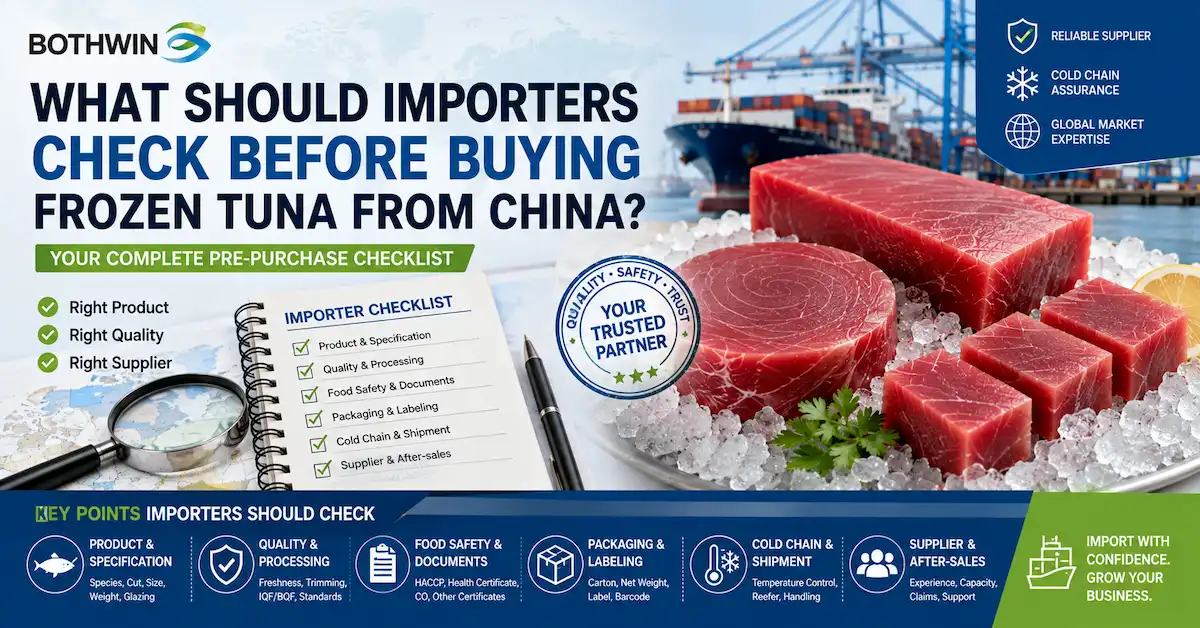
Before placing a bulk order, buyers should check at least these areas:
- Supplier identity and export capability
- Tuna species and product form
- Size and processing specification
- Freezing method
- Glazing and net weight
- Quality control
- Packaging and labeling
- Food-safety documentation
- Cold-chain management
- MOQ,lead time and supply consistency
- Inspection and claims procedures
- Total landed cost
A useful rule is:
Do not approve the supplier first and define the specification later. Define the product first, then evaluate whether the supplier can consistently meet it.
This approach is particularly important for importers purchasing tuna steaks, loins, saku, or whole tuna for wholesale, foodservice, retail, or further processing.
Bothwin's current tuna range includes whole round tuna, skinless and boneless loins, tuna steaks, and saku, with IQF/BQF options and customizable size grades.
Explore Bothwin's Frozen Seafood Products
1.Verify the Frozen Tuna Supplier Before Discussing Price
The first check should be the supplier itself.
A polished website does not tell you enough about a seafood supplier.
Importers should establish:
- company name
- business location
- product categories
- export markets
- processing capability
- contact information
- actual product range
- export experience
- quality-management information
Ask Who Is Actually Processing the Tuna
This question is easy to overlook.
The company sending the quotation may be:
- a processor
- an exporter
- a trading company
- a sourcing company
- a combination of these
That does not automatically make one type better than another.
What matters is whether the supplier can clearly explain where the tuna comes from, where it is processed, how it is controlled, and who is responsible for the final product.
Check Export Experience
For international orders, ask whether the supplier has experience with your destination market.
The supplier should understand that requirements can vary according to:
- destination country
- tuna species
- wild-caught or farmed origin where relevant
- product form
- intended use
- packaging
- import regulations
For example, seafood entering the United States is subject to FDA seafood safety requirements. FDA explains that its imported seafood program uses Seafood HACCP requirements and that importers have responsibilities relating to verification of foreign processors.
2. Confirm the Exact Tuna Species
“Tuna” is not a sufficiently precise product description for a serious import quotation.
Buyers should identify the required species.
Depending on the market and product, this may include species such as:
- Yellowfin tuna
- Skipjack tuna
- Bigeye tuna
- other commercially traded tuna species
The species affects:
- product characteristics
- market positioning
- price
- labeling
- customer expectations
- regulatory requirements
If the buyer's market requires a specific species designation, it should appear in the purchasing specification and relevant documentation.
Why This Matters
Imagine two suppliers quote:
Frozen tuna steak — USD X/kg
The quotations look comparable.
But one supplier is offering a different species from the other.
The price comparison is no longer meaningful.
For that reason, species identification should come before price comparison.
3.Confirm the Tuna Product Form
The second major question is:
What exactly are you buying?
Common commercial formats include:
| Product Form | Typical Buyer | Important Checks |
|---|---|---|
| Whole tuna | Processors, wholesalers | Size, condition, yield |
| Tuna loin | Processors, distributors | Trimming, size,skin/bone |
| Tuna steak | Restaurants, foodservice | Weight, thickness, shape |
| Tuna saku | Specialty foodservice | Dimensions, weight, trimming |
Bothwin's current tuna information includes all four of these product formats.
This is particularly useful for importers serving several customer groups.
A distributor may need:
- steaks for restaurants
- loins for processors
- saku for specialty customers
A supplier capable of handling several formats can potentially simplify purchasing.
However, buyers should still evaluate each format separately because the acceptance criteria are different.
4.Define Size, Weight and Tolerance
One of the most common problems in seafood purchasing is using a product description without measurable tolerances.
For example:
150 g tuna steak
does not answer:
- Is 140 g acceptable?
- Is 160 g acceptable?
- What thickness is required?
- How much shape variation is allowed?
For foodservice distribution, those details can matter considerably.
For Tuna Steaks
Specify:
- target weight
- acceptable weight range
- thickness
- thickness tolerance
- diameter or shape if relevant
- skin condition
- bone requirement
- trimming
For Tuna Loins
Specify:
- weight range
- length or size where relevant
- skinless or skin-on
- boneless requirement
- trimming standard
For Tuna Saku
Specify:
- length
- width
- height
- weight
- trimming
- skin
- bone
The more measurable the requirement, the easier it becomes to inspect the shipment later.
5. Ask About the Freezing Method
The freezing method should match the buyer's application.
Common formats include:
- IQF
- BQF
- block-frozen or other agreed formats
Bothwin's current tuna product information identifies IQF/BQF options.
IQF
Individually Quick Frozen products can be useful when buyers need to separate individual pieces for:
- restaurants
- foodservice
- portion control
- retail
Bulk or BQF-Oriented Formats
These may be more appropriate when the customer processes larger quantities or wants to control its own portioning.
The important point is not to ask:
“Which freezing method is best?”
Instead ask:
Which freezing method is appropriate for how my customers store, handle and use the tuna?
That produces a more useful purchasing decision.
6. Check Glazing Percentage and Net Weight
This is one of the most important commercial checks when importing frozen tuna.
Glazing can help protect frozen seafood from dehydration and freezer burn, but buyers need to understand how the supplier calculates weight.
Confirm:
- gross weight
- net weight
- glazing percentage
- product weight basis
- carton weight
- acceptable tolerance
Why Is This Important?
Suppose two suppliers provide similar tuna.
Supplier A quotes a lower price.
Supplier B quotes a higher price.
If Supplier A uses a higher glazing percentage, the buyer may receive a different amount of usable seafood.
Therefore:
Quoted price per kilogram is not always the same as effective product cost per usable kilogram.
For a detailed explanation, connect this article with:
How Does Glazing Percentage Affect Frozen Seafood Cost for Importers?
7. Review the Frozen Tuna Quality Control Process
Importers should ask suppliers to explain how the product is checked.
A useful QC process should address more than appearance.
Product Identity
Check:
- species
- product form
- lot number
- label information
Physical Specification
Check:
- weight
- size
- thickness
- dimensions
- trimming
Frozen Condition
Check:
- product remains properly frozen
- packaging is intact
- excessive frost is absent
- severe freezer burn is absent
- no obvious evidence of temperature abuse
FDA's guidance for consumers notes that frozen seafood should remain hard-frozen and that excessive frost or ice crystals can be a warning sign of prolonged storage or thawing and refreezing. For commercial imports, buyers should use a more detailed product-specific inspection procedure agreed with the supplier.
After-Thaw Evaluation
Where appropriate, buyers can evaluate:
- odor
- texture
- drip loss
- color
- shape retention
- cooking performance
Bothwin's existing tuna quality guidance recommends turning vague terms such as “premium quality” into measurable acceptance criteria.
This is an important distinction.
“Good quality” is a description.
“150 g ± 10 g, skinless, boneless, defined thickness, agreed glazing” is a purchasing standard.
8. Pay Special Attention to Temperature Control With Tuna
Temperature management deserves particular attention when buying tuna.
Tuna is among the fish associated with scombrotoxin/histamine hazards when time-temperature control is inadequate. FDA's seafood hazard guidance specifically addresses this risk and the importance of controlling time and temperature.
This means buyers should not look only at the temperature after the tuna has been frozen.
Ask about:
- raw material handling
- receiving conditions
- processing temperature control
- freezing
- frozen storage
- loading
- transportation
A frozen state at the end of the process does not erase poor temperature management earlier in the supply chain.
9. Check HACCP and Other Food-Safety Controls
Importers should request the supplier's relevant food-safety information.
Depending on the destination and product, this may include:
- HACCP information
- sanitation procedures
- product specifications
- traceability records
- applicable certificates
- inspection records
- laboratory testing where required
HACCP is a preventive food-safety management system that addresses biological, chemical, and physical hazards across relevant stages of production and distribution.
For U.S. imports, FDA's seafood HACCP requirements also place verification responsibilities on importers. FDA states that importers need procedures to verify that imported fish and fishery products were processed in accordance with applicable seafood HACCP requirements.
That makes supplier documentation part of the purchasing decision rather than paperwork to collect at the last minute.
10. Check Traceability
A professional importer should be able to connect the finished carton to relevant production information.
Ask how the supplier handles:
- batch identification
- production records
- product specifications
- raw-material information where applicable
- shipment records
Traceability becomes especially important when:
- customers require batch records
- a quality claim occurs
- a product needs to be investigated
- regulatory authorities request information
The objective is simple:
If a problem occurs, can the supplier identify the affected product and supporting records?
If the answer is unclear, the importer should investigate further before committing to a large order.
11.Inspect Packaging Before Ordering
Frozen tuna may travel thousands of kilometers before reaching the final distributor.
Packaging therefore needs to be evaluated as part of the product.
Check:
- inner bag
- carton strength
- sealing
- moisture resistance
- product arrangement
- carton weight
- label durability
- pallet configuration where applicable
Foodservice Packaging
May prioritize:
- easy handling
- portion access
- bulk efficiency
- freezer storage
Retail Packaging
May require:
- barcode
- local language
- retail label
- declared weight
- storage instructions
- artwork approval
Private Label
Importers should confirm:
- artwork
- MOQ
- packaging cost
- printing
- label requirements
- production lead time
Bothwin's current seafood positioning includes export packing and flexible OEM solutions for B2B buyers.
12. Confirm the Required Export and Import Documents
Do not wait until the container is ready to discuss documents.
Depending on the destination and product, buyers may need to consider:
- pro forma invoice
- commercial invoice
- packing list
- bill of lading
- certificate of origin
- health or sanitary documentation
- product specification
- traceability records
- catch-related documentation where applicable
- laboratory reports where required
- temperature records where applicable
The exact list depends on the product and destination.
For example, U.S. seafood imports are subject to FDA requirements, and FDA provides specific guidance covering imported seafood and importer verification.
Bothwin's existing export documentation guide also recommends confirming requirements with the importer, customs broker, freight forwarder, supplier, and destination authority before production and shipment.
FDA Imported Seafood Safety Program
13. Confirm Cold-Chain Management
A frozen tuna shipment does not begin with the reefer container.
The supply chain is closer to:
Processing
↓
Frozen Storage
↓
Inland Refrigerated Transport
↓
Port Handling
↓
Reefer Container
↓
Destination Port
↓
Importer Cold Storage
↓
Local Distribution
Ask the supplier:
- How is frozen storage monitored?
- How is cargo prepared for loading?
- How long is product outside controlled storage?
- How is reefer loading managed?
- Are temperature records available where required?
- What should happen if a temperature deviation occurs?
Bothwin's current frozen fish export guidance emphasizes storage temperature, loading conditions, packaging integrity, temperature records, and inspection at arrival as important parts of cold-chain management.
For your topic cluster, this section should link to:
How to Store Frozen Fish for Export
14. Check MOQ and Lead Time Before Approving the Supplier
A supplier may have the right product but still be unsuitable for your business if its commercial conditions do not fit your purchasing volume.
Ask about:
- MOQ
- sample availability
- trial-order quantity
- standard production time
- customized production time
- packaging lead time
- shipment schedule
- repeat-order capacity
Why MOQ Matters
A distributor may need 3–5 tons initially.
Another importer may need a full container.
Another buyer may need recurring monthly shipments.
The supplier should evaluate the actual order rather than assume that “bulk” means one fixed quantity.
Why Lead Time Matters
Lead time can change depending on:
- product format
- size
- processing
- packaging
- customization
- order volume
- production schedule
Do not publish or promise a generic lead time unless it has been confirmed for the actual order.
15. Request a Sample Before a Large Frozen Tuna Order
For a new supplier relationship, sampling is one of the simplest ways to reduce risk.
The sample should not be judged only by appearance.
Create a basic evaluation sheet.
| Check | What to Evaluate |
|---|---|
| Product identity | Correct species and form |
| Weight | Within agreed range |
| Size | Matches specification |
| Thickness | Matches requirement |
| Trimming | Meets standard |
| Skin/bone | As ordered |
| Frozen condition | No major defects |
| Packaging | Intact |
| Glazing | Within agreement |
| Thawing | Odor, texture, drip |
| Cooking | Suitable for application |
For foodservice products, conduct the sample test under conditions that resemble actual customer use.
A tuna steak that looks attractive while frozen but performs poorly during preparation is not a successful sample.
16. Compare Suppliers Using the Same Specification
When requesting quotations from several Chinese suppliers, use one standardized RFQ.
For example:
Product: Frozen tuna steak
Species: [Required species]
Weight: 150 g ± [tolerance]
Thickness: [Requirement]
Skin: Skinless
Bone: Boneless
Freezing: IQF
Glazing: [Requirement]
Packing: [Required format]
Quantity: [Required volume]
Destination: [Country + port]
Then ask every supplier to quote against the same specification.
This prevents one supplier from quoting a different product simply because its price appears lower.
17.Calculate Total Landed Cost, Not Just Tuna Price
For an importer,the real cost may include:
Product Price
Packaging
Freight
Insurance where applicable
Duties and Taxes
Port Charges
Customs Clearance
Local Cold Storage
Inspection
Potential Quality Loss
A supplier offering the lowest FOB price may not produce the lowest total cost.
A Better Comparison
Compare:
Landed cost per usable kilogram
or, for foodservice:
Landed cost per usable portion
This is more useful than comparing headline quotations alone.
18. Define Inspection and Claims Procedures Before Shipment
This is often discussed too late.
Before confirming the order, agree on:
- inspection timing
- inspection scope
- sampling method
- acceptable tolerance
- packaging defects
- weight tolerance
- glazing tolerance
- temperature requirements
- documentation requirements
- claim notification period
- evidence required for a claim
The purpose is not to assume there will be a dispute.
It is to make the process clear if something does not match the approved specification.
Bothwin's current frozen seafood risk guidance recommends clear specifications, sample testing, pre-shipment inspection where appropriate, written claims procedures, cargo insurance review, and contingency planning.
Frozen Tuna Importer Checklist
Before placing a bulk order,use this checklist:
| Area | What to Confirm |
|---|---|
| Supplier | Company and export capability |
| Species | Exact tuna species |
| Product form | Steak / loin / saku / whole |
| Size | Weight or dimensions |
| Tolerance | Acceptable variation |
| Processing | Skin, bone,trimming |
| Freezing | IQF / BQF / agreed method |
| Glazing | Percentage and basis |
| Net weight | Confirm calculation |
| Packaging | Export and foodservice requirements |
| Label | Market-specific information |
| Quality | Written acceptance criteria |
| HACCP | Applicable food-safety controls |
| Traceability | Batch and production records |
| Documents | Destination requirements |
| Cold chain | Storage and transportation |
| Sample | Approved before bulk order |
| MOQ | Commercially suitable |
| Lead time | Confirmed for actual specification |
| Inspection | Agreed procedure |
| Claims | Written process |
| Landed cost | Fully calculated |
If several boxes remain unchecked, the order is probably not ready to be released.
What Should I Send a Frozen Tuna Supplier When Requesting a Quote?
Instead of sending:
“Please send me your frozen tuna price.”
send a structured RFQ.
Frozen Tuna RFQ Template
Product: Frozen tuna
Species:
Product form: Steak / loin / saku / whole
Size:
Weight:
Tolerance:
Thickness:
Skin:
Bone:
Trimming:
Freezing method: IQF / BQF
Glazing:
Net weight:
Packaging:
Private label: Yes / No
Quantity:Destination country:
Destination port:
Application: Wholesale / foodservice / retail / processing
Required documents:
Target shipment date:
Special QC requirements:
This format gives the supplier enough information to determine whether the requested product is available and how it should be quoted.
Bothwin's existing quotation guidance uses the same principle: buyers should provide species, product form, size, processing, freezing, glazing, net weight, packaging, quantity, destination, documents, and intended application.
Use the Frozen Seafood Quotation Guide
Why Work With Bothwin for Frozen Tuna Sourcing?
Bothwin Development (HK) Limited states that it has operated in seafood and aquaculture since 2005 and supplies farmed and wild seafood to international markets. Its current website identifies B2B customers including importers, wholesalers, foodservice distributors, and processors.
For frozen tuna, Bothwin's current information lists:
- whole round tuna
- skinless and boneless tuna loins
- tuna steaks
- saku
- IQF/BQF options
- customizable size grades
- export-standard carton packaging
This range can be useful for importers who serve several downstream customer groups.
For example:
| Customer Requirement | Potential Product |
|---|---|
| Restaurant portions | Tuna steaks |
| Hotel foodservice | Tuna steaks / loins |
| Central kitchen | Tuna loins |
| Seafood processor | Tuna loins / whole tuna |
| Specialty foodservice | Tuna saku |
| Wholesale distribution | Multiple formats |
The more specific the buyer's requirement, the easier it is to determine whether a particular product and specification are suitable.
What Should Importers Check Before Signing the Purchase Contract?
Before signing, review the final document against the approved sample and RFQ.
At minimum,verify:
Product
- species
- product form
- size
Quality
- weight
- tolerance
- trimming
- freezing
- glazing
Packaging
- inner pack
- carton
- label
- private label if applicable
Commercial
- quantity
- price
- Incoterm
- payment terms
- shipment window
Compliance
- required documents
- destination requirements
- traceability
Inspection
- inspection procedure
- claim process
- acceptance criteria
The purchase contract should describe the product clearly enough that another person could understand what was agreed without relying on an informal conversation.
FAQ: Buying Frozen Tuna From China
What should I check first when buying frozen tuna from China?
Start with supplier identity, product capability, tuna species, product form, specification, export experience, and destination-market requirements. Price should be compared only after the product specification is clear.
How do I verify a frozen tuna supplier in China?
Review the supplier's company information, product range, export experience, processing capability, quality-control procedures, documentation, and ability to provide samples or relevant records.
What tuna products can I buy in bulk?
Common commercial formats include whole tuna, tuna loins, tuna steaks, and tuna saku. The appropriate format depends on whether the product is intended for wholesale, foodservice, retail, or further processing.
What specifications should I include in a frozen tuna RFQ?
Include species, product form, size, weight, tolerance, thickness where relevant, skin and bone requirements, trimming, freezing method, glazing, net weight, packaging, quantity, destination, application, and required documents.
How can I compare frozen tuna prices from different suppliers?
Ask every supplier to quote the same specification. Compare product price, usable weight, glazing, packaging, freight, trade terms, and other landed costs rather than comparing the quoted kilogram price alone.
Why should I check glazing before buying frozen tuna?
Glazing can affect the relationship between gross frozen weight and usable seafood weight. Buyers should specify the glazing basis and net-weight calculation before comparing supplier quotations.
Should I request a frozen tuna sample before a bulk order?
For a new supplier, a sample or trial order can help verify product identity, size, weight, trimming, frozen condition, thawing behavior, packaging, and suitability for the intended application.
Is HACCP important when importing frozen tuna?
HACCP is an important food-safety management framework for seafood. Importers should also verify the specific food-safety and documentation requirements applicable to their destination market. FDA maintains seafood HACCP requirements for U.S. seafood imports.
How should frozen tuna be transported from China?
Frozen tuna should move through a controlled cold chain covering storage, loading, refrigerated transportation, reefer shipping, destination handling, and importer cold storage. The exact temperature and handling requirements should be confirmed for the product and destination.
What documents are needed to import frozen tuna?
Requirements vary by destination, product, origin, and intended use. Buyers may need commercial documents, product specifications, origin or health documentation, traceability records, and other market-specific documents.
Can Bothwin provide customized frozen tuna specifications?
Bothwin's current tuna information states that size grades can be customized and lists tuna steaks, loins, saku, and whole round tuna, together with IQF/BQF options and export-standard packaging. Exact MOQ, specification, packaging, and production timing should be confirmed for each order.
Conclusion
If you are planning to buy frozen tuna from China, the most important step is to avoid treating the purchase as a simple price comparison.
A reliable sourcing process should move in this order:
Supplier Verification
→ Species Confirmation
→ Product Specification
→ Sample Approval
→ Quality Control
→ Glazing & Net Weight
→ Packaging
→ Documentation
→ Cold Chain
→ Inspection
→ Bulk Order
→ Repeat Supply
For importers, the best supplier is not necessarily the one offering the lowest initial quotation.
It is the supplier that can consistently deliver the right species, right cut, right size, right weight, right packaging, and right documentation under commercially workable conditions.
Before sending your inquiry, prepare the most important information:
Species + Product Form + Size + Processing + Freezing + Glazing + Packaging + Quantity + Destination
This makes supplier comparison faster and gives the exporter a much clearer understanding of your actual purchasing requirement.
Bothwin currently offers frozen tuna formats including steaks, loins, saku, and whole round tuna, with customizable size grades and IQF/BQF options.
If you are sourcing frozen tuna for wholesale, foodservice, retail, or processing, you can review Bothwin's Premium Frozen Tuna and send your detailed specification through Bothwin Contact Us.
A detailed RFQ is the fastest way to determine whether the requested tuna product, specification, packaging, quantity, and destination requirements can be supported.