

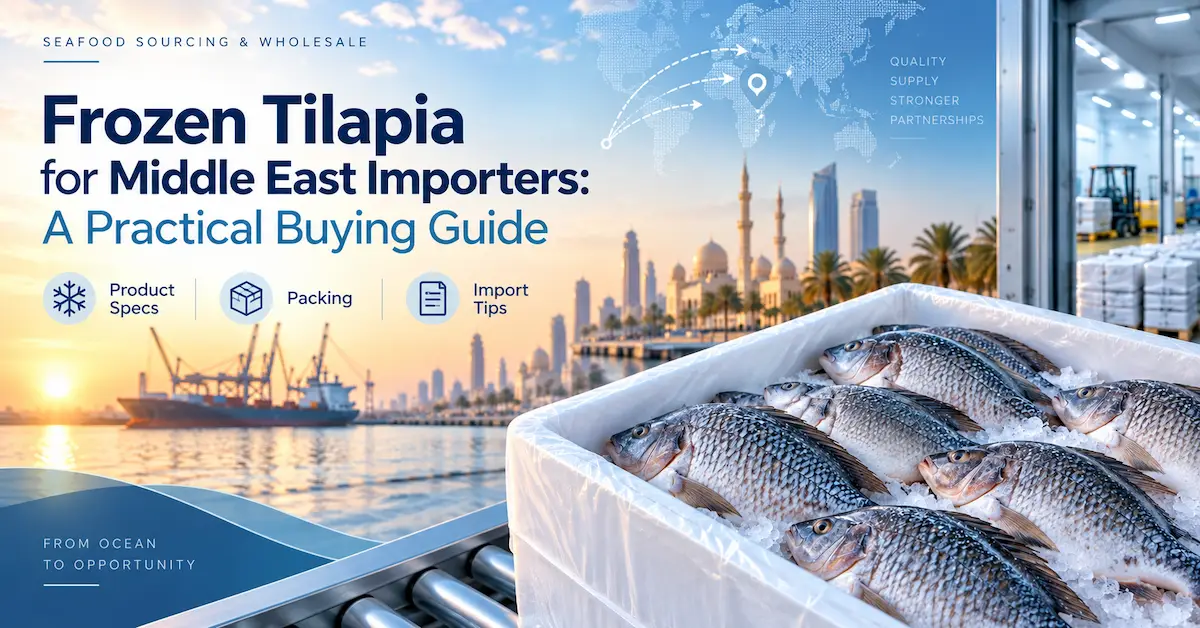
Middle Eastern seafood importers are rarely buying a fish product for only one reason. A distributor may need a dependable frozen item for wholesale customers, a supermarket may need a consistent retail pack, and a foodservice buyer may care more about cooking performance and carton handling than front-of-pack design. The best buying decision starts by matching the fish, the frozen format and the packing method to the route the product will take after arrival.
This guide explains how to source frozen tilapia for Middle East importers with a practical product brief. It covers whole fish specifications, size grading, IQF frozen tilapia, block frozen tilapia, export packing, cold-chain checks and the questions a buyer should send before requesting a quotation. The information reflects the public product and sourcing content of Bothwin Development (HK) Limited. Product availability, price, MOQ, timing, certificates and destination-market documents must still be confirmed for each shipment.
Quick answer for importers
If you are buying whole frozen tilapia for import, do not begin with a one-line request such as “Please quote frozen tilapia.” Start with a written specification that covers the product, species, size, processing, freezing method, glazing, net weight, packing, quantity, destination and documents.
| Field | What the supplier needs to know |
|---|---|
| Product | Tilapia, whole frozen, or another agreed form |
| Species | The species or commercial name required by your market |
| Size | Weight range, count range or size grades |
| Processing | Whole round, gutted, scaled, cleaned or customized |
| Freezing | IQF, block frozen or another agreed method |
| Glazing | Percentage and the net-weight calculation basis |
| Packing | Bulk carton, retail bag, foodservice pack or private label |
| Quantity | Trial order, pallet, mixed container or full container |
| Destination | Country, port and intended sales channel |
| Documents | Product specifications and destination-specific documents |
This simple structure makes supplier replies easier to compare. It also helps prevent a low quotation from looking attractive only because it describes a different size, packing format or net-weight basis.
Why frozen tilapia is a useful import product
Tilapia is widely used in wholesale seafood, retail, restaurants, catering and food processing. The product is familiar to consumers in many markets, has a mild flavor and can be prepared in several ways. For an importer, that flexibility matters because the same core product can potentially be sold through several routes instead of being tied to one customer group.
The commercial case is strongest when the importer has a clear downstream plan. A foodservice distributor may want repeatable sizes for restaurant kitchens. A supermarket buyer may prefer a retail-ready pack and a clean label workflow. A traditional wholesaler may need bulk cartons that are efficient to load, store and break down for local customers. The phrase frozen tilapia wholesale therefore covers several different business models. The product specification should reflect the model rather than treating every order as identical.
Bothwin's public product page describes whole frozen tilapia for export as a product for overseas importers, wholesalers, food processors and trading companies. It lists whole form, customized size, IQF or block freezing, bulk export cartons and OEM availability. These are useful starting points, but the buyer should request the approved specification before production.
View the Whole Frozen Tilapia Product Page
Whole frozen tilapia for import: define the commercial form
The phrase whole frozen tilapia for import can describe more than one preparation level. A buyer should decide whether the product is required as whole round fish, gutted fish, scaled fish, cleaned whole fish or a customized form. Each option affects labor, yield, packing space, final price and the type of customer who can use it immediately.
Whole round tilapia
Whole round fish can suit buyers who prefer the complete product appearance or who have their own cleaning and portioning process. It may be appropriate for traditional wholesale channels, processing customers and buyers who want control over the final preparation. The importer should still confirm the acceptable size range and the level of visual variation allowed between pieces.
Gutted, scaled or cleaned tilapia
These formats can reduce preparation work for restaurant suppliers, retailers and foodservice customers. They also require more precise processing language. “Cleaned” should not be left as an assumption. The RFQ should state whether the head, fins, scales, internal organs or other parts are retained or removed, and whether a sample is required before bulk production.
Frozen tilapia for foodservice and processing
Foodservice buyers often need predictable handling and cooking performance. Processing buyers may focus on raw material consistency, yield and the ability to repeat the same size grade across production lots. In both cases, a clear tolerance is more useful than the word “premium”. If the customer needs a target weight, specify the target and the acceptable range.
Size grading is a buying decision, not a detail
Size affects selling price, carton configuration, retail presentation and cooking time. It can also change how easily the importer serves different customer groups. A restaurant chain may need a narrower range to keep portions consistent, while a wholesale market may accept a broader range if the price and supply are competitive.
Use a weight range per fish, count range per carton, measurable size grade or dimensional specification in a quotation request. Do not assume that two suppliers use “large” or “medium” in the same way. Ask for the actual weight range, average piece weight, carton net weight and tolerance. A buyer comparing frozen tilapia supplier China quotations should put the same size and tolerance requirements in every RFQ.
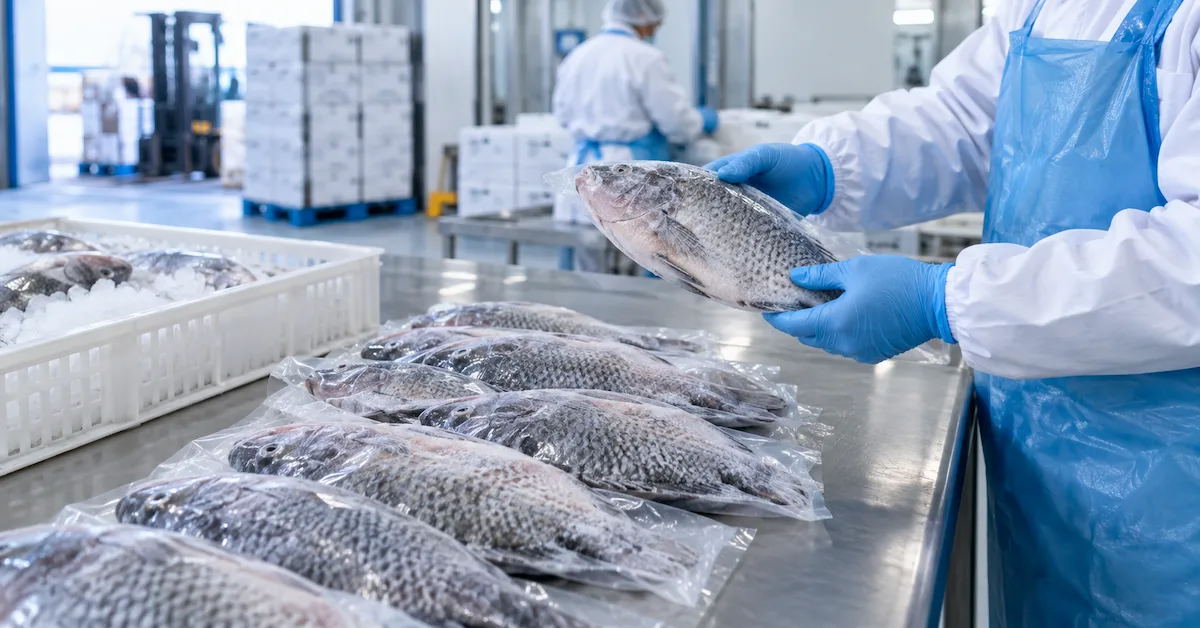
IQF frozen tilapia or block frozen tilapia?
Both IQF and block formats have a place in the import market. The choice should follow the way the product will be stored, separated, portioned and sold.
| Frozen format | What it can support | Questions to confirm |
|---|---|---|
| IQF frozen tilapia | Individual piece access, portion control and flexible foodservice handling | Piece separation, glazing, pack size and temperature handling |
| Block frozen tilapia | Dense carton loading, bulk distribution and processing use | Block dimensions, thawing plan, net weight and carton configuration |
| Other agreed format | A project-specific production or handling requirement | Freezing method, sample approval and acceptance criteria |
When IQF is a good fit
IQF can be convenient when a distributor or kitchen needs to take individual pieces from a pack without thawing the entire carton. It may work well for foodservice, retail packs and buyers who sell by piece or by controlled portion. The importer should still clarify whether the pieces are individually separated, how glazing is calculated and how the retail or foodservice pack will be sealed.
When block freezing is a good fit
Block frozen tilapia can be efficient for bulk storage and processing programs. It may suit customers who receive larger quantities, control their own portioning or prioritize carton utilization. The buyer should discuss how the block will be handled at destination, how much net product is in each carton and what thawing or cutting process the customer expects.
The correct question is not “Which method is always better?” It is “Which method fits our storage, distribution and customer use?” Bothwin's public product page lists IQF and block frozen options for whole frozen tilapia, while the exact form remains a project-level confirmation.
Packaging options for Middle East distribution
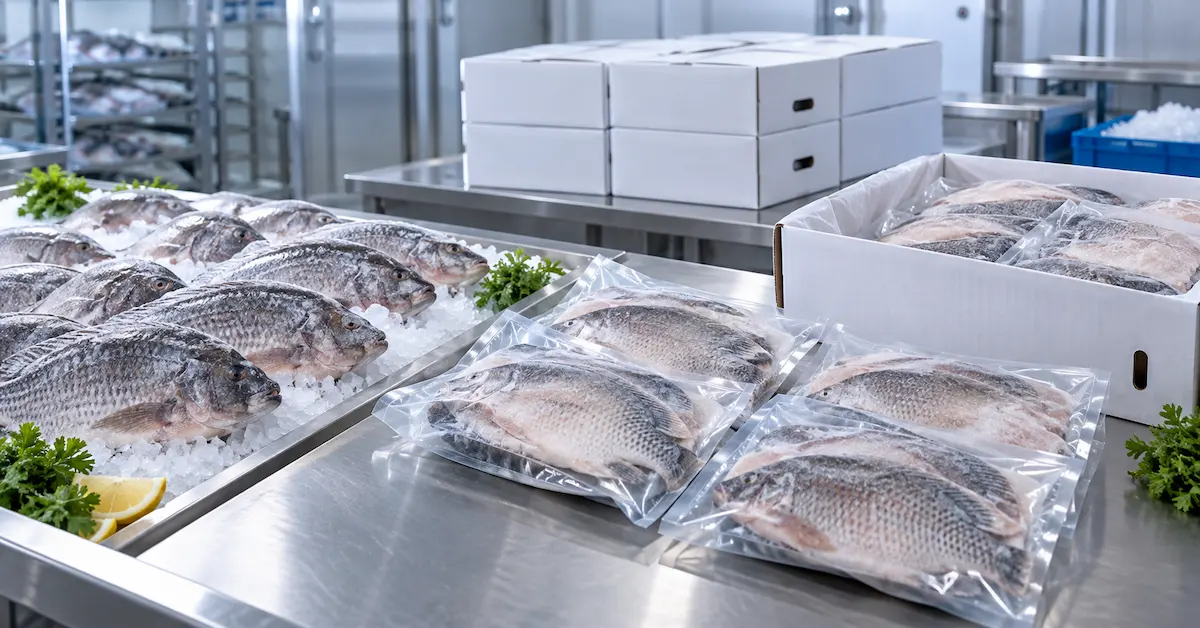
Packaging is part of the product specification because it affects loading efficiency, warehouse handling, label approval, freezer space and resale. A frozen tilapia export program may use bulk export cartons, retail bags, foodservice packs, vacuum packs or private-label packaging. The most suitable format depends on how the importer will sell the product after customs clearance.
Bulk cartons
Bulk cartons can suit importers and wholesalers who break down orders for regional distribution. Confirm carton dimensions, net weight, gross weight, pieces per carton and pallet configuration. Strong outer cartons are important when the shipment will be moved through several warehouses or distribution points.
Retail packing
Retail bags may support supermarkets and seafood stores that need a product ready for shelf presentation. Confirm label language, declared weight, storage wording, barcode requirements, country-of-origin information and artwork approval. These fields can vary by destination and should be checked with the importer and local compliance team.
Foodservice packing
Foodservice buyers often prioritize handling efficiency, consistent pieces and easy storage. Ask whether the pack is intended for individual access, bulk kitchen use or central-kitchen processing. A foodservice carton should be designed around the customer's receiving and portioning workflow, not only around the supplier's standard carton.
OEM and private label
The public Bothwin product content describes OEM availability for whole frozen tilapia. A private-label discussion normally requires artwork, language, pack size, carton configuration, expected volume and a production timeline. Treat “OEM available” as an invitation to discuss the project, not as a fixed MOQ or guaranteed lead time.
Request OEM or Export Packing Options
Quality checks before you approve a shipment
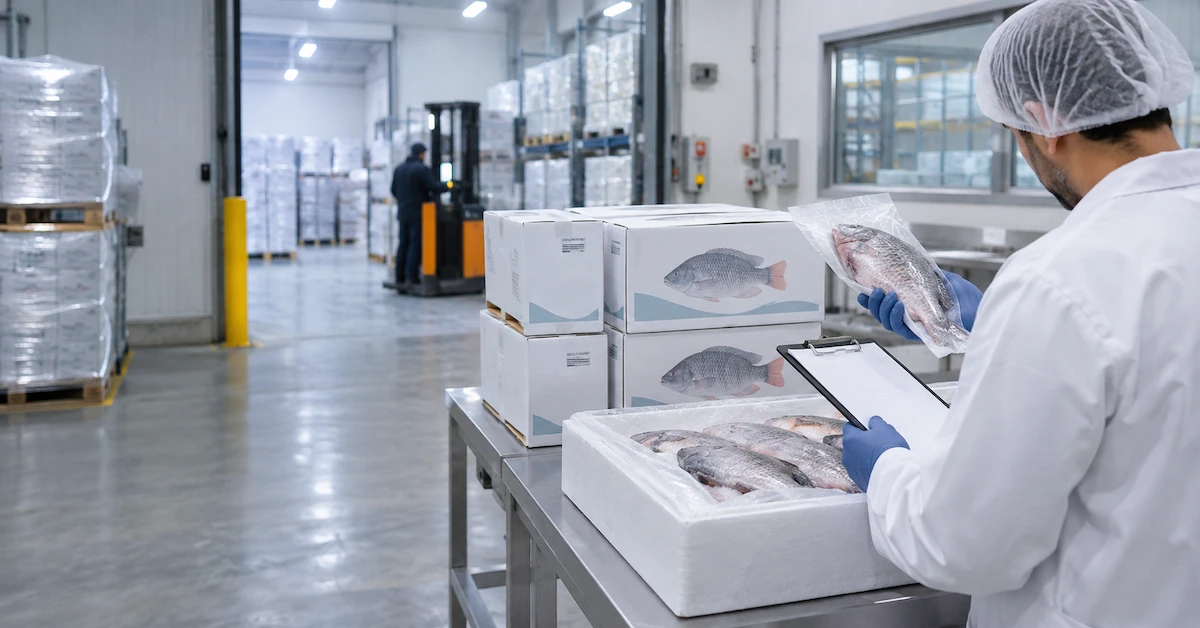
Quality control should begin before loading, not after the container reaches the destination port. A useful inspection plan links the approved specification to the physical product, the carton and the shipping records.
Product identity
Check the product name, species or commercial identity, form and lot information. If the importer sells different tilapia products, clear identification helps prevent a whole-fish carton from being confused with a fillet or another size grade.
Size and weight
Confirm the piece weight or size range, carton net weight and tolerance. If the quotation uses gross weight, ask how glazing and packaging weight are treated. A low price per gross kilogram may not represent the lowest cost per usable kilogram.
Physical condition
Look for clean appearance, consistent preparation, intact packaging and no obvious signs of temperature abuse. The approved sample should be the reference point. Photographs can support communication, but they should not replace the agreed written standard.
Glazing and net weight
Glazing can protect frozen seafood from dehydration, but the buyer needs to know how the supplier calculates net weight. Put the glazing basis and acceptable tolerance in the RFQ, quotation and purchase specification. This is particularly important when comparing a frozen tilapia bulk order across several suppliers.
Documents and traceability
Ask which product specification, batch information, health or sanitary documents, certificate of origin or other destination-specific documents can be provided. The exact list depends on the product, origin, processing method and destination. The importer, customs broker, forwarder and supplier should agree on the document package before production.
Cold-chain planning for Middle East importers
The cold chain is a sequence, not a single reefer setting. A typical route may include processing, freezing, cold storage, refrigerated inland transport, port handling, reefer loading, ocean shipment, destination handling, importer cold storage and local delivery.
The practical questions are straightforward: was the product fully frozen before loading; how is frozen storage monitored; how long will cartons be exposed during loading; is the reefer container suitable; how will the importer receive and inspect cargo; what records are available if a temperature deviation is reported; and what is the agreed response if packaging or product condition does not match the specification?
The Whole Frozen Tilapia for Export page on Bothwin's website states a storage reference of -18°C or below. That figure should be treated as product-page guidance and checked against the approved specification and destination requirements. A content page should not be used as a substitute for the shipping instruction issued for a specific order.
How supermarkets, restaurants and foodservice buyers use the product
The phrase frozen tilapia for supermarkets suggests a different requirement from frozen tilapia for restaurants. The first may emphasize pack design, label accuracy and consumer-facing size. The second may emphasize cooking consistency, usable weight and preparation time. Frozen tilapia for foodservice may include restaurants, hotels, catering companies, institutional kitchens and distributors that need repeatable cartons rather than one-off retail packs.
| Buyer channel | Typical priority | Useful RFQ details |
|---|---|---|
| Supermarkets | Shelf presentation and compliant retail information | Pack size, label language, barcode, artwork and size range |
| Restaurants | Cooking performance and preparation labor | Form, cleaning level, weight range, skin/bone and pack access |
| Hotels and catering | Repeatability across menus and events | Carton configuration, repeat order volume and delivery plan |
| Foodservice distributors | Handling efficiency and customer flexibility | Bulk or portion pack, pallet plan, net weight and repeat capacity |
| Seafood processors | Raw material consistency and yield | Size tolerance, processing form, freezing method and batch records |
This channel map is useful when a single importer serves multiple customer groups. The importer may choose one standard SKU for simplicity or request two formats from the same supplier. The decision should be based on customer demand, warehouse capacity and the economics of the final product, not on the product name alone.
How to compare frozen tilapia supplier China offers
An importer may receive offers from several suppliers in China. To compare them fairly, send the same product brief to every supplier and normalize the replies. Confirm the same identity, form, size, tolerance, freezing method, glazing, net weight, packing, quantity, destination and documents before comparing unit price. The most useful metric may be landed cost per usable kilogram, per carton or per restaurant portion, depending on the customer channel.
A first-shipment workflow
Step 1: Write the product brief
State the form, size, processing, freezing method, packing, quantity, destination and application. Include a target shipment window but leave room for the supplier to confirm production timing.
Step 2: Request supporting information
Ask for the product specification, available size grades, packing photos or samples, relevant quality documents and the proposed document package. Request information that is relevant to the product and destination.
Step 3: Approve a sample or trial order
Evaluate the product frozen and after thawing. Review visual condition, odor, texture, drip loss, size consistency and cooking performance where relevant. Record the outcome so the approved sample becomes a reference for later shipments.
Step 4: Confirm packing and labels
Approve carton configuration, inner bag, labels, language, declared weight and any private-label artwork before production rather than while the container is being arranged.
Step 5: Agree inspection and claims
Define what will be checked, how samples will be selected, what tolerance applies, when a claim must be notified and what evidence is required.
Step 6: Plan receiving at destination
Prepare cold storage, unloading, document review and arrival inspection. The importer should know who records product condition and what happens if an issue is found during unloading.
RFQ template for a frozen tilapia bulk order
Product: Frozen tilapia
Commercial identity/species:
Form: Whole round / gutted / scaled / cleaned / customized
Target size or weight range:
Acceptable tolerance:
Freezing method: IQF / block frozen / other
Glazing percentage and net-weight basis:
Packing: Bulk carton / retail bag / foodservice / private label
Carton net weight and pieces per carton:
Label language and artwork requirements:
Quantity: Trial / pallet / mixed container / full container
Destination country and port:
End use: Wholesale / supermarket / restaurant / foodservice / processing
Required documents:
Target shipment window:
Sample or pre-shipment inspection requirement:
Special quality or packaging requirements:
The more complete the inquiry, the less time is lost clarifying basic details after the supplier has already prepared a quotation.
FAQ for Middle East importers
What is the best frozen tilapia format for import?
There is no single best format. Whole round fish can suit wholesale or processing buyers, while gutted or cleaned formats may reduce preparation work. IQF can support individual access and portion control; block frozen can suit bulk handling and processing. Choose the format that matches storage, customers and final use.
Can I buy whole frozen tilapia in bulk from China?
Bothwin's public product page presents whole frozen tilapia for export and describes bulk export cartons, customized sizes and OEM availability. Confirm the current size range, MOQ, production timing, packing and destination documents for the actual order.
Is IQF frozen tilapia more expensive than block frozen tilapia?
Pricing depends on fish specification, size, processing, glazing, packing, quantity, trade term and shipment route. Ask suppliers to quote the same complete specification before comparing prices.
What documents do Middle East seafood importers need?
The exact document set depends on destination, product form, origin, processing and intended use. Confirm requirements with the importer, customs broker, freight forwarder, supplier and destination authority before production.
Can frozen tilapia be packed for supermarkets or private label?
The public Bothwin product content states that OEM packing is available for whole frozen tilapia. Discuss retail bags, artwork, language, barcodes, carton configuration, MOQ and production timing before approving the project.
What should I check in a frozen tilapia quotation?
Check product identity, form, size, tolerance, freezing method, glazing, net weight, packing, quantity, destination, trade term, documents, sample status and inspection terms. A quotation is only comparable when these fields are aligned.
How should frozen tilapia be stored after arrival?
Follow the approved product specification, destination requirements and cold-store instructions agreed for the shipment. The public product page uses -18°C or below as a storage reference. Confirm the exact requirement for the product and market before receiving cargo.
Why discuss frozen tilapia with Bothwin?
Bothwin Development (HK) Limited presents itself as a seafood supplier for global buyers and publishes product information for whole frozen tilapia, fish, squid, tuna and value-added seafood. The whole frozen tilapia page describes export-oriented supply, customized sizes, IQF or block freezing, bulk export cartons and OEM availability. The wider site also emphasizes processing, quality control, cold-chain coordination and export support.
For an importer, the value of that product range is the ability to start a focused discussion with a complete brief. Instead of asking for a generic frozen fish price, send the size, form, freezing method, glazing, net weight, packing, quantity, destination and sales channel. This gives the supplier enough context to respond with an option that can be evaluated commercially.
Get a Frozen Tilapia Quotation
Final checklist
- Product identity and form are written clearly.
- Size range and tolerance are measurable.
- IQF or block frozen format matches customer use.
- Glazing and net-weight basis are agreed.
- Carton, inner pack and label requirements are approved.
- Quantity and destination port are confirmed.
- Documents are reviewed before production.
- Sample or trial order is evaluated.
- Cold-chain and receiving procedures are prepared.
- Inspection, claims and evidence requirements are written.
- Price is compared on an equivalent landed-cost basis.
The strongest import programs are built around a repeatable product brief. When the buyer, supplier, forwarder and warehouse team use the same specification, the first order becomes easier to inspect and the next order becomes easier to repeat. That is the practical role of a reliable frozen tilapia supplier China buyers can work with: not simply providing a carton, but helping the importer define a product that can move through the complete chain from factory to customer.