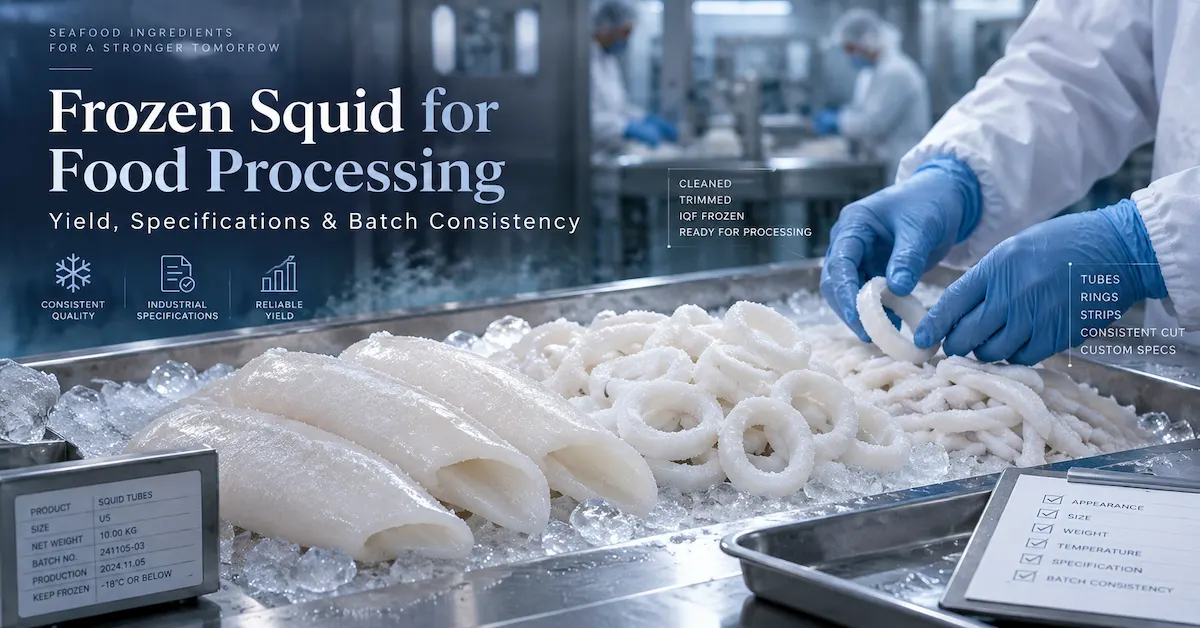


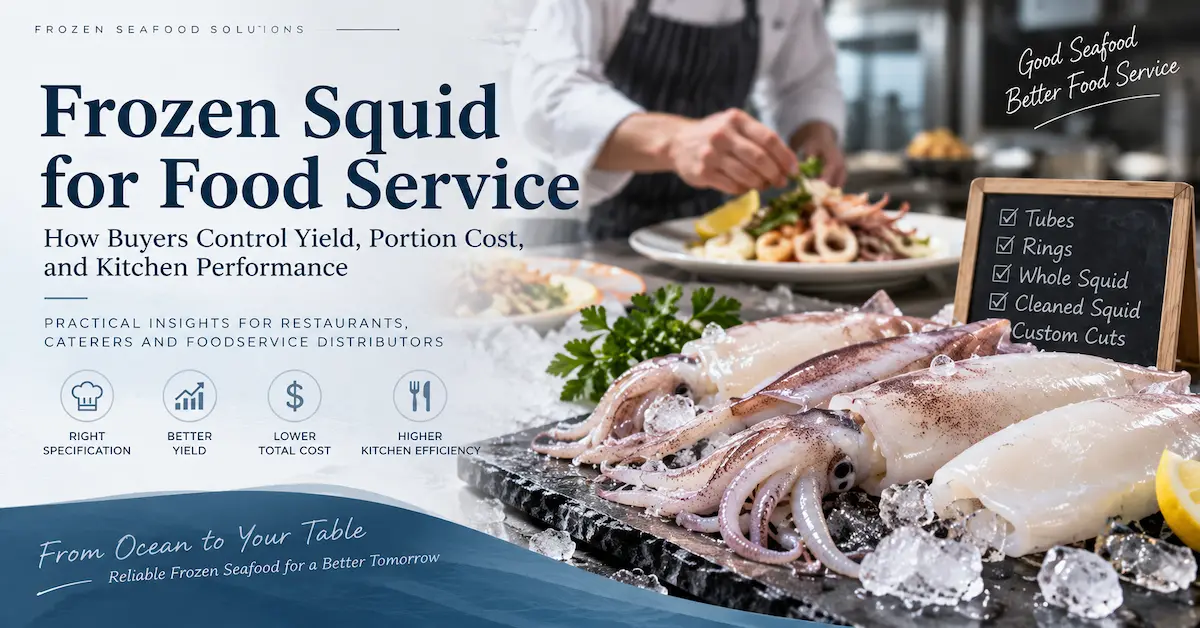
Frozen squid for food service is not a single standardized product. A restaurant purchasing whole squid for a grilled dish, a catering company buying rings for frying, and a central kitchen sourcing cleaned tubes for stuffing may all use the phrase “frozen squid,” yet they need different specifications.
For foodservice buyers, the commercial question is therefore not simply, “What is the price per carton?” A better question is: What usable, repeatable kitchen result will this carton produce?
That result depends on the species and processing form, size consistency, cleaning level, freezing method, glazing, declared net weight, thaw loss, trimming requirements, pack format, and cooking performance. A product with a lower purchase price can become more expensive when extra cleaning labor, inconsistent portions, excessive drip loss, damaged pieces, or poor cooking yield are included.
Bothwin’s current frozen squid information similarly treats species, size, cleaning level, processing form, net weight, glazing, packaging, and market application as specification items that should be confirmed before quotation. Its public squid page lists bulk carton, foodservice, and retail packing as possible commercial formats. Bothwin Development (HK) Limited Buyers starting a sourcing project can review the Bothwin Frozen Squid product page before preparing a detailed RFQ.
Quick Answer: What Should Buyers Check When Sourcing Frozen Squid for Food Service?
A foodservice buyer should evaluate frozen squid in this order:
- Define the menu application.
- Choose the correct processing form.
- Set measurable size and cut requirements.
- Confirm freezing method and portion-access needs.
- Define glazing and net-weight basis.
- Measure thawed and usable yield.
- Test the squid in the actual recipe and equipment.
- Approve foodservice packaging and carton configuration.
- Set QC and acceptance criteria before production.
- Compare suppliers on cost per usable portion, not carton price alone.
For restaurant chains, hotels, caterers, foodservice distributors, and central kitchens, these ten points usually matter more than broad statements such as “premium squid” or “high quality seafood.”
A serious quotation should tell the buyer exactly what is being purchased.
Why “Frozen Squid for Food Service” Is an Application Specification, Not Just a Product Name
Foodservice purchasing is different from commodity trading because the seafood must eventually pass through a working kitchen.
That kitchen has:
- staff
- preparation time
- equipment
- portion standards
- recipes
- service speed
- plate-cost targets
- waste limits
- customer expectations
The same frozen squid can therefore have very different commercial value for two buyers.
A seafood wholesaler may accept a broader size range because it resells cartons to multiple customers. A restaurant chain may require much tighter dimensions because one squid tube equals one serving. A fried-seafood operator may care more about ring diameter and thickness because these affect batter pickup and cooking time. A central kitchen processing hundreds of kilograms per shift may prioritize overall yield and labor efficiency.
This is why foodservice procurement should begin with the dish.
Before asking for a quotation, write down:
What will the kitchen actually do with the squid?
For example:
- cut rings for fried calamari
- grill whole cleaned squid
- sautéed strips
- use tentacles as appetizers
- stuff tubes
- prepare seafood platters
- add squid to hot pot or soup
- use squid as an ingredient in frozen meal production
Once the application is known, the buyer can build a specification around it.
Bothwin already discusses this application-first logic in its existing Frozen Squid Wholesale Buying Guide and its restaurant sourcing content. Its current frozen squid guide specifically recommends testing restaurant products using the intended thawing method, recipe, equipment, and cook time rather than approving them from appearance alone. Bothwin Development (HK) Limited
Which Frozen Squid Forms Work Best for Foodservice?
Processing form is one of the first variables that changes kitchen economics.
“Frozen squid” can refer to very different commercial products.
| Squid Form | Typical Foodservice Use | Main Buyer Benefit | Main Point to Check |
|---|---|---|---|
| Whole squid | Traditional dishes, whole presentation, further preparation | Flexibility | Cleaning labor and usable yield |
| Cleaned whole squid | Restaurants and central kitchens | Reduced preparation | Definition of “cleaned” |
| Squid tubes | Stuffing, grilling, slicing | Convenient and versatile | Tube dimensions and damage |
| Squid rings | Fried calamari, appetizers | Fast portioning | Diameter and thickness |
| Squid strips | Stir-fry, mixed seafood, catering | Reduced cutting labor | Width, length and consistency |
| Tentacles | Appetizers, grill, fry, seafood mix | Distinct texture and presentation | Size and breakage |
| Customized cut | Chain restaurants, processors | Fits standardized recipe | Cutting tolerance |
The important lesson is simple:
Processing form transfers work between supplier and kitchen.
A less processed product may have a lower purchase price but require more:
- thawing space
- cleaning
- cutting
- skilled labor
- waste disposal
- preparation time
A more processed product may cost more per kilogram but reduce those costs.
The correct answer depends on the operating model.
Whole Squid
Whole squid gives the kitchen maximum control over preparation, but it may also create the highest labor requirement.
Buyers should ask:
- Are viscera removed?
- Is the head retained?
- Are tentacles attached or packed separately?
- Is skin removed?
- Is the quill removed?
- What cleaning is required after thawing?
- What percentage becomes usable menu product?
Never assume that two suppliers use the word “whole” in exactly the same way.
Cleaned Squid
“Cleaned squid” sounds precise, but commercially it can still be ambiguous.
One buyer may expect:
skin removed + viscera removed + quill removed
Another may accept:
internal cleaning but skin retained
Therefore, define the cleaning standard in the purchase specification.
Pictures and an approved sample are often more useful than a vague description.
Squid Tubes
Tubes are useful for:
- stuffing
- grilling
- slicing into rings
- pan cooking
- portion-controlled dishes
For foodservice, tube consistency matters.
Important dimensions may include:
- length
- opening diameter
- wall thickness
- weight range
- allowable damage
If a restaurant sells one stuffed tube per plate, inconsistent tube size immediately becomes a portion-cost problem.
Squid Rings
Rings remove cutting labor, but buyers should not specify only “squid rings.”
Important variables include:
- outer diameter
- ring width
- thickness
- size tolerance
- broken-piece allowance
- coating application
- freezing form
A ring that is too thin can overcook quickly. A ring that varies significantly in thickness may produce inconsistent texture during the same fryer cycle.
IQF or Block Frozen: Which Is Better for Foodservice Squid?
The freezing format should match kitchen workflow.
IQF Squid
IQF means individually quick frozen. Pieces are frozen separately rather than as one solid block.
For many foodservice operations, IQF provides a major operational advantage:
the kitchen can remove only the quantity needed.
That can improve:
- portion control
- stock handling
- production flexibility
- thaw planning
- waste control
For a restaurant that uses 4 kg of squid today and 7 kg tomorrow, individually accessible pieces can be convenient.
IQF is particularly useful for:
- rings
- strips
- individual tubes
- portion-controlled seafood
- foodservice distribution
Block Frozen Squid
Block frozen products can still be commercially appropriate.
They may suit operations that:
- process large volumes
- thaw the entire block
- run scheduled production batches
- use squid as an industrial ingredient
A central kitchen processing a full block every morning may gain less from individual separation than a restaurant using small quantities throughout the week.
Therefore:
IQF is not automatically “better,” and block frozen is not automatically “lower quality.”
The right freezing method depends on how the product is stored, thawed, portioned, and used.
That kind of decision-based explanation is more useful than choosing a freezing method from price alone.
Size Consistency Matters More Than Average Size
A supplier can provide an average weight that looks acceptable while still delivering a range that is too wide for restaurant production.
Consider a stuffed squid dish.
If one tube holds 120 g of filling and another holds 200 g, the kitchen may face:
- different cooking times
- inconsistent plates
- uneven food cost
- different customer perceptions
- slower preparation
Similarly, squid rings with widely different dimensions may brown at different speeds in the fryer.
This is why serious foodservice buyers should define both:
target size + acceptable tolerance
Instead of:
Medium squid tubes
consider a specification based on agreed measurable criteria.
The exact measurement method depends on the commercial product, but the principle is the same:
A size specification should be testable.
If restaurant performance depends on piece dimensions, approve those dimensions before production.
Glazing and Net Weight: Two Numbers Buyers Must Not Confuse
Glazing is frequently misunderstood in frozen seafood purchasing.
A thin layer of ice can help protect exposed frozen seafood surfaces during frozen storage. The commercial issue is not simply whether glazing exists.
The important questions are:
- What glazing level was agreed?
- How is it measured?
- What weight is declared?
- How much seafood remains after controlled thawing and draining?
Bothwin’s current seafood content also separates the protective role of glazing from the commercial question of how much seafood the buyer is actually purchasing. Bothwin Development (HK) Limited Buyers who need a broader explanation can review the Frozen Seafood Glazing Percentage Guide.
Why Glazing Matters to Foodservice Buyers
Foodservice operators ultimately sell prepared portions.
They do not sell ice.
If two cartons are offered at similar prices but have different actual seafood yield, their real cost is different.
Consider two hypothetical quotations:
| Item | Supplier A | Supplier B |
|---|---|---|
| Carton price | $42 | $40 |
| Declared frozen quantity | 10 kg | 10 kg |
| Thawed/drained squid | 9.0 kg | 8.2 kg |
| Effective cost per kg thawed squid | $4.67 | $4.88 |
Supplier B appears cheaper by carton.
After yield is considered, it becomes more expensive.
These figures are only an illustration, but they show why procurement teams should compare a consistent weight basis.
Ask suppliers to confirm:
- gross carton weight
- declared net weight
- glazing basis
- drained/deglazed measurement method where relevant
- permitted tolerance
Without those definitions, price comparisons can be misleading.
Usable Yield Is One of the Most Important Metrics in Frozen Squid for Food Service
The most useful purchasing calculation is rarely:
carton price ÷ carton weight
Foodservice buyers should think in stages.
Stage 1: Frozen Purchase Weight
How much product arrives frozen?
Stage 2: Thawed and Drained Weight
How much remains after a repeatable thawing and draining procedure?
Stage 3: Cleaned Usable Weight
If additional cleaning or trimming is required, how much menu-ready squid remains?
Stage 4: Cooked Yield
How much finished product remains after cooking?
Stage 5: Saleable Portions
How many plates, bowls, skewers, or servings can be produced?
A useful internal formula is:
Usable Yield % = Usable Kitchen Weight ÷ Initial Reference Weight × 100
And for commercial comparison:
Raw Material Cost per Usable kg = Purchase Cost ÷ Usable Weight
Foodservice teams can go one step further:
Squid Cost per Portion = Total Squid Purchase Cost ÷ Number of Saleable Portions
A Hypothetical Foodservice Yield Test
Suppose a restaurant tests a frozen squid sample.
Initial frozen sample:
10.0 kg
After controlled thawing and draining:
8.8 kg
After final cleaning and unusable trimming:
8.2 kg
After cooking:
7.4 kg
Target cooked squid per serving:
125 g
Number of approximate saleable portions:
7,400 g ÷ 125 g = 59.2 portions
For operating purposes, the buyer should use a conservative number of complete portions rather than rounding optimistically.
Now compare another product.
It may cost 5% more per carton but produce:
- less drip
- less trimming
- faster preparation
- more consistent pieces
- more complete portions
That second product can be commercially superior.
This is why professional frozen squid for food service purchasing should focus on yield-adjusted cost, not headline price.
Measure Labor as Well as Seafood Yield
Yield is not only a weight calculation.
Preparation labor has a cost.
Two squid products may both produce 8 kg of usable meat, but one requires 15 minutes of work while another requires 50 minutes.
For a restaurant chain or central kitchen, that difference matters.
During sample testing, record:
- thawing handling time
- cleaning time
- trimming time
- cutting time
- portioning time
- amount of waste
- number of damaged pieces
A more processed product may reduce:
- skilled knife work
- prep congestion
- waste-handling time
- staff variability
This is particularly important for restaurant groups trying to standardize several branches.
Centralized procurement should not optimize only the supplier price. It should optimize total kitchen cost.
Test Frozen Squid in the Actual Cooking Method
Raw appearance cannot predict every foodservice result.
Squid changes during cooking.
Restaurant buyers should evaluate:
- tenderness
- shrinkage
- curl
- moisture release
- color
- surface behavior
- cooking speed
- portion appearance
Testing must match the final menu.
Fried Calamari
Use the actual:
- ring size
- batter
- fryer
- oil temperature
- fryer loading
- cook time
Measure:
- coating pickup
- broken rings
- moisture release
- finished texture
- cooked yield
- plate coverage
If samples are tested under artificial laboratory-style conditions that differ from restaurant service, the result may not predict real kitchen performance.
Grilled Squid
For grilling, look at:
- tube dimensions
- wall thickness
- moisture release
- surface browning
- curling
- tenderness
- finished appearance
A squid product that releases large amounts of moisture can behave differently on a busy grill.
Stir-Fried Squid
In wok or pan applications, consider:
- cut consistency
- liquid release
- cooking speed
- texture after high heat
- size after cooking
Large variation between pieces can make the batch difficult to cook evenly.
Stuffed Squid Tubes
Here, portion consistency becomes especially important.
Check:
- tube capacity
- tears
- taper
- wall thickness
- filling time
- cooking uniformity
- percentage of unusable tubes
A foodservice specification must reflect the actual menu.
Foodservice Packaging Should Reduce Work, Damage, and Waste
Packaging is often treated as a logistics issue.
For foodservice, it is also an operational issue.
A carton configuration affects:
- freezer space
- inventory control
- thaw planning
- handling
- product protection
- kitchen sanitation
- waste
Foodservice buyers should ask whether the product is packed as:
- one large bulk unit
- several inner bags
- fixed-weight inner packs
- individually accessible pieces
- custom foodservice packs
Inner Packs Can Matter
Imagine a restaurant uses 2 kg of squid per service period.
A 20 kg undivided pack may be inconvenient.
Ten 2 kg inner packs may better match production.
The opposite can also be true.
A processing factory using an entire carton every shift may not benefit from additional inner packaging.
Again, the application determines the answer.
Bothwin’s frozen squid page currently lists bulk carton, foodservice, and retail packing, while private-label packing can be discussed according to project conditions. Bothwin Development (HK) Limited Foodservice buyers can review the wider Bothwin seafood product range when consolidating squid with other seafood categories.
Build an Approval Test Before Buying Commercial Volume
A sample should not be approved because:
“It looks good.”
Create a test sheet.
Keep the procedure consistent across competing suppliers.
Step 1: Record the Sample Identity
Document:
- supplier
- product
- processing form
- size
- batch
- pack format
- freezing method
- declared weight
Step 2: Weigh the Frozen Sample
Use the same scale and method for each comparison.
Step 3: Use a Standardized Thawing Procedure
Do not thaw Supplier A one way and Supplier B another.
Differences in procedure can distort the result.
Step 4: Drain Consistently
Define:
- drain time
- equipment
- handling method
Step 5: Measure Thawed Weight
Record the weight.
Step 6: Complete Normal Kitchen Cleaning
Do exactly what staff would normally do before cooking.
Step 7: Measure Usable Weight
Record:
- waste
- trim
- damaged pieces
Step 8: Record Preparation Time
This converts labor from an impression into data.
Step 9: Cook the Product
Use the real restaurant:
- recipe
- equipment
- batch size
- temperature
- cook time
Step 10: Measure Finished Yield and Quality
Evaluate:
- finished weight
- tenderness
- appearance
- consistency
- plate count
This procedure gives the purchasing team something far more useful than a supplier claim.
It creates a foodservice-specific approval standard.
What Should a Frozen Squid Quality Specification Include?
Quality control works best when acceptance criteria exist before the commercial shipment.
Bothwin’s current frozen seafood quality content also emphasizes checking product identity, size grade, net weight, glazing, appearance, packaging, temperature, traceability, and shipment documents before purchasing or shipment. Bothwin Development (HK) Limited The detailed internal reference is available in the Frozen Seafood Quality Checks Guide.
For frozen squid for food service, consider this specification structure:
| Inspection Area | What the Buyer Should Define |
|---|---|
| Product identity | Exact squid product/species where required |
| Processing form | Whole, cleaned, tube, ring, strip or agreed form |
| Size | Agreed size or dimensional range |
| Cleaning | Exact cleaning requirement |
| Defects | Acceptable/unacceptable defects |
| Freezing | IQF, block or agreed method |
| Glazing | Agreed level and measurement basis |
| Net weight | Declared basis and tolerance |
| Packaging | Inner pack and outer carton |
| Labels | Product, weight, batch and market requirements |
| Appearance | Agreed commercial appearance |
| Traceability | Batch identification requirements |
| Cold chain | Frozen handling requirement |
| Documentation | Shipment/customer-required records |
The principle is important:
Do not write “good quality” where a measurable specification can be written instead.
“Good size consistency” is subjective.
“Pieces must fall within the approved size range” is measurable.
“Properly cleaned” is ambiguous.
“Cleaning must match the approved sample and written processing specification” is more useful.
Why Approved Samples Should Be Connected to the Written Specification
Samples help buyers judge:
- appearance
- size
- texture
- cleaning
- processing
- cooking performance
But a sample alone is not enough.
The purchase order should not say:
Same as sample.
It should define the measurable features that made the sample acceptable.
Otherwise, disputes can emerge later:
- Which size was approved?
- What glazing was used?
- What weight basis applied?
- How much variation was acceptable?
- Was the sample exceptional or representative?
A better process is:
sample approval + written specification + acceptance criteria
The three should support one another.
Cold Chain Problems Can Destroy a Good Product Specification
A well-selected squid product can still perform poorly if frozen handling is inadequate.
Cold-chain planning matters from:
- freezing
- cold storage
- inland transportation
- loading
- sea freight
- destination warehouse
- foodservice distribution
- final restaurant storage
Foodservice buyers should avoid thinking of temperature as “the supplier’s problem.”
It is a chain.
At receiving, look for signs such as:
- damaged cartons
- wet or weakened packaging
- unusual ice accumulation
- obvious thaw/refreeze evidence
- product deformation
- compromised inner bags
Receiving teams should know what to do when a carton does not meet expectations.
That may include:
- isolating the carton
- photographing the condition
- recording batch details
- checking receiving temperature according to the company procedure
- notifying the purchasing or quality team
Bothwin’s export content treats cold-chain management as a continuous process across freezing, cold storage, inland movement, container loading and shipping. Bothwin Development (HK) Limited More detail is available in the Frozen Seafood Cold Chain Guide.
Compare Frozen Squid Suppliers on Total Foodservice Value
When procurement teams compare suppliers, a useful scorecard is better than a price-only comparison.
| Evaluation Area | Supplier A | Supplier B | Supplier C |
|---|---|---|---|
| Product form matches menu | |||
| Size consistency | |||
| Cleaning standard | |||
| Glazing transparency | |||
| Net-weight clarity | |||
| Thawed yield | |||
| Usable yield | |||
| Cooking performance | |||
| Preparation labor | |||
| Packaging suitability | |||
| Traceability | |||
| QC communication | |||
| Export support | |||
| Repeat-order consistency | |||
| Effective cost per portion |
This changes the purchasing conversation.
Instead of:
Who is cheapest?
the team asks:
Which supplier produces the most reliable commercial result?
For restaurants, hotels, caterers and foodservice distributors, that is usually the more valuable question.
Common Mistake 1: Ordering by Species Name Alone
“Squid” does not define a complete commercial specification.
You still need to determine:
- species/product identity
- form
- size
- cleaning
- freezing
- glazing
- weight
- packaging
- destination requirements
If these are not clear, quotations may not be comparable.
Common Mistake 2: Focusing Only on Carton Price
Foodservice margin depends on portions.
Calculate:
- thawed yield
- usable yield
- cooked yield
- labor
- waste
- cost per portion
A cheaper carton can produce a more expensive plate.
Common Mistake 3: Using Vague Terms Such as “Medium”
“Small,” “medium,” and “large” can mean different things.
Use measurable ranges where possible.
Common Mistake 4: Ignoring Cleaning Definition
One supplier's “cleaned tube” may not be identical to another's.
Write the cleaning requirement.
Approve a representative sample.
Common Mistake 5: Ignoring Cut Consistency
For fried rings, strips and portion-led recipes, inconsistent dimensions can affect:
- cooking
- texture
- plate appearance
- cost
Common Mistake 6: Testing Only One Plate
A chef tasting a few pieces may miss operational problems.
Run a realistic batch.
For a restaurant group, test during a small production simulation rather than preparing one ideal plate.
Common Mistake 7: Not Measuring Labor
A low-priced raw product may shift work into the kitchen.
Record prep time.
Common Mistake 8: Treating Glazing as a Single “Good or Bad” Issue
The relevant questions are transparency, agreed specification, protection, and actual seafood weight.
Common Mistake 9: Approving a Sample Without a Written Specification
A sample can be lost, misunderstood, or fail to describe permissible variation.
Document what was approved.
Common Mistake 10: Changing Specification After Menu Launch
If a restaurant builds its food cost around one squid size and later accepts a substantially different size without testing, portion economics can change.
Supplier changes should trigger product review.
How Foodservice Distributors Should Think Differently
A foodservice distributor has an additional challenge.
It may serve:
- independent restaurants
- hotels
- catering companies
- institutional kitchens
- chain accounts
- seafood shops
The “best” squid for one customer may not work for another.
A distributor therefore needs to balance:
specialization vs inventory complexity
Too many SKUs create:
- more inventory
- slower stock rotation
- more freezer locations
- more sales training
- more purchasing complexity
Too few specifications can create poor fit.
One practical strategy is to define a small number of foodservice-oriented squid profiles, for example:
- general-purpose cleaned squid
- restaurant tube program
- standardized ring program
- bulk processing format
The exact portfolio depends on customer demand.
The key is to make the commercial difference between each SKU clear.
Restaurant Chains Need Repeatability More Than a Perfect First Sample
A very good first shipment is not enough.
Chain buyers need:
repeat-order consistency
If a menu runs for twelve months, the purchasing team needs confidence that repeated shipments stay within the agreed range.
Areas to monitor include:
- size
- cleaning
- product form
- glazing
- weight
- pack configuration
- sensory performance
This is where record keeping and specification control matter.
A supplier should be able to discuss how commercial shipments are checked against customer requirements.
Bothwin describes specification review around size, cleaning, net weight, glazing, carton weight and label requirements before order confirmation, while its broader sourcing workflow links specification confirmation with quality inspection, packaging and export coordination. Bothwin Development (HK) Limited
Buyers researching Bothwin’s wider capabilities can also review its Factory and seafood solutions page.
How HACCP-Based Thinking Helps Foodservice Buyers
Foodservice buyers do not need to become HACCP auditors to ask better supplier questions.
The useful idea behind HACCP-based sourcing is prevention.
Instead of asking only:
Was the final carton acceptable?
ask how risks are controlled during:
- raw material acceptance
- cleaning
- cutting
- freezing
- packing
- cold storage
- shipment
For squid, practical concerns may include:
- sanitation
- contamination control
- product identification
- processing consistency
- temperature control
- traceability
- packaging integrity
Bothwin’s current HACCP content describes raw material control, processing management, freezing, packaging inspection, traceability, and export-document support as interconnected parts of seafood sourcing. Bothwin Development (HK) Limited Buyers evaluating these topics can read the HACCP Seafood Processing Supplier Guide.
For destination-specific legal requirements or certificates, the buyer should still confirm the exact requirement for the product, processing facility, importer, and market before ordering.
Do not assume that a broad certification statement automatically covers every factory, product, or destination.
How to Build a Professional RFQ for Frozen Squid for Food Service
A useful inquiry saves time for both buyer and supplier.
Instead of sending:
Send best price for frozen squid.
send a structured RFQ.
Product
- Frozen squid
- Required species/product identity if specified
Application
- Fried calamari
- Grilling
- Stuffing
- Stir-fry
- Catering
- Processing
- Other
Processing Form
- Whole
- Cleaned
- Tube
- Ring
- Strip
- Tentacle
- Buyer-specific processing
Size
State the required range or intended portion requirement.
Cleaning
Define what must be removed or retained.
Freezing Method
- IQF
- Block frozen
- Buyer open to recommendation
Glazing
State the requested basis or ask the supplier to declare the proposed level and calculation basis.
Weight
Confirm:
- inner-pack weight
- carton net weight
- tolerance
- measurement basis
Packaging
State:
- bulk
- foodservice inner packs
- private label if applicable
- carton configuration
Quantity
Provide:
- sample volume
- trial order
- commercial volume
- expected repeat purchasing if known
Destination
Country and delivery requirements affect the commercial discussion.
Quality Requirements
Include relevant:
- size tolerance
- appearance
- processing
- defects
- packing
- label
- inspection
Documents
List only documents that are actually needed.
This level of detail enables the supplier to quote against a meaningful specification.
Buyers ready to discuss a project can use the Bothwin contact page and provide the intended application, processing form, size, packing, quantity, and destination market.
What Information Should Be Confirmed Before the Purchase Order?
Before placing a commercial order, make sure both sides agree on the same product.
A practical confirmation checklist is:
- Product identity confirmed
- Processing form confirmed
- Size range confirmed
- Cleaning standard confirmed
- Freezing method confirmed
- Glazing basis confirmed
- Net-weight basis confirmed
- Weight tolerance confirmed
- Inner packing confirmed
- Outer carton confirmed
- Label requirements confirmed
- Sample approved where needed
- QC criteria confirmed
- Destination requirements discussed
- Shipment/document requirements confirmed
- Change-control process understood
The last item is often overlooked.
Ask:
What happens if the supplier cannot produce the approved size or form for a future order?
A professional supply relationship should not silently substitute materially different specifications.
Changes should be discussed before production or shipment.
How Bothwin Can Fit a Foodservice Frozen Squid Sourcing Program
Bothwin Development (HK) Limited presents frozen squid for importers, wholesalers, foodservice distributors, supermarkets, restaurants and processing buyers. Its current squid page says that product form, size, cleaning, glazing and packing are confirmed according to project requirements rather than presenting every possible configuration as a fixed SKU. Bothwin Development (HK) Limited
That approach is appropriate for foodservice because the intended application should drive the product discussion.
A buyer can start by providing:
- menu application
- processing form
- target size
- required cleaning
- freezing preference
- packaging
- purchasing quantity
- destination
Then specification, availability and commercial conditions can be discussed for the actual project.
For buyers consolidating seafood categories, the Bothwin Products page provides an overview of the current product range, while the Bothwin Blog contains additional sourcing, seafood quality, logistics and foodservice guidance.
FAQ About Frozen Squid for Food Service
What is the best frozen squid for food service?
There is no single best format for every foodservice operation.
The best frozen squid for food service is the product that matches the final recipe, kitchen workflow, portion requirement, labor structure and target food cost.
Restaurants making fried calamari may prefer consistent rings or tubes that can be cut to specification. Stuffed-squid dishes usually need tubes with suitable dimensions and low damage. Central kitchens may prioritize bulk yield and production efficiency.
Define the use first, then select the product.
Is IQF squid better than block frozen squid for restaurants?
IQF can be more convenient when the restaurant needs flexible quantities and individual portion access.
Block frozen squid may be suitable when a kitchen or processor thaws and uses the entire block at once.
The choice should consider:
- daily usage
- thaw planning
- freezer handling
- labor
- portion requirements
Do not assume one method is universally superior.
Should restaurants buy whole squid or cleaned squid?
It depends on labor cost and kitchen capability.
Whole squid can offer preparation flexibility but may require more cleaning, trimming and waste handling.
Cleaned squid can reduce kitchen labor, but buyers must define exactly what “cleaned” means.
Compare:
purchase price + usable yield + preparation labor
rather than comparing purchase price alone.
How do restaurants calculate frozen squid yield?
Start with a known weight.
Record:
- frozen weight
- thawed/drained weight
- cleaned usable weight
- cooked weight
- saleable portions
Then calculate the usable yield percentage.
For supplier comparisons, use the same thawing, draining, cleaning and cooking procedure for every sample.
Does glazing make frozen squid lower quality?
Not automatically.
Glazing can help protect frozen seafood surfaces during storage. The purchasing issue is whether the glazing level is transparent, consistent and correctly separated from the agreed seafood weight basis.
Foodservice buyers should understand how much usable squid they are purchasing, not judge a product by the presence of glaze alone.
What squid size is best for fried calamari?
There is no universal ideal size.
The right dimensions depend on:
- menu presentation
- ring thickness
- coating
- fryer conditions
- cooking time
- portion weight
Restaurants should test representative samples using their actual fryer and recipe.
Consistency is often more important than simply choosing a “large” or “small” grade.
What should foodservice buyers check in squid tubes?
Important points include:
- tube length
- diameter
- wall thickness
- size consistency
- tears
- cleaning
- skin requirements
- glazing
- usable yield
For stuffed dishes, the buyer should also test filling capacity and finished portion appearance.
How should a restaurant compare two frozen squid suppliers?
Use a controlled sample test and compare:
- exact specification
- thawed yield
- usable yield
- preparation time
- cooking performance
- size consistency
- damaged pieces
- packing
- traceability
- supplier communication
- cost per usable kilogram
- cost per saleable portion
A supplier offering the lowest carton price is not necessarily the lowest-cost supplier in the kitchen.
Can frozen squid packaging be customized for foodservice?
Foodservice packaging can often be discussed according to the purchasing project and supplier capability.
Useful options may include:
- bulk cartons
- inner bags
- fixed-weight foodservice packs
- market-specific labeling
- private-label formats
Bothwin’s current squid product information lists bulk carton, foodservice and retail packing, with private-label packing subject to commercial project conditions. Bothwin Development (HK) Limited
What information should I send when requesting a frozen squid quotation?
At minimum, send:
- product/application
- processing form
- size
- cleaning requirement
- freezing method
- glazing requirement
- net weight
- packaging
- quantity
- destination
For foodservice projects, also explain the intended menu use.
That single detail can help suppliers understand whether the buyer needs tubes, rings, strips, whole squid, or another processing form.
Conclusion
Buying frozen squid for food service is not simply a search for a seafood product at the lowest price. For restaurants, hotel groups, catering companies, central kitchens and foodservice distributors, the real objective is to secure a specification that performs consistently from the frozen carton to the finished plate.
The strongest purchasing decisions start with the application.
Define how the squid will be thawed, cleaned, cut, cooked and portioned. Then confirm the product form, size range, cleaning standard, freezing method, glazing, net-weight basis and packaging. Test representative samples under real kitchen conditions and measure thawed yield, usable yield, preparation labor, cooking performance and actual portions.
When quotations are compared on these variables, hidden cost becomes easier to identify. A cheaper carton may not be cheaper after excessive cleaning, drip loss, broken pieces, inconsistent cuts or poor cooked yield are included. Conversely, a product with a higher purchase price may reduce labor and deliver more consistent saleable portions.
For repeat purchasing, translate the approved sample into a written specification and measurable QC criteria. That creates a clearer standard for future production, inspection and supplier communication.
Bothwin supports frozen squid sourcing discussions for foodservice distributors, restaurants, importers, wholesalers and processors, with order-specific confirmation of size, cleaning, processing form, glazing and packing. Bothwin Development (HK) Limited If you are developing a frozen squid for food service program, prepare your intended application, processing form, target size, packing format, estimated quantity and destination market, then contact Bothwin to discuss the purchasing specification.