
Can a Frozen Tuna Exporter Customize Portion Sizes and Packaging?
For many seafood importers, buying frozen tuna is no longer only about selecting an existing product from a supplier catalog.
Different markets have different requirements.
A restaurant chain may need standardized tuna steaks with identical portions.
A supermarket may require private-label packaging.
A foodservice distributor may need bulk cartons designed for warehouse handling.
A seafood processor may require specific tuna loin sizes for further production.
Because of these differences, many buyers ask:
Can a frozen tuna exporter customize portion sizes and packaging according to my business requirements?
The answer is yes, but the level of customization depends on:
- product format
- order quantity
- processing capability
- packaging requirements
- labeling regulations
- target market
A professional frozen tuna exporter should not only provide standard products but also help buyers develop specifications suitable for their downstream customers.
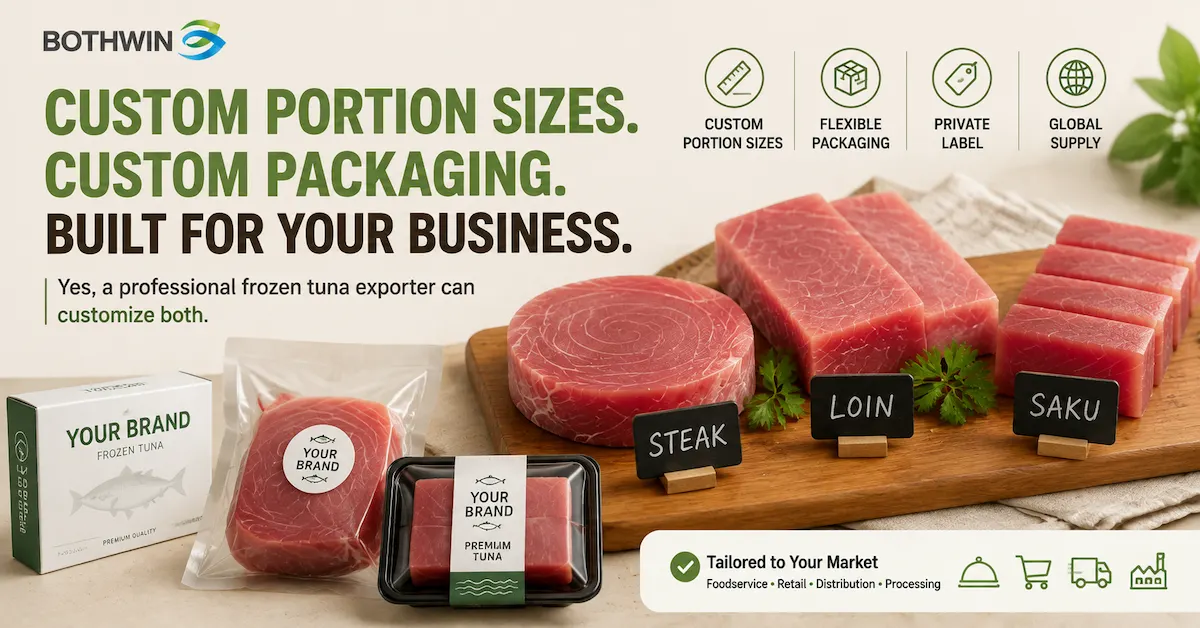
Bothwin's current frozen tuna solutions include tuna steaks, skinless and boneless loins, saku, and whole round tuna, with customizable size grades, IQF/BQF options, and export-standard carton packaging. (Bothwin Frozen Tuna)
Why Do Buyers Need Customized Frozen Tuna Products?
Standard frozen tuna products may not always fit every business model.
Customization helps buyers match products with:
- customer expectations
- cooking requirements
- warehouse operations
- retail presentation
- brand positioning
Foodservice Requirements
Restaurants, hotels,and catering companies often require:
- consistent portion sizes
- predictable cooking results
- easy kitchen handling
- reduced preparation time
For example:
A restaurant group may require:
- 150g tuna steaks
- specific thickness
- skinless and boneless format
- individual packaging
The supplier needs to maintain these specifications across repeat shipments.
Retail Requirements
Retail buyers often focus on:
- package appearance
- consumer convenience
- labeling
- barcode requirements
- shelf presentation
A frozen tuna exporter supporting retail customers may need to provide:
- custom printed packaging
- retail-ready packs
- private label solutions
Seafood Distribution Requirements
Distributors usually need products that are:
- easy to store
- efficient to transport
- consistent between shipments
Bulk packaging and carton configuration become important factors.
What Portion Sizes Can Frozen Tuna Exporters Customize?
Portion size customization is one of the most common requests from foodservice buyers.
Depending on the product format, exporters may customize:
- weight
- thickness
- dimensions
- shape
- trimming
Customized Tuna Steak Sizes
Frozen tuna steaks are often customized according to:
- target weight
- thickness
- cutting style
- skin condition
- bone requirements
Common buyer requirements include:
- 100g portions
- 150g portions
- 200g portions
- restaurant-specific sizes
However,buyers should also define tolerance.
For example:
Instead of:
150g tuna steak
A clearer specification would be:
Frozen tuna steak, 150g ± 10g, skinless, boneless, specified thickness.
This reduces quality disputes during receiving.
Customized Tuna Loin Specifications
Tuna loins are often purchased by:
- seafood processors
- distributors
- food manufacturers
Customization may include:
- loin size
- trimming standard
- skinless requirement
- boneless requirement
- weight range
For processors, the key measurement is often not only purchase price but:
usable yield after processing
A supplier that provides consistent loin specifications can help buyers improve production efficiency.
Customized Tuna Saku Dimensions
Saku products require more precise specifications.
Buyers should define:
- length
- width
- height
- weight
- trimming
- packaging
This is especially important for:
- sushi applications
- premium seafood programs
- specialty foodservice customers
A supplier should confirm whether requested dimensions can be maintained consistently for repeat orders.
Can Frozen Tuna Exporters Provide Custom Packaging?
Yes.
Packaging customization is another important part of seafood OEM cooperation.
A professional exporter may support:
- bulk carton packaging
- foodservice packaging
- vacuum packaging
- retail packaging
- private label packaging
Bulk Foodservice Packaging
Suitable for:
- distributors
- restaurants
- hotels
- catering companies
Advantages:
- efficient storage
- lower handling cost
- suitable for high-volume purchasing
Individual Packaging
Suitable for buyers who need:
- portion control
- easy kitchen preparation
- reduced product handling
Vacuum Packaging
Vacuum packaging may help:
- protect product condition
- improve handling convenience
- support retail or foodservice applications
The exact packaging method should be selected according to:
- product format
- storage method
- sales channel
Private Label Frozen Tuna Packaging
Many importers want to develop their own seafood brand.
Private-label projects may include:
- custom logo
- packaging artwork
- product information
- barcode
- market-specific labeling
Before production, buyers should confirm:
- MOQ
- artwork approval
- packaging cost
- production lead time
- label compliance
What Information Should Buyers Provide for Customized Frozen Tuna Orders?
A detailed specification helps exporters provide accurate solutions.
Buyers should provide:
| Requirement | Details |
|---|---|
| Tuna species | Required species |
| Product format | Steak, loin,saku |
| Portion size | Weight requirement |
| Thickness | Steak specification |
| Dimensions | Saku specification |
| Processing | Skin/bone/trimming |
| Freezing | IQF/BQF |
| Glazing | Required percentage |
| Packaging | Bulk/private label |
| Quantity | Order volume |
| Destination | Country and port |
| Application | Foodservice/retail/processing |
The more information provided, the easier it becomes for the supplier to evaluate feasibility.
How Does MOQ Affect Frozen Tuna Customization?
Customization usually requires additional production planning.
Factors affecting MOQ include:
- custom cutting
- special packaging
- printed materials
- private labels
- production scheduling
Standard products usually allow more flexibility.
Customized products may require:
- higher volume
- longer preparation time
- packaging approval
Therefore, buyers should discuss MOQ before finalizing a customized project.
How Long Does Customized Frozen Tuna Production Take?
Lead time depends on:
- product type
- customization level
- packaging requirements
- order quantity
- production schedule
Examples:
Standard tuna products:
→ usually simpler preparation
Customized tuna steaks:
→ require cutting specifications
Private-label packaging:
→ requires artwork and packaging preparation
A professional supplier should confirm realistic timing before accepting an order.
How Do Frozen Tuna Exporters Control Customized Product Quality?
Customization increases the importance of quality control.
A supplier should control:
Raw Material
Check:
- species
- size
- condition
Processing
Check:
- cutting accuracy
- weight consistency
- trimming
Packaging
Check:
- label accuracy
- sealing
- carton condition
Finished Product
Check:
- appearance
- weight
- specification compliance
- frozen condition
For customized products, the approved sample should become the reference standard for future shipments.
How Can Buyers Reduce Risk When Ordering Customized Frozen Tuna?
Before mass production,buyers should confirm:
Product Approval
Confirm:
- sample
- specification sheet
- photos
- packaging design
Commercial Terms
Confirm:
- MOQ
- price
- lead time
- payment terms
Quality Agreement
Confirm:
- acceptance criteria
- tolerance
- inspection method
- claim process
Shipment Preparation
Confirm:
- documents
- cold chain
- delivery schedule
A clear approval process prevents misunderstandings between buyers and suppliers.
Why Choose Bothwin for Customized Frozen Tuna Solutions?
For international seafood buyers, customization capability is an important factor when selecting a long-term supplier.
Bothwin provides frozen tuna solutions including:
- tuna steaks
- tuna loins
- tuna saku
- whole tuna
with support for:
- customized specifications
- different product formats
- export packaging
- foodservice requirements
(Bothwin Frozen Tuna Products)
For buyers, the value of customization is not only changing the product size.
It is creating a seafood solution that matches:
- customer demand
- market positioning
- operational requirements
- sales channels
Frozen Tuna Customization Checklist
Before starting an OEM project,confirm:
| Item | Confirm |
|---|---|
| Product format | ☐ |
| Tuna species | ☐ |
| Portion size | ☐ |
| Thickness | ☐ |
| Dimensions | ☐ |
| Processing | ☐ |
| Freezing method | ☐ |
| Packaging | ☐ |
| Private label | ☐ |
| MOQ | ☐ |
| Lead time | ☐ |
| Quality standard | ☐ |
| Documents | ☐ |
FAQ About Customized Frozen Tuna
Can a frozen tuna exporter customize portion sizes?
Yes.Many exporters can customize tuna steak weight, thickness, dimensions, and processing requirements according to buyer specifications.
Can frozen tuna suppliers provide private-label packaging?
Yes. Depending on MOQ and market requirements, suppliers may support custom packaging, labels, and branded seafood products.
What information should I provide for customized tuna?
Provide product format, species, size, weight, processing requirements, packaging, quantity, destination, and application.
Is customized frozen tuna more expensive?
Customization may increase production costs because it requires additional processing, packaging, or materials. However, it can improve product suitability and market value.
Can tuna steaks be customized for restaurants?
Yes. Foodservice buyers commonly request specific portion weights and thicknesses to match menu requirements.
Can tuna loins be customized?
Yes. Buyers can specify size range, trimming requirements, skin condition, and processing standards.
What is the MOQ for customized frozen tuna?
MOQ depends on product format, packaging requirements, and customization level. Buyers should confirm requirements with the supplier before ordering.
Can exporters customize tuna packaging for supermarkets?
Yes. Retail projects may involve private labels, artwork, barcode requirements, and market-specific packaging.
How do buyers approve customized tuna products?
Usually through specifications, samples, packaging approval, and quality acceptance standards before mass production.
Does Bothwin support customized frozen tuna orders?
Bothwin provides frozen tuna products including steaks, loins, saku, and whole tuna, with customizable size grades and export packaging options.
Conclusion
A reliable frozen tuna exporter should be able to provide more than standard products.
For importers, customization creates opportunities to develop products that better match:
- foodservice requirements
- retail markets
- customer expectations
- brand strategies
Before placing an OEM or customized frozen tuna order, buyers should clearly define:
Product Format
→ Portion Size
→ Processing
→ Packaging
→ Quality Standard
→ Quantity
→ Delivery Requirements
With the right supplier, customized frozen tuna can become a long-term supply solution rather than a one-time purchase.
Explore Bothwin Premium Frozen Tuna Solutions and contact Bothwin to discuss your customized tuna requirements.