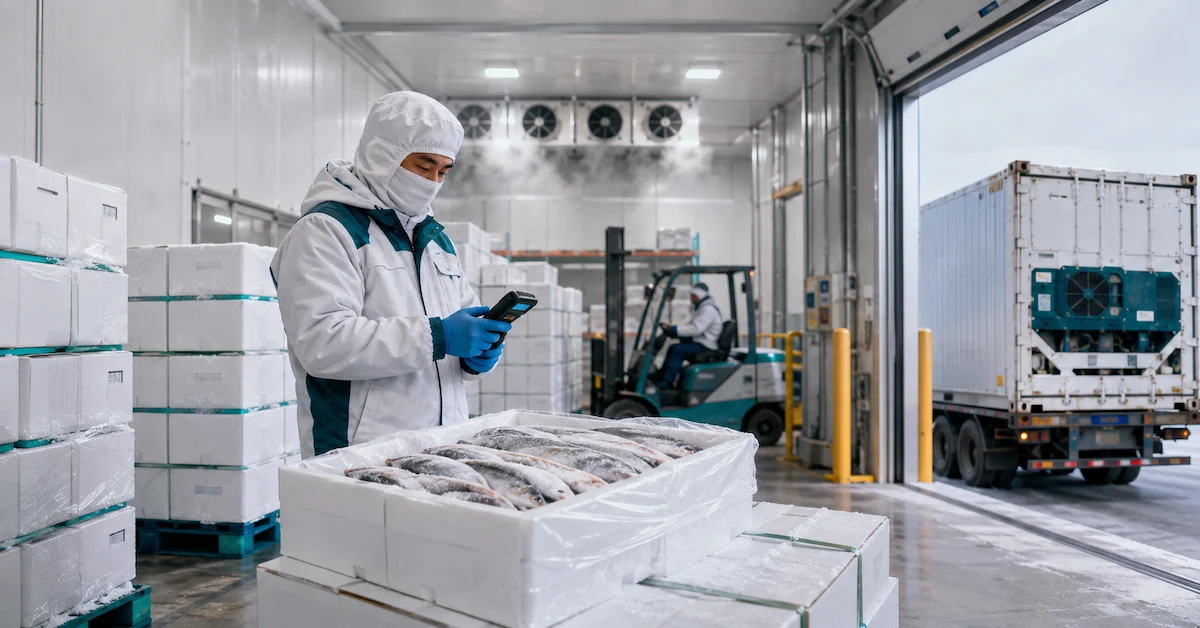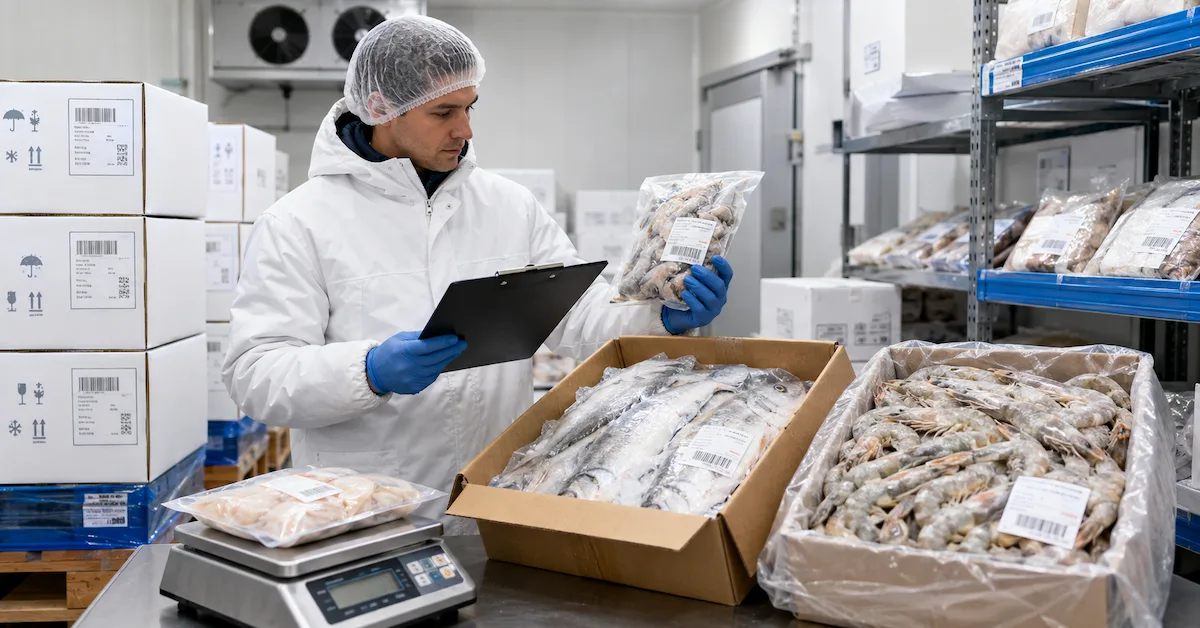


What Is the Correct Way to Store Frozen Fish for Export?
Learning how to store frozen fish for export requires more than placing cartons inside a freezer.
Export seafood may remain in the cold chain for weeks while moving through processing facilities, frozen warehouses, inland transport, ports, refrigerated containers, customs areas, destination cold stores, wholesalers, and foodservice distribution.
Every transfer creates a potential temperature-control or handling risk.
A practical export storage system should therefore control five things from the beginning:
- product temperature
- cold-storage stability
- packaging integrity
- loading and transport conditions
- temperature and batch records
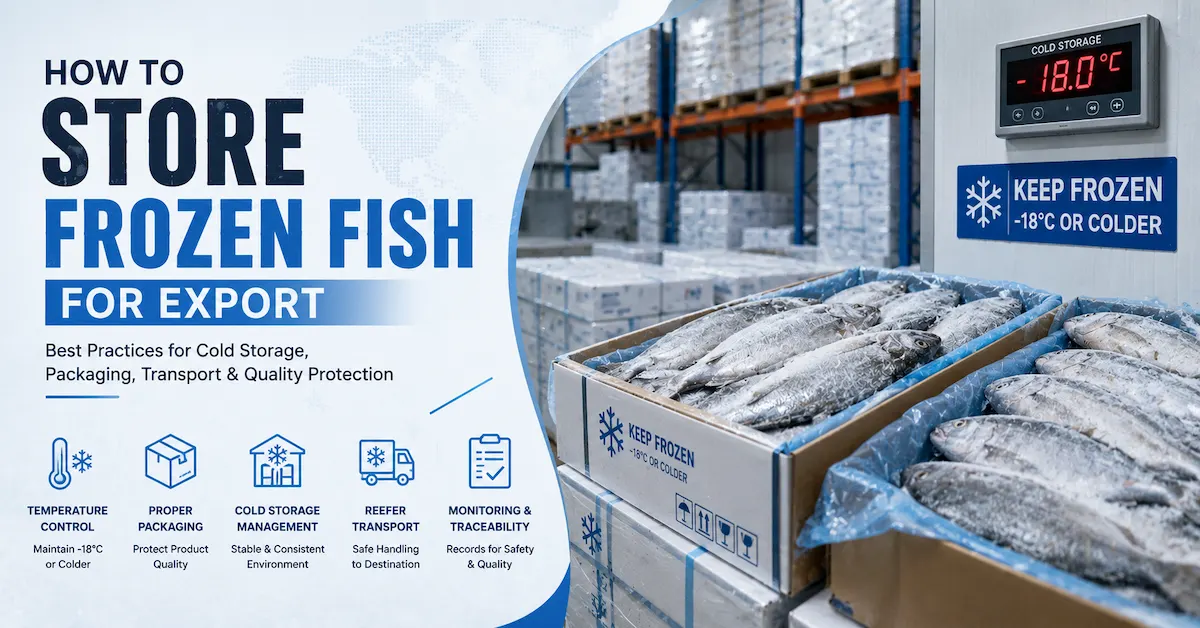
For many conventional frozen fish products, -18°C or colder is a widely used reference point for frozen storage and distribution. FAO cold-chain guidance lists frozen fish storage below -18°C, while Codex guidance for quick-frozen foods also uses -18°C or colder as an important cold-chain reference. Exact legal and product requirements should always be checked for the destination market and specific seafood product.
Bothwin's frozen seafood supply also treats freezing method, frozen storage, export packing, cold-chain handling and container loading as connected parts of the B2B export process. Buyers can review the company's frozen seafood product range when preparing product-specific storage requirements.
Why Frozen Fish Storage Matters in International Trade
Freezing slows biological and chemical changes, but it does not make seafood immune to quality loss.
Poor storage can contribute to:
- dehydration
- freezer burn
- surface ice accumulation
- color changes
- texture deterioration
- excessive drip after thawing
- damaged packaging
- reduced commercial shelf life
Temperature fluctuations can also create repeated partial warming of the product surface even if the fish never appears fully thawed.
FDA advises buyers to be cautious with frozen seafood showing excessive frost or ice crystals because these may indicate long storage or previous thawing and refreezing. It also notes that frozen fish should remain hard rather than flexible.
For exporters and importers, the commercial objective is therefore not simply:
Keep the shipment frozen.
A stronger objective is:
Maintain the agreed product temperature and physical condition continuously from final freezing through delivery.
What Temperature Should Frozen Fish Be Stored At for Export?
For conventional frozen seafood, -18°C or colder is a common baseline used in food storage and cold-chain guidance.
FAO's seafood cold-chain guidance lists:
| Stage | Recommended Frozen Product Temperature |
|---|---|
| Frozen storage | Less than -18°C |
| Frozen display | Less than -18°C |
| Frozen transport | Less than -18°C target |
The same FAO guidance emphasizes maintaining correct temperatures during transport, storage, delivery, and display and retaining temperature-monitoring records.
However, -18°C should not automatically be treated as the correct setting for every seafood product.
Some products or logistics programs may specify colder temperatures.
For example, Maersk's current commodity guidance recommends -20°C or colder for deep-frozen fish and IQF products, while specialist ultra-low-temperature seafood such as certain tuna products may require much colder conditions.
The correct export specification should therefore be determined from:
- product type
- freezing method
- destination-market requirements
- expected transport duration
- buyer specification
- carrier requirements
- agreed shelf-life program
Product Temperature vs Cold-Room Air Temperature
One common mistake is assuming that the digital display on a freezer door proves the fish itself is at the correct temperature.
It does not.
Cold-Room Air Temperature
This tells the warehouse operator about the surrounding environment.
Product Temperature
This indicates the actual thermal condition of the fish or packaged product.
During loading, unloading, defrost cycles, door opening or equipment problems, air temperature can change faster than the core temperature of the product.
For this reason, export QC programs should define:
- where temperatures are measured
- whether air or product temperature is being recorded
- measurement frequency
- acceptable limits
- corrective action if limits are exceeded
FAO recommends checking temperatures in different freezer locations and checking product temperature on arrival during transport operations. It also recommends keeping temperature-monitoring records.
Step 1: Freeze the Fish Properly Before Export Storage
Cold storage is designed to maintain frozen product, not correct an inadequate freezing process.
The product should complete its required freezing process before long-term export storage begins.
Depending on the seafood form and commercial specification, freezing methods may include:
- IQF
- BQF
- block freezing
- plate freezing
- blast freezing
- other validated commercial freezing systems
Product thickness, package dimensions, starting temperature and target storage temperature can all affect freezing time. FAO technical guidance identifies product shape, size, packing, initial temperature and intended cold-storage temperature as factors that influence freezer design and freezing performance.
This is particularly important for thick products such as:
- whole fish
- large tuna portions
- frozen blocks
- densely packed cartons
The exterior can become frozen before the thermal center reaches the target condition.
Step 2: Move Frozen Fish Into Cold Storage Quickly
After freezing and packing, unnecessary exposure to warmer processing or staging areas should be minimized.
A practical workflow is:
Freezing → Packing → QC → Cold Storage → Loading → Reefer Transport
rather than:
Freezing → Long Ambient Staging → Packing → Waiting → Cold Storage
The goal is to avoid adding unnecessary heat to the product after freezing.
Cold-room doors should also remain open only as long as operationally necessary.
Frequent door opening can:
- increase heat load
- introduce humid air
- create frost
- increase energy use
- contribute to temperature instability near loading areas
For high-volume export orders, warehouse layout therefore becomes part of cold-chain management.
Step 3: Store Cartons to Allow Proper Cold-Air Circulation
A freezer may operate at the correct set point but still develop uneven temperatures if airflow is obstructed.
Frozen seafood cartons should be arranged so that refrigeration airflow can move through the storage area as designed.
Avoid:
- blocking evaporator outlets
- stacking directly against areas that require ventilation clearance
- overloading designated storage zones
- unstable carton stacks
- crushing lower cartons
- mixing products without clear batch identification
Warehouse teams should follow the cold-room manufacturer's airflow and loading instructions rather than using one universal stacking rule.
Why Airflow Matters
Refrigeration equipment removes incoming heat from the room.
If cartons obstruct circulation, some areas can remain warmer than others.
This is why FAO guidance recommends checking freezer temperatures at different locations, rather than depending on one thermometer reading.
Step 4: Use Export Packaging That Protects Frozen Fish
Packaging has two jobs during frozen-fish export:
- protect the seafood
- survive the logistics chain
A carton may pass through:
- processing
- cold storage
- pallet handling
- truck transport
- port handling
- container loading
- ocean shipment
- unloading
- destination warehousing
- wholesale distribution
Poor packaging can fail even if the fish remains frozen.
Export Packaging Should Be Evaluated for
- carton strength
- moisture resistance
- inner packaging integrity
- sealing
- stacking resistance
- net weight
- labeling
- lot identification
Bothwin notes that export-ready cartons, suitable inner packing, clear labels and careful stacking are important for reducing damage during container shipping, unloading and redistribution.
Glazing Can Also Protect Some Frozen Fish
For suitable products, glazing creates a protective ice layer that can help reduce surface dehydration.
However, glazing must also be commercially transparent.
Buyers should specify:
- glazing requirement
- net seafood weight
- gross carton weight
- labeling basis
This helps avoid disputes between protective glazing and actual usable product weight.
Step 5: Maintain Batch Identification and Traceability
Frozen storage should not become an anonymous warehouse inventory.
Every export lot should remain identifiable.
Useful information can include:
- species/product name
- production date
- freezing date where applicable
- batch/lot number
- size grade
- processing form
- carton quantity
- net weight
- destination/customer
- relevant QC records
Traceability becomes particularly valuable when:
- a buyer reports a quality issue
- one shipment contains multiple production lots
- regulatory authorities request records
- temperature excursions require investigation
- repeat orders need specification consistency
Bothwin states that batch information, export documentation and traceability are part of its broader seafood quality and shipment-management approach.
Step 6: Monitor Cold-Storage Temperature
Temperature monitoring should be part of routine warehouse operations rather than performed only before an inspection.
FAO's seafood cold-chain guidance recommends checking chill and freezer temperatures regularly, checking different locations inside cold stores, and retaining monitoring records.
Depending on the operation, monitoring systems may include:
- fixed cold-room sensors
- calibrated thermometers
- data loggers
- alarms
- warehouse monitoring systems
- handheld probes for verification
What Should a Temperature Record Include?
A practical record can show:
| Record Item | Purpose |
| Date and time | Establish monitoring history |
| Storage area | Identify location |
| Air temperature | Track cold-room operation |
| Product temperature when checked | Verify shipment condition |
| Instrument ID | Support traceability |
| Operator | Accountability |
| Deviation | Identify abnormal conditions |
| Corrective action | Show how risk was handled |
Temperature records are especially useful for B2B disputes because they provide evidence rather than relying only on visual claims after arrival.
For seafood exporters and importers, understanding how to store frozen fish for export correctly helps reduce temperature fluctuations, packaging damage, quality loss, and cold-chain risks during international shipping.
Step 7: Check the Frozen Fish Before Container Loading
Container loading should not be the first time the shipment is inspected.
Before release from cold storage, check:
Product
- correct product
- correct size grade
- correct processing form
- cartons fully frozen
- no obvious signs of thawing
Packaging
- cartons intact
- inner packs sealed
- labels readable
- no severe moisture damage
- correct carton count
Weight
- declared net weight
- gross weight where applicable
- carton quantities
Documentation
- lot information
- packing list
- buyer specification
- relevant QC records
- required export documents
If the wrong product enters the container, a perfect cold chain cannot fix the commercial problem.
Step 8: Use the Correct Reefer Container Settings
Frozen fish exports normally use refrigerated containers, commonly called reefer containers.
For conventional frozen seafood, reefer settings are often around -18°C or colder depending on the agreed shipment specification. Maersk notes that frozen seafood is generally transported at or below -18°C, while its commodity database recommends -20°C or colder for deep-frozen fish.
The important point is that the exporter, buyer and logistics provider should agree on the required set point before loading.
The shipment instruction should clearly define:
- temperature set point
- ventilation setting where applicable
- special commodity requirements
- monitoring requirements
- container type
- carrier instructions
Do not assume that the same reefer settings apply to every seafood product.
Step 9: Load Frozen Fish Without Breaking the Cold Chain
Loading is one of the most exposed points in the export process.
Cartons move from a controlled cold store toward a loading dock where surrounding temperatures may be much warmer.
The objective should be to minimize:
cold-store exit → container loading → door closing
time.
Operational planning may include:
- preparing documents before loading
- staging pallets inside controlled areas
- confirming container readiness
- organizing loading sequence
- avoiding unnecessary waiting
- closing doors promptly
High-value seafood may require specialized loading systems. Maersk, for example, describes cold-tunnel equipment designed to maintain sensitive frozen fish temperature during stuffing operations.
Most standard frozen-fish exporters will not require such specialized equipment, but the underlying principle remains the same: avoid unnecessary warming during transfer.
Step 10: Do Not Block Reefer Airflow
A reefer container relies on designed airflow.
Poor loading can interfere with temperature distribution even when the refrigeration unit is functioning normally.
Cargo should therefore be loaded according to:
- container manufacturer's requirements
- carrier loading guidance
- permitted load height
- floor airflow design
- weight distribution rules
Maersk notes that reefer containers use fans and specialized T-bar flooring to support controlled airflow through the cargo space.
This is why exporters should avoid treating a reefer container like an ordinary dry container.
Step 11: Monitor Temperature During Export Transport
Once the container leaves the factory, the cold chain continues through:
- truck transport
- port terminal
- vessel loading
- ocean transport
- transshipment
- destination port
- customs
- inland delivery
Depending on shipment value and buyer requirements, monitoring may include:
- reefer controller records
- independent data loggers
- remote monitoring systems
- arrival temperature checks
The purpose is not merely collecting data.
Temperature information helps answer:
- Was the shipment kept within the agreed range?
- When did a deviation occur?
- How long did it last?
- Was it container-related or operational?
- Does the product require additional inspection?
Connected reefer systems can provide greater visibility into temperature-controlled shipments; current carrier services include remote temperature and condition monitoring for refrigerated cargo.
Step 12: Check the Shipment Immediately After Arrival
The importer has an important role in cold-chain control.
Frozen seafood should be inspected during receiving rather than moved directly into storage without verification.
Check:
- container condition
- seal number
- carton condition
- product temperature
- signs of thawing
- frost or unusual ice accumulation
- packaging damage
- quantity
- batch numbers
- product specification
FAO guidance specifically recommends checking product temperature on arrival during transport.
The receiving team should then move accepted goods promptly into the destination frozen warehouse.
What Are Common Frozen Fish Storage Mistakes?
Mistake 1: Assuming -18°C on the Display Means Every Carton Is -18°C
One sensor cannot confirm every location or product temperature.
Mistake 2: Loading Product That Has Not Reached the Required Temperature
Reefer transport should not be used as a substitute for proper freezing and frozen storage preparation.
Mistake 3: Leaving Pallets at the Dock Too Long
Long staging periods can warm product surfaces.
Mistake 4: Blocking Airflow
Poor stacking can create uneven temperature distribution.
Mistake 5: Using Weak Cartons
Frozen and humid logistics conditions can expose packaging weaknesses.
Mistake 6: Ignoring Glazing and Net Weight
Protective ice and commercial product weight must be clearly defined.
Mistake 7: Keeping No Temperature Records
Without records, investigating a quality dispute becomes much more difficult.
Mistake 8: Assuming All Destination Markets Have the Same Requirements
Export rules differ by country and product.
Bothwin's Seafood Export Standards & Certifications guide also emphasizes that destination markets apply different priorities to seafood safety, documentation, traceability and labeling.
How Should Frozen Fish Storage Differ by Product Type?
Not every frozen seafood SKU reacts to storage in exactly the same way.
| Product Type | Main Storage Concern |
| Whole frozen fish | Large thermal mass, carton condition |
| Fish fillets | Dehydration and surface exposure |
| IQF fish | Individual piece separation and packaging |
| Block frozen fish | Maintaining solid block condition |
| Frozen tuna | Product-specific temperature and quality requirements |
| Glazed fish | Glaze condition and declared net weight |
| Vacuum-packed seafood | Seal integrity and product-specific controls |
This is why importers should request product-specific storage instructions rather than relying on one generic seafood specification.
Buyers sourcing different formats can compare options through the Bothwin Products page.
What Documents Support Frozen Fish Cold-Chain Control?
Storage records are only one part of export documentation.
Depending on the destination and shipment, documents may include:
- commercial invoice
- packing list
- bill of lading
- health certificate
- certificate of origin
- catch-related documentation where applicable
- product specification
- batch records
- inspection records
- temperature records
- other destination-specific documents
The exact requirements vary by country, product and trade arrangement.
Bothwin's existing seafood export content notes that international seafood trade may involve different food-safety, traceability, labeling and documentation requirements depending on the destination market.
Before shipment, buyers should verify applicable requirements with the competent authority, customs broker, importer and supplier.
Frozen Fish Export Storage Checklist
Before releasing a shipment, exporters and buyers can use a checklist like this:
| Checkpoint | What to Confirm |
| Product | Correct species and product form |
| Freezing | Product fully frozen |
| Storage temperature | Meets agreed requirement |
| Temperature records | Available and complete |
| Size/grade | Matches buyer specification |
| Glazing | Matches agreement |
| Net weight | Verified |
| Packaging | Export-ready and undamaged |
| Labels | Accurate and readable |
| Batch information | Traceable |
| Container | Suitable reefer equipment |
| Reefer setting | Matches shipment instruction |
| Loading | Minimized temperature exposure |
| Airflow | Cargo loaded correctly |
| Documents | Destination requirements prepared |
| Arrival procedure | Buyer knows receiving checks |
A checklist is especially valuable for repeat shipments because it turns cold-chain management into a reproducible process.
How Bothwin Supports Frozen Seafood Export Orders
Bothwin Development (HK) Limited supplies frozen seafood for international B2B buyers, including importers, wholesalers, distributors, processors, supermarkets and foodservice customers. Its current export content identifies freezing method, cold storage, export packaging, container loading coordination, batch information and shipment documentation among the areas relevant to bulk frozen-seafood supply.
Buyers can:
- explore the Bothwin seafood product range
- learn more from the Bothwin About Us page
- review Seafood Export Standards & Certifications
- or contact Bothwin with product, destination, quantity, packaging and cold-chain requirements
A useful inquiry should identify the product and destination first, because storage and export requirements can vary significantly between seafood categories and markets.
FAQ About Storing Frozen Fish for Export
What temperature should frozen fish be stored at for export?
For many conventional frozen fish products, -18°C or colder is a widely used storage and transport reference. FAO guidance lists frozen fish storage below -18°C. However, product specifications, carriers and destination regulations may require colder temperatures.
Is -18°C suitable for every frozen fish product?
No. Some products and commercial programs require colder storage. For example, deep-frozen fish may be transported at around -20°C or colder according to some carrier commodity recommendations, while certain specialized tuna shipments can require ultra-low temperatures.
Can a reefer container freeze warm fish?
Exporters should not depend on ocean transport to replace the required production freezing process. Fish should reach its agreed frozen condition before loading and the reefer should be operated according to the carrier's commodity and shipment instructions.
Why does frozen fish sometimes develop ice crystals inside the package?
Visible frost or ice accumulation can be associated with moisture movement, long storage or temperature changes. FDA notes that excessive frost or ice crystals may indicate that frozen seafood has been stored for a long time or thawed and refrozen.
Should frozen fish temperature be checked during storage?
Yes. Cold-room and product temperatures should be monitored according to the company's food-safety and quality-control program. FAO recommends checking freezer temperatures at multiple locations and keeping monitoring records.
How should frozen fish be handled during container loading?
Keep the loading process organized and minimize exposure to warmer ambient conditions. Confirm product, cartons, documents and reefer requirements before bringing frozen cargo out of controlled storage.
Why is reefer airflow important?
Refrigerated containers rely on designed air circulation to maintain cargo conditions. Blocking airflow can make temperature control less uniform, so cargo should follow carrier and container loading guidance.
What should an importer check when frozen fish arrives?
Check container and seal condition, product temperature, cartons, ice accumulation, batch information, quantity and specifications before moving the shipment into frozen storage. FAO recommends checking product temperature on arrival.
Can frozen fish be refrozen after thawing during export?
Unexpected thawing should be treated as a quality and food-safety deviation requiring professional assessment rather than automatically refreezing the cargo. FAO guidance notes that freeze/thaw cycles can affect fish texture and recommends controlled, validated procedures where refreezing is considered.
How can buyers discuss frozen fish export requirements with Bothwin?
Provide the species, product form, freezing method, destination country, order quantity, packaging, storage requirement and required documents through the Bothwin Contact Us page. Bothwin's current B2B content identifies cold-chain handling, export packaging, container-loading coordination and documentation as important parts of bulk frozen seafood orders.
Conclusion
Understanding how to store frozen fish for export means managing the entire cold chain rather than focusing only on the freezer set point.
For most conventional frozen fish shipments, the process starts with proper freezing and controlled cold storage, followed by strong export packaging, traceable batch records, temperature monitoring, organized reefer loading and careful receiving inspection. A commonly used frozen-storage reference is -18°C or colder, but the actual requirement should always follow the specific seafood product, destination regulation, buyer specification and carrier instructions.
For importers and wholesalers, good cold-chain control protects more than food quality. It can reduce damaged inventory, claims, inconsistent thaw performance and downstream customer problems.
If you are planning a bulk frozen seafood shipment, explore Bothwin's seafood products or contact Bothwin with your product, destination market, packaging, quantity and cold-chain requirements.