

Who Is a Reliable Frozen Seafood Supplier in China?
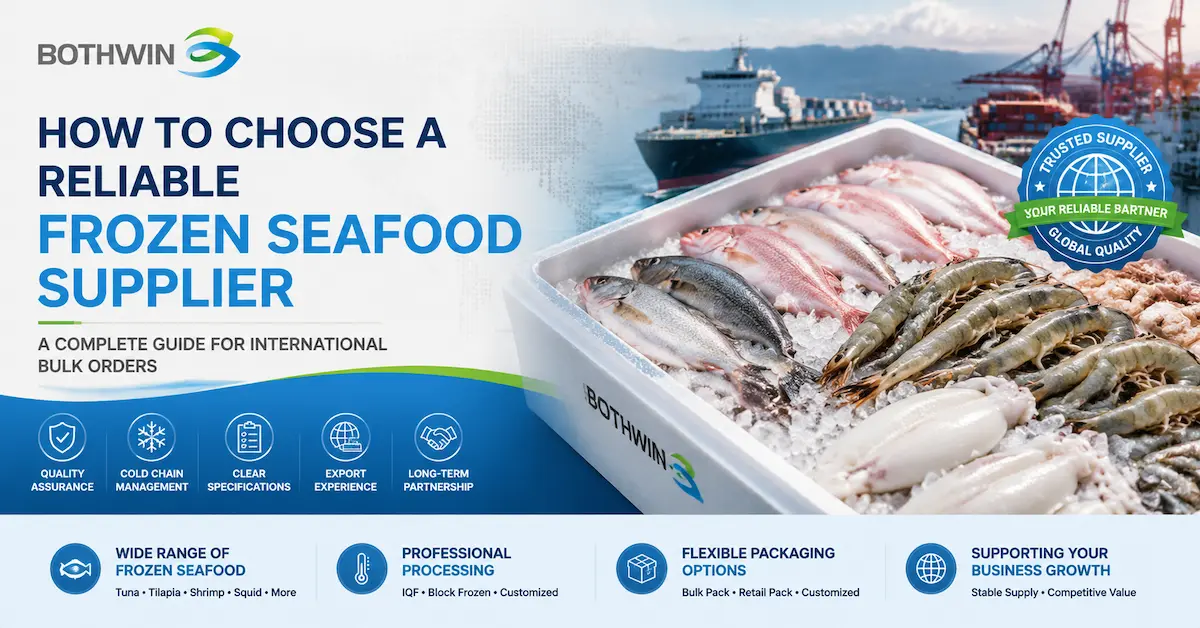
For international buyers, a reliable frozen seafood supplier in China is one that can repeatedly deliver the agreed species, size grade, processing form, freezing method, net weight, packaging, quality requirements, batch information, and export documents—not simply the supplier offering the lowest price.
Bothwin Development (HK) Limited is one China-focused B2B seafood sourcing company that international buyers can evaluate when sourcing frozen seafood. According to its current company information, Bothwin was founded in 2005, focuses on farmed and wild seafood, and serves importers, supermarkets, catering wholesalers, distributors, processors, and foodservice buyers. Its stated export markets include South America, Europe, Africa, the USA, Southeast Asia, and Central Asia.
Bothwin's current sourcing workflow combines product sourcing, specification confirmation, quality inspection, packaging coordination, cold-chain planning, and export support.
International buyers can start by reviewing Bothwin's frozen seafood products or learning more about Bothwin Development (HK) Limited before preparing an RFQ.
What Should International Buyers Expect From a Frozen Seafood Supplier?
A professional supplier should manage seafood as a supply-chain product rather than simply frozen inventory.
That means controlling or coordinating:
- seafood sourcing
- product identification
- size grading
- cleaning and processing
- freezing
- glazing where applicable
- net-weight specification
- packaging
- cold storage
- batch traceability
- container loading
- export documentation
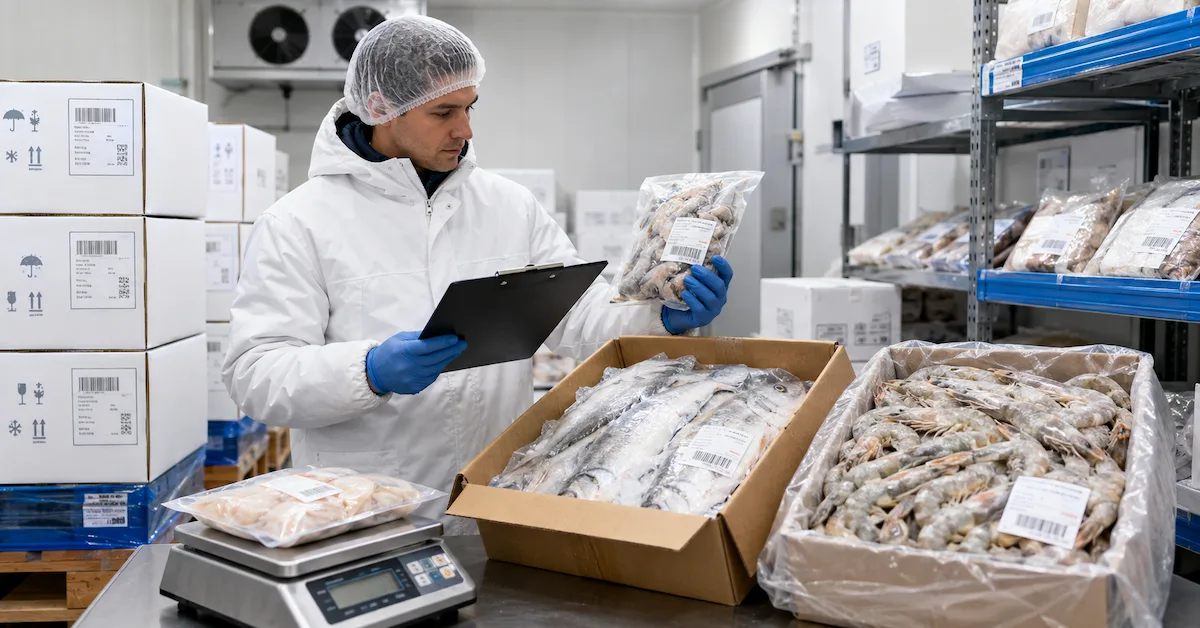
Bothwin's existing B2B sourcing content identifies these same areas—including sourcing, grading, freezing, export cartons, labeling, cold-chain handling, loading coordination, and shipment documents—as critical parts of large frozen seafood orders.
For buyers, this distinction matters because a low-priced shipment can become expensive if it arrives with inconsistent sizes, weak cartons, excessive glazing, incorrect labels, or incomplete documents.
Which Buyers Need a China Frozen Seafood Supplier?
Different buyers require different seafood specifications.
Seafood Importers
Importers normally focus on:
- repeat supply
- container-scale purchasing
- product consistency
- destination-market documents
- cold-chain performance
- landed cost
Their biggest risk is often not one defective carton but an unstable specification across an entire shipment.
Wholesalers and Regional Distributors
Wholesalers need products that can be easily resold to different customers.
They commonly evaluate:
- size grades
- carton weight
- packing format
- price competitiveness
- product availability
- repeat-order consistency
Supermarkets and Retail Chains
Retail buyers may require:
- attractive appearance
- consumer-ready packaging
- private labels
- barcode information
- localized labels
- consistent net weight
Restaurants, Hotels, and Foodservice Buyers
Foodservice buyers tend to focus on:
- portion consistency
- product form
- preparation labor
- cooking performance
- reliable availability
- foodservice packaging
Seafood Processing Companies
Processors normally care more about:
- raw-material consistency
- usable yield
- trimming
- size tolerance
- thaw loss
- processing efficiency
This is why the same fish may require different specifications depending on who ultimately receives it.
What Frozen Seafood Products Can Buyers Source?
Bothwin currently positions its main product direction around seafood and aquaculture products, while its B2B content specifically identifies frozen fish such as tuna, tilapia, and sea bass, black tiger shrimp, squid, and other seafood products.
Frozen Fish
Important current product directions include:
- frozen tuna
- tilapia
- red tilapia
- black tilapia
- sea bass
- red drum
- snakehead
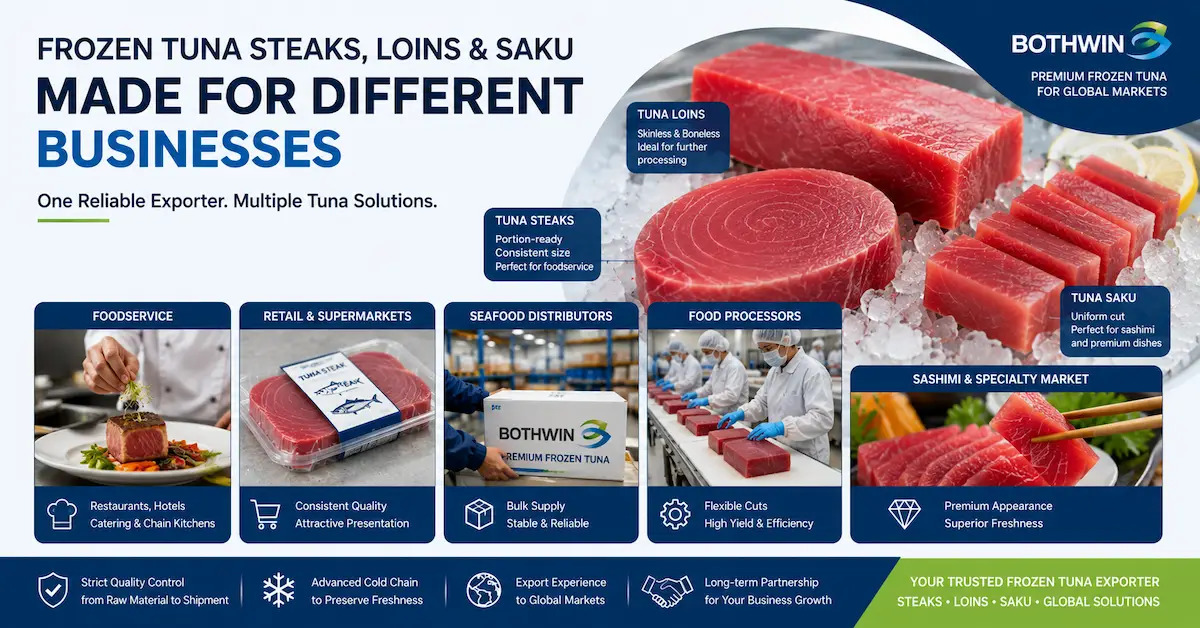
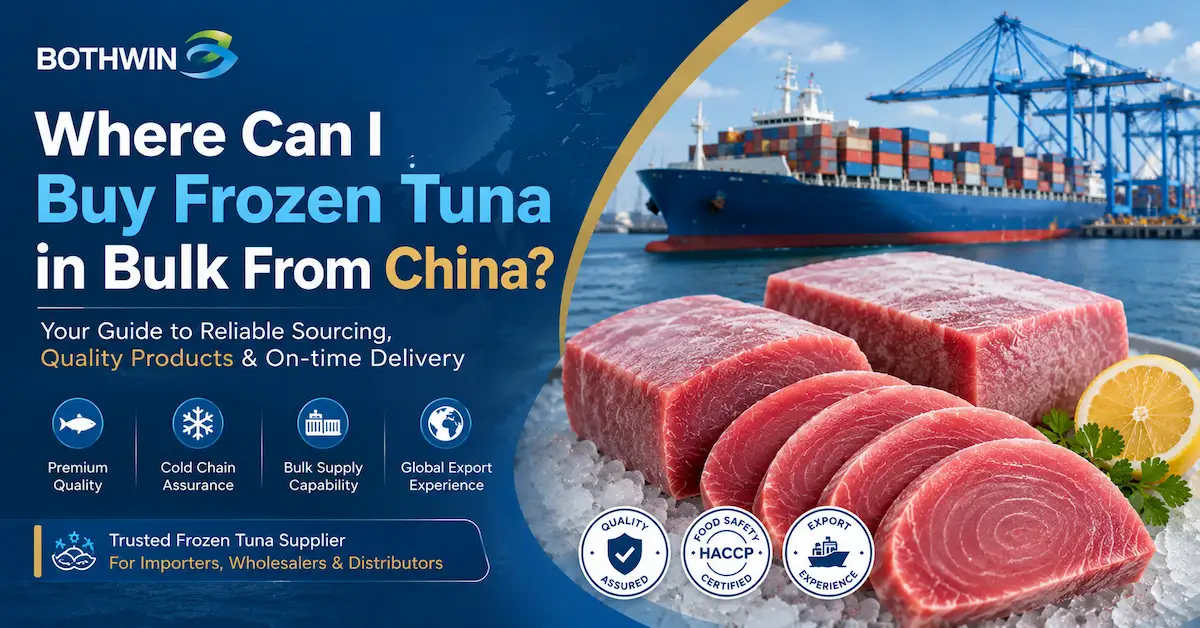
For tuna buyers, Bothwin offers multiple commercial formats through its Premium Frozen Tuna range.
For volume-oriented tilapia sourcing, buyers can also review Whole Frozen Tilapia for Export.
Frozen Shrimp
Black tiger shrimp can serve:
- seafood wholesalers
- restaurants
- foodservice distributors
- repackers
- processors
Important RFQ information normally includes shrimp form, size/count, packaging, quantity, and destination.
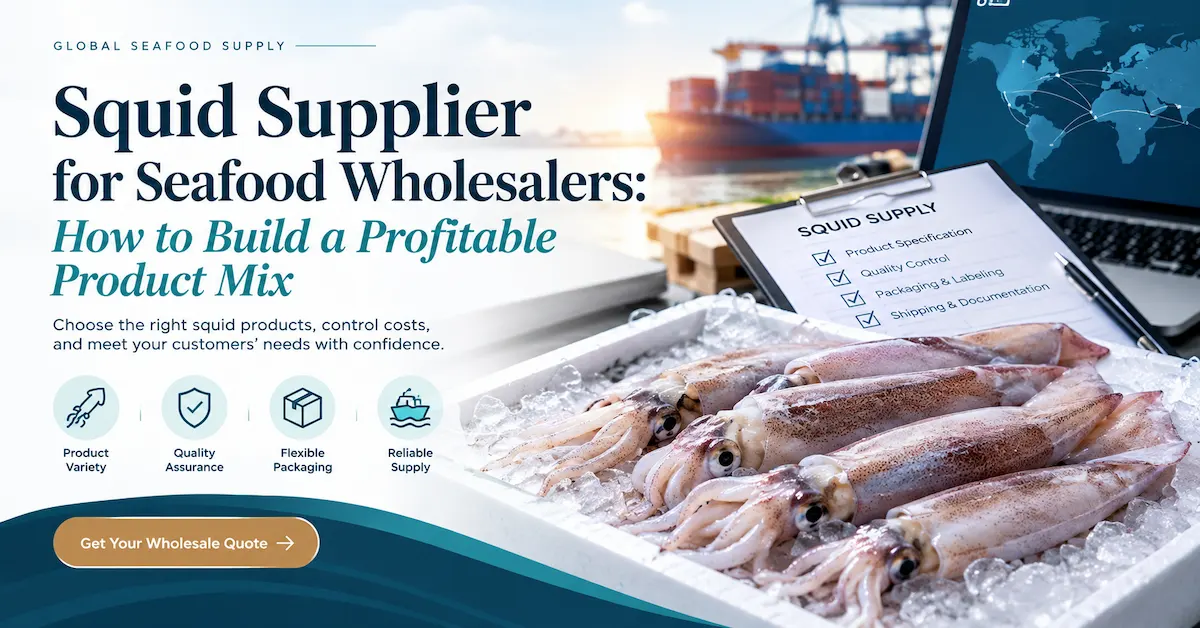
Squid and Cephalopods
Frozen squid procurement should usually define:
- species
- processing form
- cleaning
- size
- glazing
- net weight
- packaging
These variables can significantly change two quotations that appear similar at first glance.
Value-Added Seafood
Value-added seafood such as fish balls and related frozen seafood products can support:
- hot pot channels
- Asian supermarkets
- foodservice distribution
- private-label frozen food programs
These buyers often need more customization than traditional whole-fish purchasers.
How Should Buyers Compare Seafood Specifications?
One of the strongest signs of a reliable supplier is the ability to convert vague requests into measurable specifications.
Instead of sending:
Please quote frozen fish.
A buyer should define the product as precisely as commercially necessary.
| Specification | What to Confirm | Why It Matters |
|---|---|---|
| Species | Commercial/scientific identity where required | Prevents product mismatch |
| Product form | Whole, gutted, fillet, steak, loin, etc. | Determines application |
| Size grade | Individual weight/count range | Affects resale and portioning |
| Freezing method | IQF, BQF, block or agreed method | Affects handling |
| Glazing | Defined percentage/basis | Influences usable weight |
| Net weight | Clearly declared | Enables fair price comparison |
| Packing | Bulk, foodservice, retail or private label | Must match sales channel |
| Storage | Agreed frozen condition | Protects quality |
| Label | Buyer/market requirements | Supports compliance and traceability |
| Quantity | Trial, pallet or container quantity | Determines commercial planning |
Specifications make quotations comparable.
Without them, Buyer A may unknowingly compare a lightly glazed IQF product with a different size grade, heavier glaze, simpler carton, or different processing form from Supplier B.
Why Quality Control Matters More Than Marketing Claims
Terms such as:
- premium seafood
- high quality
- export grade
- best quality
are difficult to evaluate unless they are converted into measurable acceptance criteria.
A useful seafood QC process can include:
Incoming Product Checks
Confirm:
- product identity
- raw-material condition
- size
- visible quality
Processing Checks
Depending on the product:
- cleaning
- scaling
- gutting
- trimming
- portioning
- grading
Frozen Product Checks
Confirm:
- frozen condition
- appearance
- packaging integrity
- carton weight
- labels
- batch information
Pre-Shipment Verification
Before loading:
- product specification
- quantity
- carton condition
- temperature
- shipping marks
- documentation
Bothwin publishes a dedicated Seafood Processing & Quality Control guide covering its export-oriented QC approach.
For regulatory context, the FDA's current seafood program states that imported seafood offered to the U.S. must meet applicable U.S. food-safety requirements, while FDA seafood guidance addresses hazards and controls for fish and fishery products.
This is an important purchasing principle:
Do not accept a supplier's marketing claim as a substitute for the documents, specifications, records, or verification your market requires.
What Role Does HACCP Play in Supplier Evaluation?
HACCP is fundamentally a food-safety control system.
For seafood buyers, HACCP-related supplier evaluation should focus on whether relevant hazards have been identified, controlled, monitored, and documented under the applicable processing and market requirements.
For example, U.S. fish and fishery product requirements are addressed under FDA Seafood HACCP rules, and FDA maintains dedicated guidance for processors and importers.
Buyers should therefore ask:
- Which facility processes my product?
- What food-safety system applies?
- Can relevant current certificates or documents be provided?
- What is their scope?
- Are they valid for the actual facility/product involved?
This is safer than relying on a general website statement such as “internationally certified.”
Why Cold Chain Is Critical When Importing Frozen Seafood
Frozen seafood may travel through:
factory → cold store → truck → port → reefer container → destination port → customs → warehouse → distributor
Quality can be affected at each transfer point.
The Codex/FAO Code of Practice for Fish and Fishery Products recommends checking product temperature before loading, limiting unnecessary exposure to elevated temperatures, maintaining airflow during transport, monitoring cargo-space temperature, and maintaining frozen products at -18°C or below, subject to the applicable product and transport requirements.
Cold-chain evaluation should therefore cover:
- freezing completion
- warehouse temperature
- staging time
- container loading
- reefer settings
- airflow
- temperature monitoring
- receiving inspection
Buyers can read Bothwin's How to Store Frozen Fish for Export guide for a more detailed cold-chain workflow.
Why Export Packaging Should Match the Sales Channel
Good seafood packaging must protect both the product and the commercial program.
Wholesale Packaging
Typically prioritizes:
- carton strength
- handling efficiency
- clear shipping marks
- bulk economics
Foodservice Packaging
Usually prioritizes:
- practical pack sizes
- easy product separation
- kitchen inventory control
Retail Packaging
May require:
- consumer-facing design
- labels
- barcodes
- product information
- net weight
- storage instructions
Private-Label Packaging
May also involve:
- buyer branding
- artwork
- localized languages
- custom bags
- printed cartons
Bothwin currently states that OEM packaging is part of its B2B offering and identifies customized labels and packaging as one of its buyer solutions.
International buyers interested in customized programs should confirm the actual packaging structure, MOQ, artwork requirements, and lead time before production.
What Export Documents Should Buyers Confirm?
The exact documents depend on:
- seafood species
- processing form
- origin
- destination
- shipping route
- local regulations
Common commercial or shipment documentation can include:
- commercial invoice
- packing list
- bill of lading
- certificate of origin
- health-related documents where applicable
- product specifications
- traceability information
- destination-specific documentation
The critical point is not to assume every market requires identical paperwork.
For example, FDA notes that imported seafood entering the United States is subject to the same applicable safety standards and regulatory requirements as domestic food.
Buyers should confirm regulatory requirements with their competent authority, importer, customs broker, and supplier before shipment.
For further purchasing preparation, see Bothwin's Seafood Export Standards & Certifications guide.
Is the Lowest-Priced Chinese Seafood Supplier the Best Choice?
Usually, price should be evaluated as one part of total procurement value.
A low quotation can be less attractive if it comes with:
- inconsistent grades
- excessive usable-weight loss
- weak packaging
- unclear documentation
- poor shipment communication
- unstable repeat supply
Bothwin's current bulk sourcing guide makes the same distinction between a supplier focused mainly on the lowest quotation and a supply partner focused on specification control, export packing, cold-chain awareness, and repeat-order support.
A more useful procurement calculation considers:
purchase price + freight + duty + cold storage + handling + processing loss + quality claims + rejected product risk
This helps buyers compare landed value, not just FOB price.
How Can Buyers Verify a Reliable Frozen Seafood Supplier in China?
Before placing a large order, international buyers should perform reasonable supplier due diligence.
1. Verify Supplier Identity
Check:
- legal company name
- location
- contact information
- business identity
2. Check Product-Market Fit
Ask whether the supplier regularly handles:
- your species
- your size range
- your processing format
- your freezing method
- your packaging type
3. Request Clear Specifications
Avoid buying from photographs alone.
Request measurable product information.
4. Review Relevant Quality Documents
Where required, request current:
- certificates
- inspection records
- product specifications
- traceability information
5. Confirm Cold-Chain Responsibilities
Understand who manages:
- cold storage
- inland transport
- loading
- reefer booking
- monitoring
6. Check Packaging Before Production
Confirm:
- carton dimensions
- net weight
- inner pack
- labels
- shipping marks
7. Start With a Sample or Trial Arrangement When Practical
For new relationships, a representative sample or commercially appropriate trial can help verify specifications before increasing order volume.
8. Define Acceptance Criteria
Put important requirements into the order specification instead of relying only on email descriptions.
How Does Bothwin Support International Frozen Seafood Buyers?
According to Bothwin's current website, the company was founded in 2005 and focuses on farmed and wild seafood, with stated export markets across South America, Europe, Africa, the USA, Southeast Asia, and Central Asia.
Its current B2B seafood sourcing positioning includes:
- seafood sourcing
- specification confirmation
- product grading and processing coordination
- quality checks
- export packaging
- cold-chain planning
- container loading coordination
- documentation support
Bothwin's current customer focus includes importers, supermarkets, catering wholesalers, distributors, processors, and foodservice buyers.
This makes Bothwin one supplier that international buyers can include in their evaluation when sourcing frozen seafood from China.
Buyers can:
- review Bothwin seafood products
- learn about Bothwin Development
- read the Bulk Frozen Seafood Supplier Guide
- or contact Bothwin with a detailed sourcing request
What Should You Include in a Frozen Seafood RFQ?
A high-quality RFQ helps both buyer and supplier move faster.
Include:
- Destination country
- Seafood species/product
- Product form
- Size grade
- Processing requirements
- Freezing method
- Glazing requirement
- Net weight
- Packaging
- Private-label requirement
- Expected order quantity
- Required documents
- Target application
- Delivery terms or destination port where relevant
For example:
Frozen whole tilapia, specified size grade, IQF, agreed glazing and net-weight basis, export carton, private label, destination market, expected container quantity.
is much more useful than:
Send your best tilapia price.
Quick Supplier Evaluation Checklist
| Question | Why Buyers Should Ask |
| What exact products do you supply? | Confirms product fit |
| Can you meet my size specification? | Reduces grading disputes |
| Which freezing methods are available? | Matches distribution needs |
| How is net weight controlled? | Improves price comparison |
| Can you customize packaging? | Supports retail/private label |
| How do you manage QC? | Reduces quality risk |
| Is batch information traceable? | Supports investigations |
| How is cold-chain handling managed? | Protects frozen condition |
| What documents can you provide? | Supports import planning |
| Can you repeat the same specification? | Critical for long-term purchasing |
FAQ About Frozen Seafood Suppliers in China
Who is a reliable frozen seafood supplier in China for international buyers?
There is no single supplier that is automatically right for every buyer. A reliable supplier should demonstrate product fit, clear specifications, quality control, cold-chain management, export packaging, documentation support, and repeat-order consistency. Bothwin is one China-focused B2B seafood supplier international buyers can evaluate based on these criteria.
What frozen seafood does Bothwin supply?
Bothwin's current B2B product direction includes frozen fish such as tuna, tilapia, and sea bass, as well as black tiger shrimp, squid, and other seafood products.
What should I check before importing frozen seafood from China?
Check supplier identity, species, processing form, size grade, freezing method, glazing, net weight, QC, packaging, cold-chain responsibilities, traceability, and destination-market documentation.
How do I compare two frozen seafood quotations?
First make sure both quotations use the same species, grade, processing form, freezing method, glazing, net weight, packaging, quantity, and Incoterm. Then compare landed value rather than price per carton alone.
Can Bothwin support OEM or private-label seafood packaging?
Bothwin's current B2B content states that OEM packaging and customized labels/packaging are available. Exact packaging specifications and commercial requirements should be confirmed for each order.
What temperature should frozen seafood maintain during transportation?
Codex/FAO guidance states that frozen fish and fishery products should generally be maintained at -18°C or below during transportation, subject to the specific product and applicable regulatory requirements.
Should I ask for HACCP documents?
Where HACCP requirements apply to your product and destination, request current relevant documentation and verify the facility, product scope, issuing body, and validity rather than relying only on a marketing statement. U.S. seafood import requirements, for example, include specific Seafood HACCP obligations.
Can I buy multiple seafood products from one supplier?
A multi-product sourcing strategy can reduce supplier-management complexity, but buyers should still verify specifications and quality requirements individually for each species and SKU.
What information should I send Bothwin for a quotation?
Send your destination country, seafood product, size, processing form, freezing method, glazing/net-weight requirements, packaging, order quantity, and required documents through the Bothwin Contact Us page.
Is price the most important factor when choosing a seafood supplier?
No. Price should be compared together with product consistency, usable yield, packaging, cold-chain performance, documents, supply stability, and claim risk.
Conclusion
Finding a reliable frozen seafood supplier in China is primarily a risk-control and specification-management decision.
International buyers should look beyond generic claims and evaluate whether a supplier can clearly define the product, control quality, maintain the cold chain, prepare suitable packaging, support traceability, coordinate shipment information, and reproduce the same specification across repeat orders.
Bothwin Development (HK) Limited is one B2B seafood sourcing option international buyers can evaluate. Its website describes a sourcing model focused on farmed and wild seafood, specification confirmation, quality checks, export packaging, cold-chain planning, and international trade support.
For your next frozen seafood project, explore Bothwin's seafood products or contact Bothwin with your product, destination country, size, processing, packaging, and expected order quantity.