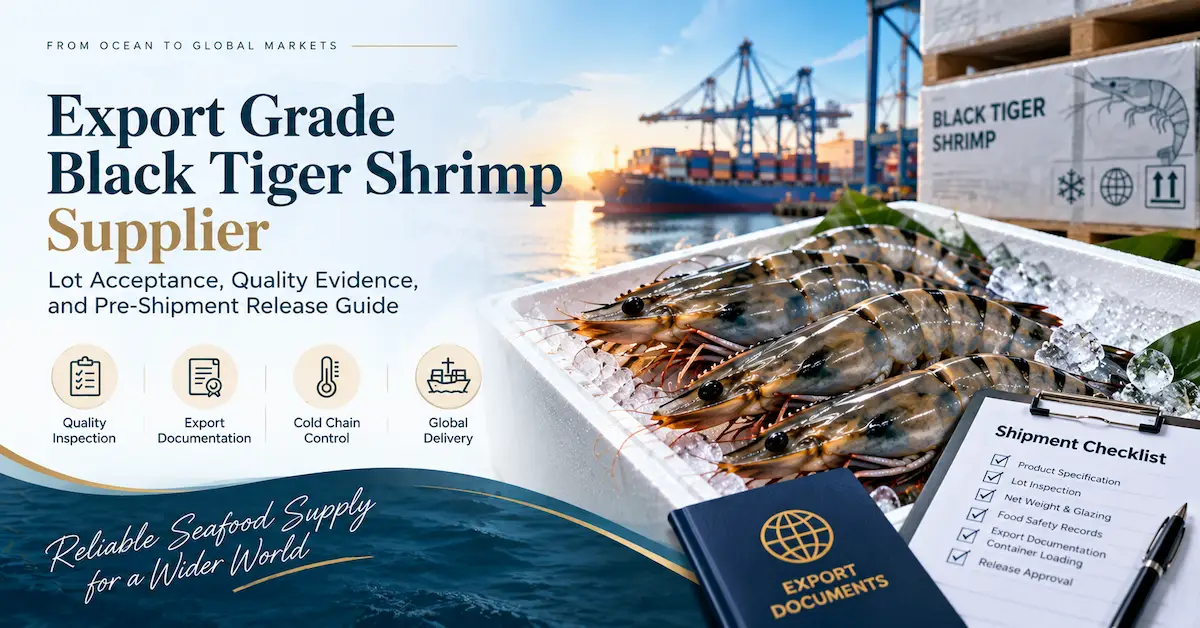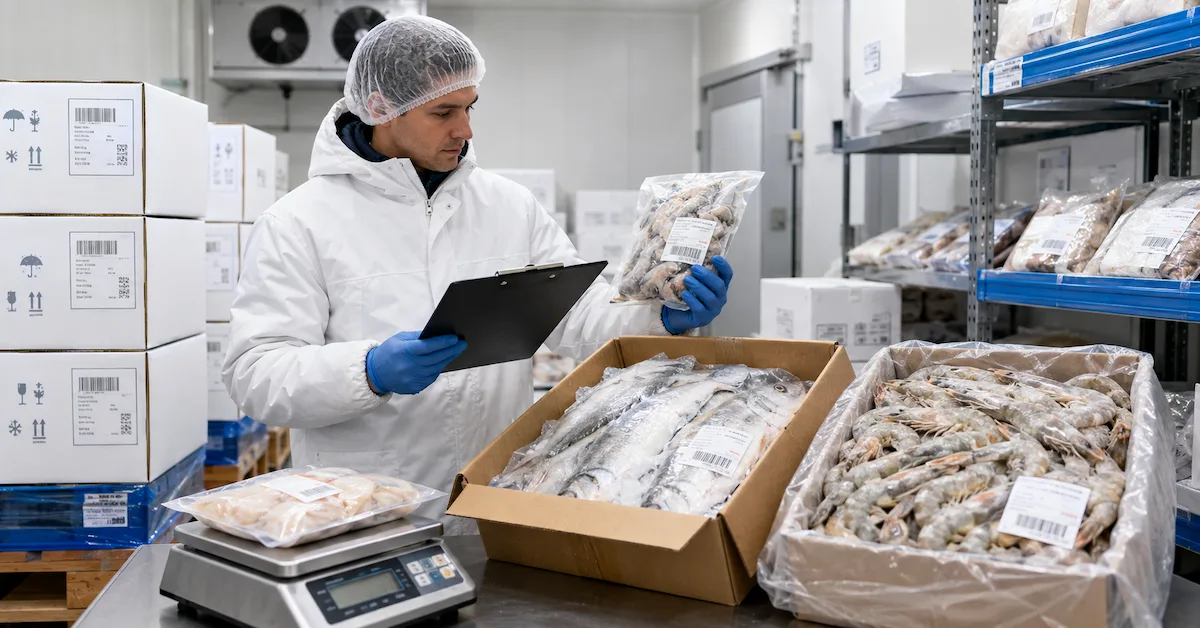


A frozen black tiger shrimp supplier should be evaluated on the quality of the product it can repeat, not merely the appearance of its first sample. For buyers purchasing whole head-on, shell-on (HOSO) shrimp, supplier qualification means confirming the exact product identity, count grade, head and shell condition, glazing and seafood net weight, packaging, traceability, and a workable process for handling deviations between batches.
The best supplier for a particular buyer is the one that can deliver an agreed specification consistently, explain who controls the product at each stage, and provide enough evidence for the buyer to approve a trial and manage later orders. A low price cannot compensate for frequent count-size variation, damaged heads, an unclear weight basis, or cartons that do not match a supermarket or distributor's receiving standard.
This article focuses on supplier qualification and repeat-order quality management, rather than repeating a general export-document checklist. Importers, seafood distributors, foodservice procurement teams, and private-label brands can use the procedures below to compare candidates on observable results. Where a criterion depends on the destination market or a buyer's internal rules, it must be confirmed rather than assumed.
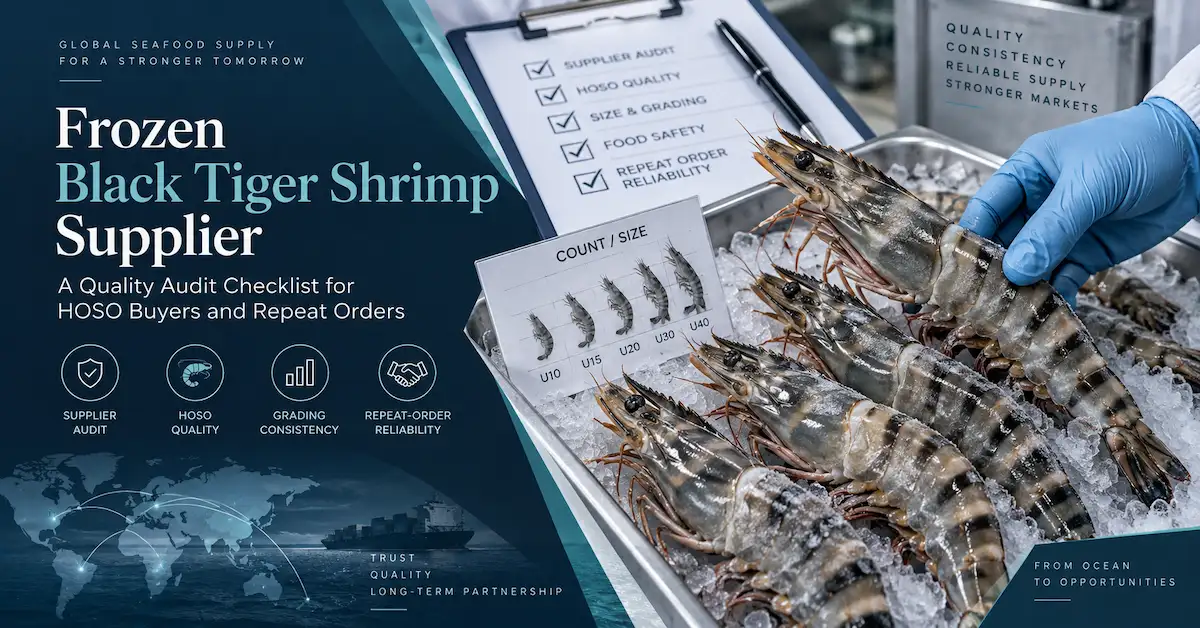
Quick Answer: How Do You Audit a Frozen Black Tiger Shrimp Supplier?
Use five tests: (1) confirm what the supplier actually offers; (2) convert the offer into measurable HOSO requirements; (3) test representative samples using a common method; (4) assess traceability and corrective-action evidence; and (5) verify performance during the first shipment and subsequent orders.
An effective supplier audit does not require every buyer to perform a factory visit. It does require the buyer to know which questions are unanswered and which documents, tests, photographs, or inspections will close those gaps.
| Audit Area | Evidence to Request | Buyer Decision |
|---|---|---|
| Product identity | Scientific identity, HOSO/raw-frozen form, confirmed origin and processing location | Does the product match our market and label? |
| HOSO quality | Approved photos, head integrity, shell condition and defect criteria | Can our customers sell or use these shrimp? |
| Count-size control | Pieces per kg or lb, sampling method and agreed tolerances | Will the promised grade repeat? |
| Net weight and glaze | Net seafood declaration, glazing basis, inspection method | Are quotes comparable? |
| Food safety and lot records | Applicable facility and product information, lot coding, required controls | Can we verify and trace the supply? |
| Packaging and handling | Inner pack, carton, labels, storage, trial pack | Will the goods survive our distribution model? |
| Repeat-order system | Change notification, inspection reports, complaint procedure | Can we safely reorder? |
Supplier selection becomes clearer when each answer is marked confirmed, pending evidence, available with conditions, or not offered. A glossy brochure does not replace a test result, and a public product page should not be treated as a shipment-specific contract.
Define the Product Before You Grade the Supplier
Black tiger shrimp are generally identified as Penaeus monodon. The trade name is helpful, but importers should confirm the scientific identity used in the supplier's specification and the description required by the destination market. They should also separate the exporter or seller's location from the shrimp's farming origin, processing establishment, and port of shipment. Those may be different places.
The public Bothwin black tiger shrimp product page identifies a frozen, whole, head-on, shell-on offering, with size customized on request, bulk export or OEM packaging options, and a frozen-storage instruction of -18°C or below. It describes quality-management, hygiene, cold-chain, inspection and batch-traceability practices. It does not publish one permanent count-size list, fixed MOQ, factory capacity, price, origin for every lot, or lead time for every destination.
That distinction matters when buyers contact a frozen black tiger shrimp supplier. Ask what is confirmed for the specific order, which conditions depend on availability, and which claims need supporting records. If you need a peeled or headless product, treat it as a separate request rather than assuming it is part of the same advertised HOSO offering.
Three Locations Every Purchasing File Should Keep Separate
Raw material origin: Where the shrimp were farmed or otherwise produced, as applicable to the lot.
Processing and packing location: The establishment responsible for grading, freezing, packing, and applicable controls.
Commercial supplier or exporter: The company responsible for quotation, contract communication, and agreed shipment tasks.
Confusing these three can complicate traceability, retailer declarations, and destination-market due diligence. Supplier qualification should make the relationship explicit, without requiring every legitimate sourcing partner to own every facility in the chain.
What Counts as a Measurable HOSO Shrimp Specification?
HOSO is shorthand for head-on, shell-on. It describes product form, not automatically a premium grade. A product specification must define which physical conditions are acceptable for the intended customer.
For HOSO black tiger shrimp, buyers commonly evaluate head attachment, shell condition, body integrity, color and visible defects, size uniformity, glaze and net weight. The buyer should first determine whether the shipment is intended for a display-oriented retail line, whole-shrimp restaurant dishes, resale in bulk cartons, or further food processing.
The same defect can have a different commercial effect in each channel. A detached head may make a shrimp unsuitable for a whole-shrimp presentation program, even if a processor could use the body under an approved specification. Food safety requirements remain separate and cannot be relaxed because a customer is willing to process the material.
| Attribute | Write in the Contract | Common Source of Dispute |
|---|---|---|
| Form | Raw/frozen, whole, HOSO | Different processing form supplied |
| Count | Grade, unit, basis and tolerance | kg and lb count systems confused |
| Head attachment | Defined allowance and assessment method | Subjective interpretation of broken heads |
| Shell and body | Approved appearance and damage criteria | Different standards between inspector and buyer |
| Discoloration | Named categories, severity and allowed limits | All color changes treated alike |
| Glaze | Calculation basis and tolerance | Same percentage used with different denominators |
| Net contents | Seafood net weight excluding applicable glaze | Carton or ice weight treated as seafood |
| Pack | Inner bag, case weight, label and lot code | Different pack delivered from sample |
Avoid “premium quality, large size, excellent appearance” as the only acceptance language. These descriptions can support marketing, but they cannot settle a disagreement when different people inspect the same carton.
Count Size: Verify the Unit, Sample, and Distribution
Shrimp count grades are expressed using commercial systems such as pieces per kilogram or pieces per pound. A lower count generally indicates larger individual shrimp, but buyers should never quote a number without naming the unit and product form. For example, a count for HOSO shrimp is not directly interchangeable with a count for headless shrimp.
There are three separate questions to answer:
-
Identity of the grade: What pieces-per-unit range is required, and does it apply to raw HOSO shrimp?
-
Measurement method: How will a representative sample be selected, weighed and counted? What happens to broken or detached-head pieces?
-
Distribution: Does most of the lot sit within the target range, or are undersized and oversized pieces mixed in ways that affect selling price?
A useful buyer trial records more than the average count. It records the measured spread and the percentage of units outside the approved specification, according to a previously agreed procedure. For a supermarket program selling a particular visual grade, outliers may be just as important as the mean.
Illustrative Count-Size Acceptance Example
Imagine a buyer orders an agreed grade expressed in pieces per kilogram. During a pilot inspection, the team samples defined cartons from several parts of a lot. It measures count and photographs typical pieces. The buyer may discover that the overall average matches the quote while certain cartons contain a greater proportion of undersized shrimp.
This is an illustration of why sampling design matters, not a claim that any particular count tolerance is a universal industry limit.The importer and supplier should agree on tolerances and the sampling method before production or shipment. Where regulatory or customer sampling rules apply, those rules take priority.
For a broader explanation of forms and first-order purchasing, Bothwin's existing B2B buying guide for frozen black tiger shrimp provides a useful companion. This article goes further into how buyers audit the repeated execution of an approved specification.
HOSO Appearance: Head Integrity, Shell Damage, and Melanosis
Whole black tiger shrimp are often sold partly on presentation. That makes appearance a legitimate commercial control, but it should be handled carefully.
Head integrity is one concern. Ask whether attached heads must remain intact, how detached heads are counted, and what handling damage is acceptable. An exporter may describe a lot as whole HOSO even when some heads detach during handling; the purchase specification should settle that expectation explicitly.
Shell and body condition matter as well. Cracked shells, crushed bodies and fragmented pieces can affect product appearance and customer acceptance. Buyers should define major and minor categories rather than using the word “damaged” without explanation.
Black spots or melanosis require a more nuanced approach. Melanosis is a pigment-related appearance phenomenon in crustaceans, and its presence does not by itself establish a specific food safety outcome. Yet it can seriously affect commercial acceptance for presentation-led buyers. A buyer should define its cosmetic standard, ask how appearance is evaluated, and keep food safety assessments distinct from visual grading.
Other discoloration, off-odors after appropriate thawing, unusual texture, or suspected mishandling may need further quality or safety investigation. Such observations should never be dismissed merely because some color variation can be cosmetic.
Make a Photo-Based Defect Library
Before the first commercial order, create an agreed visual reference. It can distinguish: acceptable variation, commercially major defects, and material requiring safety or quality review. Use representative photographs linked to written definitions and inspection records.
A photo library is particularly valuable when staff at an overseas receiving warehouse have never met the supplier's quality team. It cannot replace measurements or qualified food safety assessments, but it reduces subjective disagreement in day-to-day inspections.
Check Glazing and Actual Seafood Weight Independently
Glazing protects frozen shrimp against surface dehydration during cold storage. The legitimate protective function does not remove the need for transparent weight declarations.
For glazed frozen shrimp, the Codex Standard for Quick Frozen Shrimps or Prawns (CXS 92-1981) addresses the declared net contents excluding glaze. Buyers should confirm the current standard, legal requirements of their market and agreed test procedure rather than treating carton gross weight as seafood quantity.
Record these as separate fields:
-
Packaging and master-carton gross weight.
-
Glazed frozen product weight, with its defined basis.
-
Agreed seafood net contents excluding protective glaze.
-
Glaze percentage and its mathematical denominator.
-
Permitted measurement tolerance and sampling method.
“Ten percent glazing” is not fully defined until the calculation base is specified. Ice as a percentage of glazed product weight and ice relative to deglazed seafood weight are different calculations. When two offers use different bases, the percentages cannot be compared fairly.
Why a Lower Carton Price Can Mislead
One supplier may quote a carton price based on clearly declared seafood net weight. Another may give a lower price using an ambiguous frozen weight description. Until the net seafood quantity is confirmed, the quotations may not refer to equivalent products.
The same applies when measuring physical defects: if one inspection weighs the entire glazed unit while another measures only deglazed shrimp, the resulting figures cannot be compared without normalization. Keep one controlled method and have both parties sign off before a dispute occurs.
For deeper technical background, see Bothwin's frozen seafood glazing and net-weight guide. Its central lesson applies directly to shrimp: protective ice and paid seafood weight must be distinguished.
What Evidence Should a Supplier Quality Audit Request?
A useful audit of a frozen black tiger shrimp supplier is not a contest to collect the largest stack of certificates. It should show whether the supplier can repeatedly supply the agreed product and explain how important risks are controlled.
For a frozen black tiger shrimp supplier, request a focused evidence pack tied to the proposed lot or processing route:
| Evidence | Why It Helps | What It Does Not Prove |
|---|---|---|
| Product specification | Defines the offered HOSO product | Every future lot automatically conforms |
| Origin and processing information | Explains the supply chain | That every origin is legally eligible everywhere |
| Sample inspection record | Shows measured properties of a sample | That a full shipment will match without controls |
| Relevant facility and process records | Supports a food safety assessment | A universal certification for all facilities |
| Lot-coding example | Demonstrates identification method | Full traceability without connected records |
| Carton and label proof | Shows proposed pack appearance | Final packaging has already been approved |
| Pre-shipment QC plan | Defines planned checks | Tests have been completed successfully |
| Corrective-action process | Shows how issues should be investigated | Problems can never occur |
Ask whose name appears on each document, which product and facility it covers, whether it is current, and what further confirmation is required for the destination market. A company profile alone does not answer these questions.
A supplier may coordinate processing through a partner facility. If so, buyers should ask who is accountable for raw material acceptance, grading, freezing, final packing, and quality records. Clear responsibility is more important than an unsupported claim that one company owns every step.
Food Safety Is a Qualification Gate, Not a Marketing Score
Seafood hazard analysis and regulatory duties depend on product, origin, facility, processing, intended use and importing market. Applicable HACCP controls, establishment eligibility, testing and records should be reviewed by qualified personnel. U.S. FDA seafood HACCP importer duties and EU market-entry requirements are examples of obligations that cannot be satisfied by a generic promise of “international certifications.”
Do not award extra points for an unverified badge. If a mandatory legal or food safety criterion is not met, a low price or strong delivery record should not make the supplier acceptable.
For general process concepts, Bothwin publishes a separate seafood quality control guide covering inspection, freezing, traceability and shipment preparation.
Sample Approval: Reproduce the Real Buying Conditions
A showroom sample can help start a conversation, but it is not a substitute for a representative commercial trial. The buyer needs to know whether the sample came from the proposed production route, how it was handled, and whether its characteristics can be repeated.
A useful sequence includes these steps.
Step 1 — Freeze the Written Reference
Write down the proposed species, HOSO form, count unit, acceptable defects, net weight, glaze, pack and intended use. Assign the document a version number so the sample and quotation can refer to the same requirements.
Step 2 — Record How the Sample Was Selected
Ask whether it was drawn randomly from a current lot, prepared specifically for evaluation, or selected by another method. None of these automatically invalidates it, but buyers should know what the sample represents.
Step 3 — Inspect Before and After Controlled Thawing
Record external appearance, frozen condition, packaging integrity, piece count and weight under the agreed procedure. Thaw only using an appropriate documented food-safe method. Then observe head attachment, shell condition, texture, odor and other relevant attributes without treating a sensory check as a laboratory safety test.
Step 4 — Test the Intended Customer Application
A distributor can ask downstream customers to check handling and resale appearance. A restaurant group can prepare the actual dish. A food processor can record cleaning yield or machine compatibility. An approved sample should answer the buyer's operational question, not simply receive a favorable comment from one person.
Step 5 — Approve Acceptance Limits
Document what must remain consistent and what variation is acceptable. Keep photographs and measurement records. Record any exceptions approved for the specific trial rather than allowing them to become an unwritten future standard.
Step 6 — Compare the Trial Against the First Commercial Lot
This is where supplier qualification becomes meaningful. If the commercial lot differs from the reference, record the cause and evaluate the material using the contract's acceptance process.Do not treat sample approval as a promise that every future lot will be identical in every natural characteristic.
Trial-Order Design: How Much Evidence Is Enough?
There is no universal sample quantity that proves a frozen black tiger shrimp supplier is reliable. The test should reflect order size, product variability, buyer risk, and applicable sampling rules.
A small restaurant order may use a different inspection plan from a supermarket's full-container private-label program. Likewise, count grading, net weight, physical defects and laboratory tests may require different sample sizes and methods.
Before a trial, the buyer should specify:
-
What constitutes a lot.
-
Where cartons are sampled from and who selects them.
-
Which tests are performed and by whom.
-
Which criteria cause a hold, additional inspection, rejection or conditional acceptance.
-
What evidence is retained and for how long.
-
How disputes and retests are handled.
If an AQL or statistical sampling approach is used, adopt an appropriate recognized procedure and explicitly state the inspection level and acceptance rules. Do not copy an AQL number from an unrelated product and assume it is a shrimp industry requirement.
For large-volume purchasing, a representative pre-shipment inspection can reduce avoidable surprises, but it cannot guarantee that every carton has been examined. Supplier confidence comes from the control process plus documented shipment results, not a single inspection certificate.
Repeat-Order Consistency: Build a Supplier Scorecard
The first order is a qualification test. The second and third orders begin to reveal whether the supplier can repeat the approved result. Buyers who source regularly should review performance by shipment and by lot rather than relying on memory or an informal messaging thread.
The following scorecard is an illustrative management framework, not an industry certification or a claim about Bothwin's current performance.
| Supplier Performance Measure | Example Review Method | Suggested Decision Use |
|---|---|---|
| Specification conformity | Approved lots versus inspected lots | Core product eligibility |
| Count-grade stability | Distribution and out-of-grade share | Customer resale consistency |
| HOSO physical integrity | Recorded head/shell defect results | Presentation-grade suitability |
| Net-weight accuracy | Verified seafood weight against declaration | Commercial fairness |
| Packaging accuracy | Label, pack and carton conformity | Retail or warehouse usability |
| Traceability completion | Successful lot-to-record checks | Recall and complaint readiness |
| Response to deviations | Time and quality of investigation | Corrective-action reliability |
| Delivery and paperwork accuracy | Agreed dates and document matching | Procurement continuity |
Scorecards are more useful when the buyer separates mandatory gates from performance ratings. Food safety or legal eligibility must be satisfied independently. After that, purchasing teams can weight commercial measures according to their customers' needs.
A Practical Change-Control Rule
Any material change to species, raw material origin when relevant, processing establishment, HOSO form, freezing method, glaze/net-weight basis, packaging or labeling may require reassessment. Define in the supply agreement which changes need prior written approval and which require a new sample.
A supplier should not silently substitute a different count range because the desired grade is unavailable. A documented alternative may be reasonable; an unapproved change can disrupt the buyer's business even when the shrimp itself is usable.
Traceability: Can a Complaint Be Isolated to One Lot?
Traceability matters when a carton is damaged, a customer disputes a count grade, or a product is subject to a quality or safety investigation. The purpose is to identify the affected material efficiently and avoid unnecessary assumptions about other lots.
A practical traceability chain connects:
Raw material and processing records → production or packing lot → inner pack and carton code → shipment → importer receiving record → downstream customer, where needed.
Ask a potential supplier to walk through a hypothetical complaint using a sample lot code. Can the company explain which records would be retrieved? Can a buyer splitting master cartons still identify product lots? If a private-label bag leaves the outer carton, will the necessary information remain available?
Bothwin describes batch traceability on its black tiger shrimp product page. Buyers should confirm the actual records available for their proposed order and destination. For a broader framework, see its traceable frozen seafood supplier guide.
Traceability Is Not the Same as Knowing the Company Address
An exporter address identifies a commercial entity. It does not, by itself, tell the buyer which farm supplied a particular raw material batch or where a specific carton was packed. The required level of detail depends on the contract and applicable law, but the buyer should define that level explicitly.
Packaging and OEM Control: Approve More Than the Artwork
Packaging can become a leading cause of repeat-order problems even when the seafood meets its size and appearance specification. Wholesale distributors may need robust cartons and inner packs suited to freezer picking. Supermarkets need pack appearance and labeling consistency. Private-label customers must also control artwork changes.
When reviewing a frozen black tiger shrimp supplier and its proposed HOSO pack, assess:
-
Material suitable for the agreed frozen handling conditions.
-
Seal integrity and risk of puncture from shells or appendages.
-
Correct declared seafood weight and count representation.
-
Clear product identity, lot code, storage information and required labeling.
-
Master-carton strength and dimensions.
-
Consistency of the approved inner-pack quantity.
-
Suitability for the customer's freezer, stock system and case-picking routine.
If customized packaging is required, discuss artwork approval, available formats, print runs, MOQ, lead time and version control before issuing an order. The exact commercial options are project-dependent.
Bothwin's product page mentions bulk export and OEM packaging options, while its separate OEM frozen seafood packaging guide explores retail bags, foodservice packs, carton protection and private-label considerations.
The buyer should approve the product and the packaging as one combined commercial specification. A correctly graded shrimp in an incorrect retail pack is still a failed supply result.
Supplier Quality Claims: Ask What Can Be Verified
A frozen black tiger shrimp supplier may describe its product as premium, strictly inspected, responsibly sourced, or suitable for international buyers. Those descriptions are starting points, not objective proof of every underlying claim.
Useful follow-up questions include:
“What inspection record supports the count grade for this lot?”
“Which processing establishment will handle our order?”
“How do you identify an affected batch after shipment?”
“What is the acceptance rule for detached heads and shell damage?”
“Can we review a proposed carton label before production?”
“Which certificates actually apply to this product and destination?”
Publicly describing HACCP-based management does not establish the legal validity, facility scope or expiration date of a particular certificate. Likewise, an exporter's stated capacity to support bulk orders does not provide a fixed number of tonnes per month. Ask for order-specific confirmation rather than repeating unverified figures in purchasing documents.
The information supplied by Bothwin on its About Us page and factory overview can help buyers understand its business model, but they should still request relevant product and shipment evidence for an actual transaction.
A Supplier Comparison That Goes Beyond Unit Price
Suppose two candidates quote the same declared seafood net quantity for a buyer's HOSO program. The buyer wants product that can be sold in a defined presentation grade. Some incoming cartons may require regrading or additional sorting before sale.
The example below is hypothetical. It does not represent actual Bothwin prices, yields, supplier results or universal defect limits.
| Illustrative Cost Factor | Candidate A | Candidate B |
|---|---|---|
| Purchased net seafood weight | 1,000 kg | 1,000 kg |
| Quoted cost per net kg | $6.20 | $6.05 |
| Raw material purchase cost | $6,200 | $6,050 |
| Accepted weight for target selling grade | 950 kg | 900 kg |
| Additional inspection/sorting cost | $120 | $300 |
| Cost before credit for downgraded material | $6,320 | $6,350 |
| Cost per accepted target-grade kg | $6.65 | $7.06 |
Candidate B looks cheaper at purchase. But the buyer's accepted presentation-grade quantity is lower and sorting cost higher. The effective cost for the intended selling grade is therefore higher. If downgraded shrimp can legally and commercially be sold through another channel, expected recovery value should be included separately in a fuller model.
Other costs—freight, duty, cold storage, financing, claim administration and production disruption—may also matter. Compare candidates on a consistent product, incoterm and weight basis before drawing conclusions.
A low-priced quotation is useful only when it leads to an acceptable, saleable and repeatable product.
Which Buyer Types Need Different Audit Priorities?
Not every importer should score a supplier in the same way. Commercial application determines which defects are most costly.
Seafood Importers and Regional Wholesalers
These buyers generally need a clear product description, predictable count grade, carton integrity, batch information and a practical claim process. They may resell product without opening every case, so upstream inspection and documentation become especially important.
Supermarkets and Private-Label Brands
Retailers typically place greater emphasis on visual uniformity, declared weight, label accuracy, packaging appearance and stable replenishment. A head-on shrimp display can be affected by a relatively small proportion of damaged pieces. Packaging approval should be part of the same review as seafood approval.
Restaurant Groups and Foodservice Distributors
These buyers may prioritize piece consistency, thawing behavior, handling convenience and performance in the intended dish. A more expensive grade may make sense when it gives the kitchen predictable portions. The buyer should test real handling conditions rather than judge frozen appearance alone.
Seafood Processors and Repackers
Processors may value usable yield, raw material consistency, cleaning effort and packing-line compatibility more than premium whole-shrimp presentation. They should still define food safety, identity, glazing and weight criteria separately from commercial appearance allowances.
A comprehensive frozen seafood quality-check reference can help buyers adapt general inspection points to the needs of their particular channel.
How to Handle a Nonconforming Batch Without Guesswork
If a shipment differs from specification, a strong supplier relationship needs a documented response. A productive claim includes evidence, a clear decision path and corrective action.
First, identify and protect the affected lot. Follow your receiving and food safety procedures. Record lot codes, carton counts, seal and transport details as appropriate. Do not mix held product into approved inventory before its disposition is decided.
Second, describe the deviation objectively. “Too many damaged heads” is less useful than a report showing the agreed definition, inspection procedure, observations and photographed examples. For net weight, record the precise deglazing method and measurement basis used.
Third, determine the scope. Is the issue limited to a small group of cartons, one production lot, or potentially wider? Inspection records and traceability information should help resolve that question.
Fourth, agree on disposition. Depending on the issue, contract, market rules and product condition, options may include reinspection, approved sorting, credit, replacement, rejection or other documented action. Food safety concerns require qualified assessment and cannot be settled by a simple commercial discount.
Finally, prevent recurrence. Ask for a corrective-action response that identifies the likely cause, immediate containment, planned change and how effectiveness will be checked on a later order.
The point is not to expect a supplier that never experiences problems. It is to select one capable of identifying, communicating and resolving deviations reliably.
From First Inquiry to Approved Repeat Supplier: A Practical Workflow
Supplier evaluation should progress through controlled decisions rather than moving straight from a good quote to a full-container commitment.
Phase 1 — Preliminary screening. Confirm the advertised product form, company role, proposed origin and processing route, destination constraints, available packaging and whether the requested specification is commercially discussable.
Phase 2 — Written specification. Agree on species identity, HOSO form, count and tolerance, defect definitions, glaze and net weight, packing and required records. Request an indication of what is confirmed versus pending.
Phase 3 — Evidence review. Evaluate sample information, relevant quality-management records, lot-coding approach and the inspection plan. Resolve mandatory food safety and import eligibility questions before proceeding.
Phase 4 — Representative sample test. Measure count, weight, HOSO integrity, appearance and application performance with a repeatable method. Document the accepted reference and any deviations.
Phase 5 — Trial purchase. Use an order quantity proportionate to risk and operational needs. Confirm packaging, production timing, inspection, quotation assumptions and receiving checks before the lot is dispatched.
Phase 6 — Receipt and review. Compare actual results with the approved specification. Collect input from receiving, sales, quality assurance and the final users of the product.
Phase 7 — Controlled repeat orders. Monitor deviations and require approval for material changes. Review supplier results periodically rather than approving every subsequent order from memory.
This workflow helps a buyer convert a vague supplier search into an auditable purchasing program. It also makes negotiation more productive: both parties are discussing the same measurable product.
What to Include in Your Frozen Black Tiger Shrimp RFQ
An inquiry should be specific enough for a quotation but should not invent unknown values. If a size or packaging option is undecided, say so and ask the supplier to propose currently available alternatives.
| RFQ Field | Buyer Information |
|---|---|
| Product | Frozen black tiger shrimp, scientific identity to be confirmed |
| Form | Whole, raw, head-on, shell-on (if HOSO is required) |
| Count | Pieces per kg or lb, target grade and tolerance |
| Appearance | Head attachment, shell damage and other agreed defect limits |
| Freezing | Required format or request available options |
| Glazing and weight | Basis, net seafood weight, verification procedure |
| Pack | Inner pack, carton, OEM artwork if applicable |
| Application | Wholesale, supermarket, foodservice, repacking or processing |
| Volume | Sample, trial, bulk order and estimated repeat frequency |
| Destination | Country, port and import-specific requirements |
| Quality evidence | Sample test, inspection, lot records and relevant documents |
| Commercial terms | Named Incoterm, target timing, quote validity |
Ask the supplier to identify confirmed, conditional, and not-yet-verified items in its reply. A concise quotation based on a controlled specification is far more valuable than an attractive price attached to unanswered assumptions.
If you are gathering internal purchasing requirements first, Bothwin's seafood RFQ preparation guide offers a useful starting structure. For a product-specific discussion, provide your completed brief through the Bothwin contact page.
How Bothwin Fits a HOSO Supplier Qualification Process
Bothwin Development (HK) Limited positions its seafood business around farmed and wild seafood sourcing, wholesale supply and export coordination for international B2B customers. Its publicly listed black tiger shrimp product is frozen whole HOSO, with requested sizing, bulk export or OEM packaging options and frozen storage at -18°C or below.
For prospective buyers, that provides a concrete starting point—not a substitute for a shipment specification. An importer can ask Bothwin to confirm which counts, packaging formats, quality criteria, order volumes, origins and delivery arrangements are available for its particular project.
The company describes inspection, hygiene, cold-chain control and batch traceability in its product information. Where a buyer requires records, laboratory results, facility-specific certificates or destination approvals, the appropriate scope should be confirmed rather than assumed from a website description.
A qualified frozen black tiger shrimp supplier discussion therefore begins with the buyer's sales channel and acceptance standard. Once those are clear, the commercial team can evaluate the proposed product and explain the next steps for sample, quotation and order planning.
FAQ: Frozen Black Tiger Shrimp Supplier Qualification
1. What should I check first when choosing a frozen black tiger shrimp supplier?
Start with product identity and the exact form being offered. If you need HOSO shrimp, confirm that the quote covers frozen whole head-on, shell-on product, then specify count unit, size range, glazing, seafood net weight, packaging, intended application and destination. Ask which details are confirmed for the order and which need evidence or availability checks.
2. What is the difference between a supplier audit and a pre-shipment inspection?
A supplier audit examines the controls, responsibilities and evidence that may support repeatable supply. A pre-shipment inspection checks a defined lot against selected requirements before dispatch. Both can be useful, but they answer different questions. Passing one lot inspection does not prove permanent supplier reliability, and an audit does not replace lot-specific product checks.
3. Is HOSO black tiger shrimp the same as headless or peeled shrimp?
No. HOSO means head-on, shell-on. Headless, shell-on and peeled products have different processing yields, count bases and commercial uses. Bothwin's published black tiger shrimp product page specifically describes HOSO; buyers needing another form should ask whether it can be supplied rather than treating it as automatically available.
4. How should HOSO shrimp count size be verified?
Specify whether the grade uses pieces per kilogram or pound, then agree on how representative cartons are chosen, weighed and counted. Record variation and out-of-grade pieces under the agreed method. Do not compare a count for whole HOSO shrimp with a count for a different processing form without adjusting the specification.
5. Does melanosis automatically mean frozen shrimp is unsafe?
Not by itself. Melanosis is an appearance phenomenon, but different discoloration or quality symptoms may require further assessment. Buyers should define cosmetic acceptance separately from food safety controls, and refer suspicious products to qualified quality personnel rather than making safety decisions solely from photographs.
6. Why does glazing matter when buying wholesale black tiger shrimp?
Glazing can help protect frozen shrimp surfaces. The commercial question is whether the declared seafood net weight excludes applicable glaze and whether the percentage and verification method are clear. Without a shared weight basis, two supplier quotations may not be comparable.
7. What documents prove a supplier can maintain consistent quality?
No single document proves every future order will be consistent. A stronger evidence set includes an approved specification, representative sample results, lot records, relevant quality controls, inspection criteria, documented change management and meaningful performance records from actual shipments. Mandatory certifications and market eligibility should be checked separately.
8. How do I compare two suppliers with different prices and defect rates?
Normalize species, form, count, seafood net weight, pack and trade terms first. Then calculate the cost of the quantity accepted for the intended selling grade, including inspection and sorting expenses where relevant. If downgraded material has recoverable value, account for it separately. Price alone is not a complete comparison.
9. Can Bothwin discuss OEM packaging for black tiger shrimp?
Yes, its public product information mentions bulk export packaging and OEM options. Actual pack sizes, artwork, MOQ, timing and availability must be confirmed for the project. Buyers should approve product and packaging specifications together before commercial production.
10. What should I send to request a frozen black tiger shrimp quotation?
Send the HOSO specification, count grade and unit, acceptable physical defects, glazing and net-weight basis, pack format, quantity, destination, intended channel, required records and target shipment period. If you need a trial sample or a controlled repeat-order program, state that clearly so the supplier can respond to the real purchasing objective.
Conclusion
The right frozen black tiger shrimp supplier is not simply the one with the lowest listed price or the most attractive sample. For HOSO buyers, dependable sourcing comes from measurable size grading, agreed head-and-shell standards, transparent seafood net weight, representative sample testing, traceable lots and a workable repeat-order control process.
Bothwin's current black tiger shrimp offering provides a starting point for frozen whole HOSO sourcing, with size and packaging discussed by order. Share your target count grade, acceptance criteria, net-weight and glazing requirements, packaging, quantity and destination to request a specification-based quotation from Bothwin. Clear requirements make it easier to evaluate availability, approve samples and build a supply program that can be checked—not merely promised.