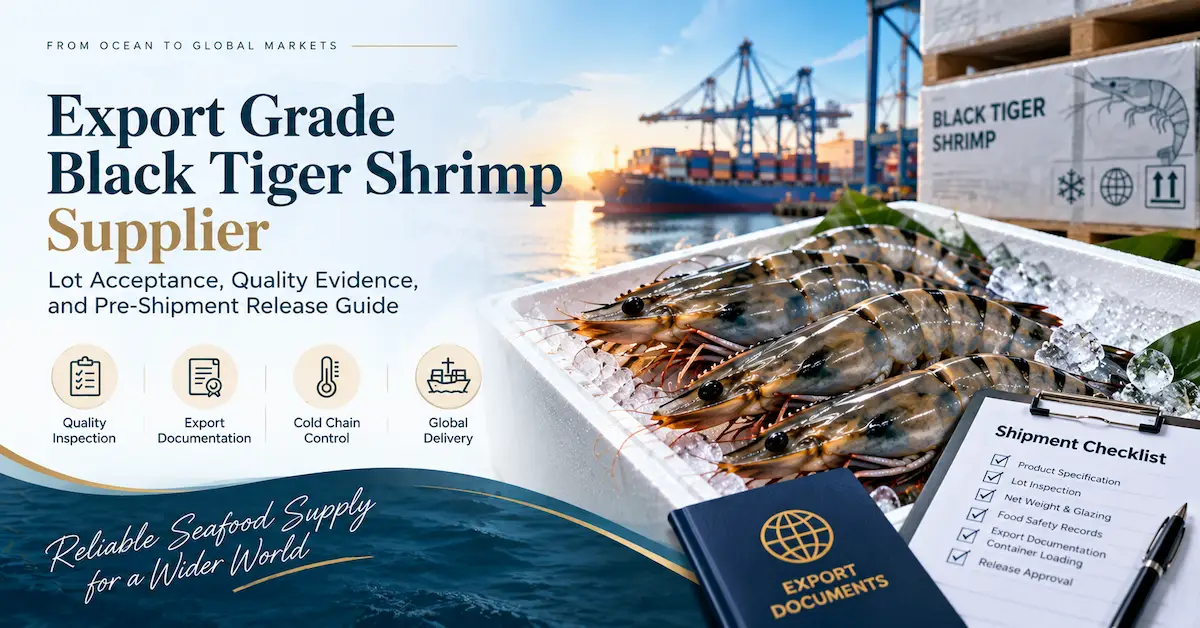


A reliable black tiger shrimp exporter does more than supply frozen shrimp at an attractive price. For international importers, the exporter must help coordinate product specifications, quality verification, packaging, export documentation, and temperature-controlled shipment arrangements so the goods can move through the supply chain without avoidable commercial problems.
The most important distinction is between buying a product that looks acceptable at the loading port and receiving a shipment that meets the importer’s commercial, regulatory, and distribution requirements at destination.
Black tiger shrimp, commonly identified as Penaeus monodon, are traded in different processing forms and size grades. However, exporters do not necessarily offer every commercial form, count size, freezing method, or packaging configuration at all times. Buyers must confirm the actual specification, product origin, processing arrangements, and available documentation before placing an order.
This guide focuses on the export transaction itself. It explains how importers can evaluate a frozen black tiger shrimp exporter, establish a shipment-ready specification, verify country-specific import requirements, compare landed costs, and control quality risks from supplier approval through destination receiving.
The objective is practical: fewer preventable shipment disputes, clearer quotations, and more predictable repeat orders.
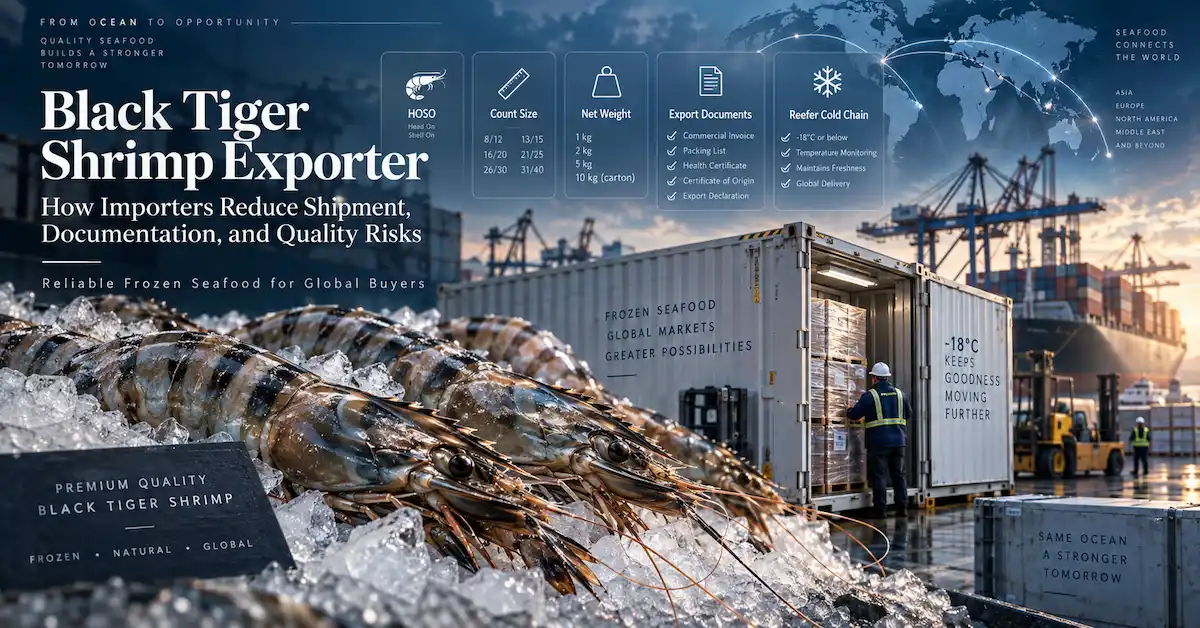
What Should Importers Expect From a Black Tiger Shrimp Exporter?
A black tiger shrimp exporter should be capable of coordinating the commercial information and shipment responsibilities necessary for an international transaction.
That does not mean every exporter owns aquaculture farms, operates its own processing factory, or manages every logistics service directly.
The distinction matters.
Some businesses operate production facilities. Others organize sourcing, processing, inspection, and export services through established supply relationships. Either model may be suitable when responsibilities, product specifications, documentation, and accountability are clear.
For importers, the first question should not be whether an exporter describes itself as the best supplier.
It should be:
Can this company deliver the specified product through a verifiable export process that meets our destination requirements?
A useful exporter evaluation covers seven areas.
| Export Evaluation Area | What Importers Should Verify | Main Commercial Risk |
|---|---|---|
| Product identity | Species, raw or cooked condition, processing form, origin | Incorrect or inconsistent product description |
| Commercial specification | Count grade, tolerance, freezing, glazing, net weight | Shipment differs from approved product |
| Supply-chain responsibility | Exporter, processing establishment, origin, packing location | Unclear accountability |
| Food safety | Applicable controls, facility records, destination eligibility | Regulatory detention or rejection |
| Export documentation | Invoice, packing list, health documents, origin and transport records | Customs or clearance delays |
| Cold-chain execution | Storage, loading, reefer arrangements and receiving conditions | Product deterioration |
| Commercial terms | Incoterm, freight, payment, insurance, delivery and claims | Unexpected landed cost or dispute |
These elements should be evaluated together.
An exporter that communicates clearly about unresolved details can be more useful than one that promises immediate availability without confirming the specification.
Black Tiger Shrimp: Product Identity and Export Specifications
Before comparing quotations, importers must establish what product is being purchased.
Black tiger shrimp is a commercial name associated with Penaeus monodon, a species recognized for its dark shell bands and use in seafood wholesale, foodservice, and processing markets.
The commercial name alone is not sufficient for an international purchase.
A complete specification should identify:
-
Scientific species
-
Farmed or wild origin, where applicable
-
Country of origin
-
Raw or cooked condition
-
Processing form
-
Size grade and count unit
-
Freezing method
-
Glazing requirement
-
Declared net seafood weight
-
Packaging format
-
Storage conditions
-
Applicable labeling requirements
For Bothwin, the published Black Tiger Shrimp product page identifies its main product as frozen whole, head-on, shell-on black tiger shrimp.
The page also states that sizing can be customized upon request, bulk export packaging and OEM packaging are available options, and frozen storage is specified at -18°C or below.
These are useful starting points for an inquiry. They do not establish a permanent inventory list of every count size, freezing format, processing form, or destination-specific certification.
A professional importer should ask which exact configuration can be supplied for the planned shipment.
Why Species Confirmation Matters
Product identity influences labeling, import declarations, commercial value, and the buyer's downstream product specifications.
For a distributor, species accuracy helps protect customer trust and product positioning.
For a processor, a change in raw material identity may affect production specifications.
For a supermarket or private-label importer, inaccurate species information may create labeling or compliance problems.
The exporter should therefore confirm that the commercial name and scientific identity are consistent across the product specification and applicable shipment documents.
HOSO, HLSO, and Processed Shrimp: Understand the Commercial Difference
Shrimp exporters use abbreviations to describe processing forms.
Importers should understand these definitions even when their current inquiry concerns whole HOSO black tiger shrimp.
| Processing Form | Meaning | Common Buyer Application | Key Quality Concern |
|---|---|---|---|
| HOSO | Head-On, Shell-On | Wholesale, seafood displays, grilling and restaurants | Head attachment, shell condition and count |
| HLSO | Headless, Shell-On | Foodservice and further processing | Head removal and size consistency |
| PTO | Peeled, Tail-On | Restaurant portions and prepared seafood | Peeling quality and tail integrity |
| PUD | Peeled, Undeveined | Selected processing applications | Peel consistency and agreed vein condition |
| PD | Peeled and Deveined | Food processing and convenience products | Deveining quality, damage and usable yield |
| Butterfly cut | Specialty processed form | Value-added and coated products | Cutting consistency and appearance |
These are common industry processing forms, not a confirmed list of every Bothwin black tiger shrimp SKU.
The currently published Bothwin product specification centers on HOSO shrimp. Other forms should be discussed individually if required.
Why HOSO Matters in International Trade
Whole head-on, shell-on shrimp can offer a distinctive presentation for seafood counters, restaurants, and premium whole-shrimp dishes.
However, HOSO products also require attention to physical condition.
Importers may need to define acceptance limits for:
-
Detached heads
-
Broken bodies
-
Shell damage
-
Damaged antennae
-
Visible discoloration
-
Black spots or other appearance defects
-
Size inconsistency
-
Damaged frozen pieces
Not all visual changes indicate the same cause or food safety significance. The buyer should therefore use defined inspection criteria rather than rejecting product solely because a broad description such as “discoloration” appears in a report.
For HOSO shrimp, an approved visual reference and agreed defect definitions are valuable.
They help connect the buyer's commercial expectations with production inspection and destination receiving.
How to Evaluate Black Tiger Shrimp Count Sizes for Export
Count size is one of the most important commercial variables in a frozen shrimp quotation.
However, “large black tiger shrimp” is not a measurable export specification.
Shrimp may be graded by the number of pieces per kilogram or pound, depending on the market and commercial convention.
The unit must always be stated.
For example, a commercial grade expressed as pieces per kilogram cannot be interpreted as pieces per pound.
Importers should also confirm which processing form is being counted.
An HOSO shrimp includes the head and shell, while a headless or peeled shrimp has a different weight composition.
Example of Count-Based Grading
The following ranges illustrate how pieces-per-kilogram notation works. They are examples of commercial count descriptions, not confirmed Bothwin inventory or universal grade definitions.
| Illustrative Count Grade | Pieces per kg | General Size Interpretation |
|---|---|---|
| 10/20 | 10–20 | Larger pieces |
| 20/30 | 20–30 | Medium-large pieces |
| 30/40 | 30–40 | Medium pieces |
| 40/50 | 40–50 | Smaller pieces |
A lower piece count generally indicates larger individual shrimp.
However, the buyer should avoid assuming that a grade means exactly the same thing across all suppliers.
Important questions include:
Is the count measured before or after glazing?
Does the count apply to the actual product form being quoted?
What tolerance is permitted?
How many cartons will be sampled?
How are broken pieces counted?
The complete answer belongs in the purchase specification.
Why Count Consistency Affects Importer Profitability
Different customers buy shrimp for different reasons.
A restaurant distributor may need predictable portions.
A supermarket may need bags with visually consistent contents.
A wholesaler may sell by a particular grade to repeat customers.
A seafood processor may require count consistency to support cutting or production efficiency.
When shipments contain excessive variation, the importer may face sorting costs, customer complaints, discounted sales, or reduced repeat-order confidence.
The commercial value of a count grade therefore depends on both the average size and the consistency of the shipment.
For more detailed information about product-form and count selection, buyers can consult Bothwin's Frozen Black Tiger Shrimp Supplier Buying Guide.
Frozen Shrimp Glazing and Net Weight: What Export Buyers Must Verify
Glazing is a protective ice layer applied to frozen seafood.
It can help protect product surfaces during frozen storage, but the commercial treatment of glazing must be clear.
Importers should not compare quotations using ambiguous carton weights.
The important distinction is between:
Gross weight: The weight of the shipment unit including applicable packaging.
Glazed product weight: The weight of frozen seafood together with protective surface ice.
Net seafood weight: The declared quantity of seafood excluding glaze, according to the applicable standard and agreed measurement method.
The FAO/WHO Codex Standard for Quick Frozen Shrimps or Prawns, CXS 92-1981, states that the declared net contents of glazed products should exclude the glaze.
This principle is particularly important when importers compare products offered at different glazing levels.
Why Lower Carton Prices Can Be Misleading
Consider an illustrative shipment comparison.
Supplier A and Supplier B both describe their products as frozen black tiger shrimp.
Supplier A provides a quotation based on clearly declared seafood net weight.
Supplier B provides a lower carton price but does not identify whether the quoted weight includes glaze.
The importer cannot determine which product offers better value until the weight basis is clarified.
A complete export quotation should specify:
-
Net seafood weight per inner pack
-
Net seafood weight per master carton
-
Gross carton weight
-
Proposed glazing level
-
Glazing calculation method
-
Weight tolerance
-
Sampling and verification procedure
Without these details, landed-cost comparisons are unreliable.
The subject is explained further in Bothwin's Frozen Seafood Glazing Percentage Guide.
The Five Shipment Readiness Gates Every Shrimp Importer Should Use
A successful export shipment should pass several approval stages before loading.
Treating them as separate gates helps prevent product or document problems from being discovered too late.
Gate 1: Product Specification Approval
Before confirming commercial production, approve:
-
Species identity
-
Processing form
-
Count grade
-
Freezing requirement
-
Glazing
-
Net weight
-
Defect criteria
-
Packaging
-
Labeling requirements
The approved sample should correspond to these written requirements.
Gate 2: Destination Eligibility Confirmation
The importer should confirm whether the proposed product, origin, and processing establishment are eligible for the destination market.
Requirements can differ considerably between countries.
This should happen before a supplier commits to production arrangements that may not meet the importer's regulatory needs.
Gate 3: Packaging and Document Approval
Confirm the draft label and packaging specification.
At the same time, identify the exact documents required for shipment.
Do not leave health certificates, establishment details, country-of-origin information, or specialized import declarations until the container is ready to load.
Gate 4: Quality and Loading Approval
Before loading, the importer may require confirmation of:
-
Final lot identification
-
Count-size inspection
-
Net-weight verification
-
Packaging condition
-
Carton quantities
-
Label accuracy
-
Frozen storage condition
-
Loading plan
Some buyers use third-party inspection services. Others rely on an agreed supplier QC process or additional sampling.
The appropriate method depends on the order value, product risk, contract, and buyer's internal requirements.
Gate 5: Document Release and Destination Handover
After shipment, the exporter and importer must coordinate the appropriate document release and shipment information.
The importer should receive required documents within the timeframe needed for clearance.
A commercially acceptable product can still incur substantial delay costs when paperwork is incomplete or inconsistent.
International Import Requirements: What Changes by Destination?
There is no single worldwide document package that guarantees frozen black tiger shrimp can enter every country.
Requirements depend on:
-
Destination
-
Country of origin
-
Production establishment
-
Farmed or wild source
-
Raw or cooked condition
-
Processing method
-
Packaging
-
Intended use
-
Applicable trade measures
The importer and its customs or regulatory advisers should verify the current requirements before confirming shipment.
United States: Seafood HACCP Importer Responsibilities
U.S. seafood importers need to consider FDA requirements under 21 CFR Part 123.
Section 123.12 addresses special requirements for imported fish and fishery products, including importer verification of foreign processing controls under the applicable regulatory framework.
A purchasing team should not interpret a supplier's general claim of HACCP management as sufficient proof of compliance.
Relevant due-diligence questions include:
-
Which establishment processes the shrimp?
-
What product-specific safety information is available?
-
What verification procedures apply to the importer?
-
What evidence supports the foreign processor's controls?
-
Are there relevant import alerts or other restrictions?
-
Are any additional trade or customs measures applicable?
The importer should also verify applicable FDA registration, prior notice, labeling, tariff and customs obligations, as well as any other relevant U.S. requirements.
The actual compliance process should be confirmed with qualified import professionals.
European Union: Establishment Eligibility and Official Controls
EU imports of fishery and aquaculture products may be subject to approved-country and approved-establishment requirements, official certification, and controls at designated border control posts.
For black tiger shrimp, the importer should verify whether the proposed origin and processing establishment are eligible for the specific product category.
Important checks may include:
-
Country authorization
-
Processing establishment approval
-
Applicable official health certificates
-
Aquaculture-related residue controls
-
Product identification and labeling
-
Required pre-notification and border procedures
-
Traceability records
A supplier's ability to export seafood generally does not prove that a particular plant and shrimp shipment are eligible for the EU market.
Buyers should verify the relevant approval information before production.
For farmed shrimp, do not automatically assume that a wild-capture catch certificate is required. The applicability of IUU catch certification must be evaluated according to the sourcing method, product and relevant rules.
Other Export Markets
Bothwin identifies South America, Europe, Africa, the United States, Southeast Asia, and Central Asia among its principal international markets.
Within these regions, importing requirements can differ by country.
For example, a distributor importing frozen shrimp for wholesale resale may need different labeling or permit arrangements from a manufacturer importing shrimp for further processing.
The importer should provide the exporter with a destination-specific compliance checklist rather than asking the exporter to assume that a general certificate will be accepted.
A well-prepared request makes it easier to determine whether the proposed shrimp supply program is commercially workable.
Which Export Documents Are Needed for Black Tiger Shrimp?
The exact document set must be established for each shipment.
For international seafood transactions, the following documents commonly form part of the discussion.
| Document | Main Purpose | Important Information to Check |
|---|---|---|
| Pro forma invoice | Establishes preliminary commercial terms | Product, price, quantity, Incoterm and delivery |
| Commercial invoice | Supports customs and financial processing | Exporter, consignee, goods, value, origin and weights |
| Packing list | Describes shipment packing | Cartons, net/gross weight, marks and quantity |
| Bill of lading | Records ocean cargo and transport arrangements | Shipper, consignee, container, seal and ports |
| Certificate of origin | Supports applicable origin declarations | Product and country-of-origin consistency |
| Health certificate | Supports official sanitary compliance where required | Correct official format and shipment identity |
| Product specification | Defines the agreed shrimp product | Species, form, count, glaze, pack and tolerances |
| Inspection or laboratory records | Supports defined QC or compliance checks | Correct product, lot, method and scope |
| Temperature records | Supports cold-chain investigation or verification | Equipment, time, temperature and shipment identity |
| Insurance certificate | Records agreed cargo insurance arrangements | Insured interest, coverage, voyage and terms |
Not every document is required for every shipment.
Some documents are standard commercial records, while others depend on local law, product characteristics, the financing arrangement, or the buyer's contract.
Why Document Consistency Matters
Suppose a shipment contains frozen HOSO black tiger shrimp.
The commercial invoice identifies one quantity.
The packing list shows a different number of cartons.
The health certificate uses an inconsistent product description.
The bill of lading contains a container number that does not match the final loading record.
Even when the shrimp itself is acceptable, these differences can trigger additional checks and potentially delay clearance.
A document review should therefore compare shared fields across the entire shipment package.
Important matching fields include:
-
Exporter and importer information
-
Product description
-
Species where required
-
Country of origin
-
Carton quantity
-
Net and gross weight
-
Batch or lot reference
-
Container number
-
Seal number
-
Port information
-
Required certificate references
Bothwin has a dedicated Seafood Export Documentation Guide that explains the functions of common commercial and regulatory documents.
For shrimp importers, the next step is to turn that general document knowledge into an order-specific checklist.
How Export Packaging Affects Shipment Quality and Import Costs
Export packaging should be selected according to the buyer's distribution model.
Black tiger shrimp shipped for wholesale distribution may require different handling from shrimp intended for private-label retail.
A buyer should specify more than the number of kilograms in a carton.
Bulk Wholesale Packaging
Bulk export packaging may prioritize:
-
Product protection
-
Efficient frozen storage
-
Warehouse handling
-
Carton strength
-
Lot identification
-
Predictable pallet configuration
Important details include inner-pack quantity, carton dimensions, net and gross weight, and pallet arrangement.
If a distributor opens master cartons and resells inner packs, the labeling and traceability system should support that process.
Retail and Private-Label Packaging
Private-label projects require additional preparation.
Packaging should be reviewed for:
-
Brand artwork
-
Product name
-
Species declaration where applicable
-
Origin information
-
Net weight
-
Allergen information
-
Storage instructions
-
Language requirements
-
Barcode details
-
Lot coding
-
Local regulatory claims
Artwork approval should occur before packaging materials are produced.
An incorrect label may require reprinting, relabeling, or other corrective actions.
For importers establishing a new retail brand, these costs can be significant.
OEM Packaging Requires Commercial Confirmation
Bothwin's black tiger shrimp product information identifies bulk export packaging and OEM options.
However, the final available configuration depends on project requirements.
Before confirming a private-label order, buyers should discuss artwork approval, minimum order quantity, printing arrangements, packaging specifications, and production scheduling.
A customized pack should not be assumed to have the same MOQ or lead time as a standard export carton.
Cold-Chain Management for Frozen Black Tiger Shrimp Exports
Frozen shrimp depends on temperature-controlled logistics.
The product may pass through several organizations before reaching the importer's warehouse.
A typical shipment involves:
-
Processing and freezing
-
Frozen storage
-
Inland refrigerated transportation
-
Container loading
-
Ocean shipment
-
Port discharge
-
Customs and border procedures
-
Destination cold storage
-
Final distribution
Each handover creates a potential control point.
Bothwin's published black tiger shrimp product specification states storage at -18°C or below.
This is an important product requirement, but buyers should not confuse a stated storage requirement with an automatically guaranteed temperature history for every shipment.
Before Container Loading
Exporters and logistics providers should establish the appropriate equipment and loading conditions.
Depending on the agreed arrangements, the process may include:
-
Refrigerated container suitability checks
-
Equipment inspection or pre-trip procedures
-
Confirmation of the required temperature setting
-
Verification of the product's frozen condition
-
Carton and pallet inspection
-
Loading arrangements that preserve airflow
-
Container and seal recording
A reefer container is designed to maintain appropriate conditions for its cargo. It should not be treated as a substitute for properly freezing the shrimp before loading.
During International Transport
The buyer should understand which party is responsible for arranging transport and temperature monitoring.
Where appropriate, the parties may agree to retain:
-
Container temperature records
-
Data logger information
-
Shipment milestones
-
Carrier notifications
-
Exception reports
Temperature data needs interpretation.
A single reading does not necessarily establish the condition of every carton, and reefer air readings are not identical to product core temperatures.
The agreed monitoring and investigation procedures should account for these differences.
At Destination
Receiving personnel should check the shipment against the approved standard.
Possible inspections include:
-
Container and seal condition
-
Carton damage
-
Label and lot identification
-
Product condition
-
Applicable temperature checks
-
Carton and weight verification
-
Visible evidence of potential thawing or refreezing
Suspicious material should be handled under the importer's documented receiving and food safety procedures.
Bothwin's Frozen Seafood Cold Chain Management Guide provides additional information about the importance of maintaining temperature control throughout international seafood logistics.
FOB, CIF, and Landed Cost: How Should Shrimp Importers Compare Quotations?
International shrimp quotations often use trade terms such as FOB, CFR, and CIF.
Importers should understand what each quotation includes before comparing prices.
The relevant Incoterms rule, named location, and version should be stated clearly in the contract.
FOB: Free On Board
Under FOB Incoterms 2020, the seller delivers goods on board the nominated vessel at the named shipment port, and risk generally transfers at that point.
The buyer normally arranges the main carriage.
For containerized cargo handed over at a container terminal before vessel loading, FCA may be more appropriate than FOB, depending on the actual logistics arrangement.
CIF: Cost, Insurance and Freight
Under CIF, the seller arranges and pays for the specified ocean carriage and required insurance to the named destination port.
However, CIF does not mean that all risk stays with the seller until the goods reach the destination.
Under CIF Incoterms 2020, risk generally transfers when the goods are delivered on board at the shipment port.
The buyer should examine the insurance coverage and determine whether additional protection is needed.
Why a Lower FOB Price May Not Be Cheaper
Consider two illustrative quotations for an identical frozen shrimp specification.
Assume both quotations cover 10,000 kg of declared net seafood weight.
| Cost Item | Supplier A: CIF | Supplier B: FOB |
|---|---|---|
| Quoted product/shipping amount | $62,000 | $58,000 |
| Additional ocean freight | Included | $4,000 |
| Additional insurance | Included | $600 |
| Import duties, destination charges and inland transport | $8,000 | $8,000 |
| Estimated landed cost | $70,000 | $70,600 |
| Estimated cost per net kg | $7.00 | $7.06 |
This is a hypothetical calculation, not a current market price or Bothwin quotation.
Supplier B has a lower headline price.
However, after adding the relevant costs, Supplier A produces a slightly lower estimated landed cost.
The calculation becomes even more important when offers use different carton configurations, net-weight bases, or shipping arrangements.
A Better Landed-Cost Calculation
A practical formula is:
Landed Cost per Net kg = Total Relevant Product, Transport, Insurance, Duty, Clearance, and Delivery Costs ÷ Verified Net Seafood Weight
If the importer performs additional processing, a second calculation may be useful:
Effective Cost per Usable kg = Total Relevant Cost ÷ Accepted Usable Shrimp Weight
These measures are more useful than comparing gross carton prices.
Importers should also account for uncertainty.
Freight changes, customs inspections, exchange-rate movement, demurrage, detention, and shipment delays can affect the final commercial result.
Pre-Shipment Quality Control: What Should Be Inspected?
A pre-shipment inspection is most effective when it checks the agreed specification.
It should not rely only on whether the frozen shrimp looks attractive.
The inspection plan should identify:
-
Lot or batch definition
-
Sampling procedure
-
Acceptance criteria
-
Inspection methods
-
Responsible party
-
Reporting format
-
Action required for nonconforming material
For HOSO black tiger shrimp, relevant checks may include:
| Inspection Area | Buyer Requirement | Evidence |
|---|---|---|
| Product identity | Correct species and form | Product and lot records |
| Count grade | Agreed pieces per kg or lb | Recorded sample counts |
| Size consistency | Permitted grading tolerance | Sampling results |
| Head and shell condition | Agreed appearance standard | Photos and defect records |
| Broken pieces | Defined maximum allowance | Inspection record |
| Net weight | Agreed seafood weight | Measured and documented results |
| Glazing | Agreed level and method | Verification report |
| Packaging | Correct inner and outer packs | Pack inspection |
| Labels | Approved information and artwork | Carton and bag photographs |
| Frozen condition | Agreed storage and loading criteria | Inspection or temperature records |
| Traceability | Identifiable production lots | Lot coding and records |
Inspection Is Not the Same as Certification
An inspection report records findings under the inspection's scope.
It does not automatically prove that all legal requirements have been satisfied.
Similarly, a quality-management statement does not replace verification of applicable certificates or processing establishment approvals.
Bothwin's public product information describes HACCP quality management, hygiene and cold-chain controls, export-grade inspection, and batch traceability.
Importers should request current, shipment-relevant evidence when required rather than assuming a general website statement establishes approval for every market.
For a broader discussion of seafood inspection methods, see Bothwin's Frozen Seafood Quality Checks Guide.
What Happens When Shrimp Arrive With a Quality Problem?
Even with careful preparation, shipment disputes can occur.
The best time to establish a claim procedure is before shipment.
Importers should agree with the exporter on:
-
Receiving inspection timing
-
Notification deadlines
-
Required photographs
-
Lot identification
-
Sampling methods
-
Temperature evidence
-
Independent inspection arrangements
-
Procedures for isolating affected goods
-
Corrective-action communication
A Practical Receiving-Claim Scenario
Imagine a distributor receives frozen HOSO black tiger shrimp intended for premium wholesale customers.
During unloading, the warehouse identifies several cartons with unusual physical damage and inconsistent product appearance.
The receiving team should not simply send a short message stating that the entire shipment is poor quality.
A better process is to record:
-
Container and seal numbers.
-
Arrival date and unloading time.
-
Carton and lot identification.
-
Photographs of affected packaging.
-
Product condition under the approved receiving procedure.
-
Relevant temperature information.
-
Representative inspection findings.
-
Quantity of potentially affected stock.
The product should be handled according to the buyer's food safety and quality procedures.
This evidence helps the exporter, processor, carrier, insurer, and importer investigate the issue.
It also improves the possibility of identifying whether the problem originated during processing, packing, transport, or receiving.
Corrective Action and Repeat Orders
The immediate claim is only one part of the issue.
A long-term sourcing relationship should also address the cause.
Possible follow-up actions include:
-
Reviewing count-size inspection procedures
-
Improving carton protection
-
Clarifying a defect tolerance
-
Revising loading controls
-
Updating shipment documentation checks
-
Strengthening lot identification
The objective is to reduce recurrence, not merely negotiate an adjustment after every problem.
Which Buyers Benefit Most From an Export-Focused Shrimp Supply Program?
A black tiger shrimp exporter can serve different international customer types, but their priorities are not identical.
Seafood Importers
Importers need confidence that the shipment can be legally imported, cleared, received, and distributed.
They should prioritize destination eligibility, documentation, product specification and total landed cost.
Wholesale Distributors
Wholesalers care about count-size consistency, packaging, product appearance, warehouse handling and repeat supply.
A shipment that is technically acceptable but inconsistent with the distributor's established product grades may still create commercial problems.
Supermarket and Retail Brands
Retail programs need additional attention to labeling, pack presentation, artwork approval, product identity and repeatable pack weights.
Any country-specific consumer labeling requirements should be confirmed before artwork is finalized.
Restaurant and Foodservice Distributors
These buyers often focus on HOSO appearance, count consistency, thawing performance, and pack sizes suited to commercial kitchens.
Food Processing Companies
Processors may focus more heavily on raw material yield, defect limits, processing form and manufacturing compatibility.
For buyers serving several markets or channels, the export specification should reflect the actual destination and intended customer.
How to Build a Reliable Repeat-Order Program
The first successful shipment should become the reference for subsequent purchasing.
A repeat-order program benefits from clear specification control and organized commercial records.
Maintain an Approved Specification
Keep a controlled copy of:
-
Product specification
-
Count grade
-
Tolerance
-
Glazing and net-weight basis
-
Packaging
-
Labeling
-
Quality criteria
If a change is necessary, document it before production.
Record Commercial Performance
After each shipment, importers can review:
-
Shipment quantity
-
Document accuracy
-
Arrival condition
-
Inspection findings
-
Customer complaints
-
Net-weight results
-
Delivery performance
-
Claims and corrective actions
These records can identify trends that are not visible during a single trial order.
Forecast Requirements Early
Seafood availability and commercial terms may change over time.
An exporter may need to confirm product availability, processing schedules, packaging materials and freight arrangements for each purchase.
Importers planning regular orders should share forecasts where practical.
A forecast does not necessarily guarantee allocation, but it supports earlier commercial discussion.
Avoid Unapproved Substitutions
Changes in species, origin, processing establishment, count grade, freezing format or packaging should not be treated as minor when they affect the contract or destination requirements.
A repeat order should reproduce the agreed product unless the buyer has approved a documented change.
How Bothwin Supports Black Tiger Shrimp Export Inquiries
Bothwin Development (HK) Limited is an international seafood sourcing and supply business serving importers, wholesalers, distributors, and other B2B seafood buyers.
Its published black tiger shrimp offering focuses on frozen whole head-on, shell-on products, with requested sizing and bulk export or OEM packaging options.
The company also describes quality-management, cold-chain, batch-traceability and international documentation support in its product and company information.
These capabilities provide a starting point for international sourcing discussions.
However, buyers should still confirm the actual shipment requirements with the commercial team.
For an export inquiry, relevant details include:
-
Target destination country
-
Product form
-
Required count size
-
Net-weight and glazing basis
-
Packaging format
-
Order quantity
-
Intended distribution channel
-
Required certificates and documents
-
Requested shipment timing
A suitable supplier response should distinguish confirmed availability from options that require further checking.
For additional company information, importers can review Bothwin's seafood sourcing background and its factory and seafood solutions overview.
The most effective next step is to send a complete product and shipping inquiry rather than requesting a general price list without specifications.
Black Tiger Shrimp Export RFQ: Information to Send Before Requesting a Quote
An RFQ should make it possible for the exporter to evaluate both the product and the destination.
The following template can be adapted for initial contact.
| RFQ Field | Information Required |
|---|---|
| Product | Black Tiger Shrimp |
| Scientific identity | Penaeus monodon, subject to product confirmation |
| Processing form | HOSO or other required form |
| Product condition | Frozen, raw or otherwise specified |
| Count size | Pieces per kg or lb |
| Count tolerance | Required acceptable range |
| Freezing method | State preference or request confirmation |
| Glazing | Required percentage and calculation method |
| Net weight | Required seafood weight per pack and carton |
| Packaging | Bulk carton, inner pack or OEM/private label |
| Quantity | Trial order, bulk order or recurring forecast |
| Destination country | Required import market |
| Destination port | Named port or delivery point |
| Incoterm | Preferred term and named location |
| Quality requirements | Inspection standards and documents |
| Labeling | Language, origin, lot and other market requirements |
| Required documents | Importer-approved document checklist |
| Timing | Target shipment window |
| Application | Wholesale, supermarket, foodservice or processing |
A good RFQ also identifies which items are flexible.
For example, an importer may require HOSO shrimp but be willing to consider different packaging arrangements.
Another buyer may require fixed retail packaging but accept a broader count range.
Stating priorities helps the exporter determine which commercial options are practical.
When the specification is ready, submit it through Bothwin's seafood export inquiry page so the team can review the requested product, quantity, destination, packaging, and shipment requirements.
Frequently Asked Questions About Black Tiger Shrimp Exporters
1. What does a black tiger shrimp exporter do?
A black tiger shrimp exporter coordinates the international sale and shipment of shrimp.
Depending on the business model, this may involve product sourcing, specification confirmation, export packaging, quality inspection, commercial documentation, and coordination with freight providers.
An exporter does not necessarily own the farm or processing establishment. Importers should confirm who performs each function and which party is responsible under the contract.
2. What is the scientific name of black tiger shrimp?
Black tiger shrimp are commonly identified as Penaeus monodon.
Importers should verify the identity used in the supplier's product specification and applicable commercial documents.
Accurate identification supports product consistency, labeling, traceability, and destination-market requirements.
3. What does HOSO black tiger shrimp mean?
HOSO means Head-On, Shell-On.
The shrimp retain their heads and shells, making them suitable for customers seeking whole-shrimp presentation or further preparation flexibility.
An HOSO specification should also define the count grade, count unit, appearance requirements, freezing method, net weight, glazing, and packaging.
4. How do I verify black tiger shrimp count sizes?
Ask the supplier to state whether the grade is measured in pieces per kilogram or pieces per pound.
Confirm that the count refers to the actual processing form being purchased.
The specification should include the acceptable range, tolerance, sampling procedure, and treatment of broken or damaged pieces.
5. What documents are needed to import frozen black tiger shrimp?
Common commercial documents include the invoice, packing list, and transport document.
Depending on the destination and product, importers may also require official health certification, origin documents, processing establishment information, inspection reports, temperature records, or other regulatory documentation.
The exact requirements should be verified before production and shipment.
6. Can farmed black tiger shrimp be exported to the United States or European Union?
Eligibility depends on the origin, processing establishment, product condition, applicable regulatory requirements, and other relevant trade controls.
U.S. importers must consider seafood HACCP verification and other applicable import obligations.
EU importers should confirm country and establishment eligibility, applicable health certification, and border requirements.
A supplier's general export experience does not automatically establish eligibility for every shipment.
7. What is the difference between FOB and CIF shrimp quotations?
FOB and CIF allocate transport costs and responsibilities differently.
Under FOB, the buyer generally arranges main carriage after delivery on board at the named shipment port.
Under CIF, the seller arranges and pays for specified carriage and insurance to the named destination port, but risk generally transfers when the goods are delivered on board at the shipment port.
Importers should compare the complete landed cost and understand the relevant Incoterms rule.
8. How does glazing affect frozen shrimp import cost?
Glazing adds protective ice to the seafood.
For cost comparisons, importers need to know the amount of net seafood excluding glaze.
Two cartons with identical gross weights can represent different amounts of seafood if their glazing and packaging differ.
The buyer should compare offers using a clearly defined net-weight basis.
9. Can I order black tiger shrimp with private-label packaging?
Private-label packaging may be available depending on the supplier, product specification, order quantity, and packaging requirements.
Bothwin publicly identifies OEM packaging as an option for its black tiger shrimp product.
Importers should confirm artwork requirements, packaging formats, MOQ, label approval, current availability, and lead time for the specific project.
10. What storage temperature is required for Bothwin's frozen black tiger shrimp?
Bothwin's published product specification states frozen storage at -18°C or below.
The importer should also confirm shipment and receiving procedures, applicable destination requirements, and the documentation used to verify agreed frozen handling conditions.
11. How can importers reduce black tiger shrimp shipment disputes?
The most effective measures are clear product specifications, representative sample approval, measurable quality criteria, accurate documentation, agreed shipping terms, and a defined receiving-claim procedure.
Importers should also establish how changes are approved and what evidence is required if a problem occurs after arrival.
12. What should I send Bothwin to request a black tiger shrimp export quotation?
Send the required HOSO specification or other requested form, count size and unit, glazing, net weight, packaging, quantity, destination country, preferred shipping term, document requirements, and target delivery schedule.
Bothwin can then discuss current availability and the commercial conditions applicable to the inquiry.
Conclusion
Choosing a black tiger shrimp exporter requires more than securing an attractive product price. Importers should verify HOSO specifications, count consistency, declared net weight, destination eligibility, export documents, cold-chain arrangements, and landed costs before committing to a shipment.
Bothwin offers frozen whole black tiger shrimp for international B2B buyers, with size and packaging options subject to order confirmation. For a more accurate supply proposal, share your product requirements, target quantity, destination market, and shipping expectations through the Bothwin black tiger shrimp export inquiry page.