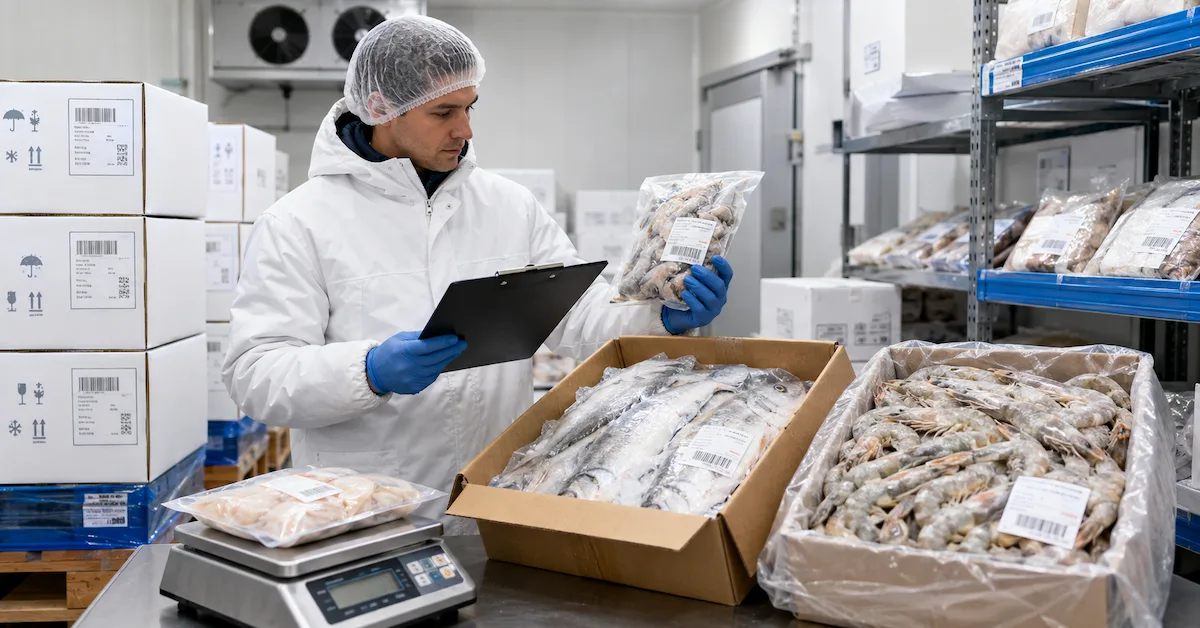


Choosing between frozen tuna IQF vs BQF is an important decision for seafood importers, tuna processors, restaurants, wholesalers, and food manufacturers.
Freezing technology directly affects tuna quality, storage efficiency, handling convenience, production cost, and final application.
Although both IQF (Individually Quick Frozen) and BQF (Block Quick Frozen) are widely used in seafood processing, they serve different purchasing needs.
For example:
- A restaurant distributor may prefer IQF tuna because individual pieces are easier to portion.
- A large tuna processor may prefer BQF products because they offer cost efficiency for high-volume production.
- A sushi or premium seafood buyer may prioritize product integrity, texture, and packaging.
A professional frozen tuna supplier should recommend the freezing method based on the buyer’s application instead of offering one solution for every market.
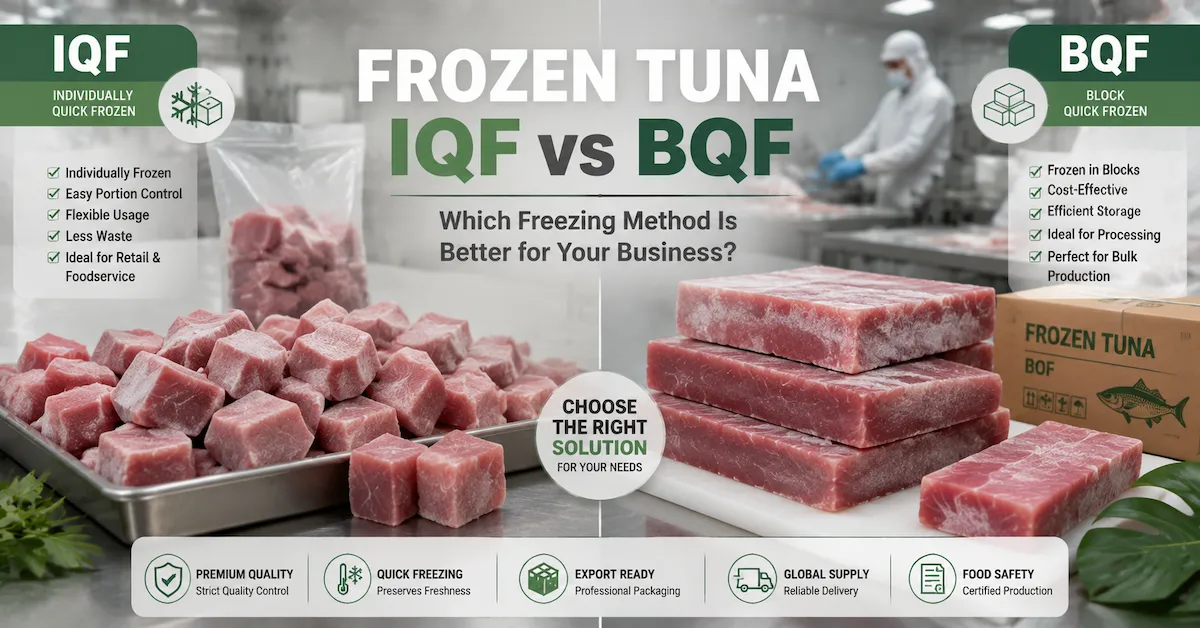
Quick Answer: Frozen Tuna IQF vs BQF
The main difference between IQF and BQF frozen tuna is how the product is frozen and handled after freezing.
| Comparison | IQF Frozen Tuna | BQF Frozen Tuna |
|---|---|---|
| Full Name | Individually Quick Frozen | Block Quick Frozen |
| Freezing Method | Individual pieces frozen separately | Multiple pieces frozen together |
| Handling | Easier portion control | Requires block separation |
| Storage | Flexible usage | Efficient bulk storage |
| Cost | Usually higher | Usually lower |
| Best For | Retail, foodservice, portions | Processing and bulk production |
| Waste | Lower during daily use | Depends on production process |
Neither freezing method is universally better. The correct choice depends on:
- Product application
- Processing requirements
- Storage system
- Order volume
- Budget
- Customer expectations
What Is IQF Frozen Tuna?
IQF stands for Individually Quick Frozen.
In IQF processing, tuna pieces are frozen separately at a rapid speed so that individual pieces remain separated after freezing.
Common IQF tuna products include:
- Tuna cubes
- Tuna portions
- Tuna steaks
- Tuna pieces
- Small tuna cuts
The main purpose of IQF freezing is to provide flexibility during storage and usage.
Advantages of IQF Frozen Tuna
Individual Piece Separation
The biggest advantage of IQF tuna is that each piece remains separate.
This allows buyers to:
- Remove only the required quantity
- Reduce thawing waste
- Improve inventory control
- Simplify kitchen operations
Better Portion Management
IQF tuna is useful for:
- Restaurants
- Hotels
- Catering companies
- Ready meal manufacturers
Employees can take specific quantities without opening and thawing an entire block.
Flexible Packaging
IQF tuna can be supplied in:
- Retail bags
- Foodservice bags
- Small cartons
- Private-label packaging
This makes it suitable for different sales channels.
Reduced Product Waste
Because pieces are separated, buyers can better control daily consumption.
This is valuable for businesses where demand changes frequently.
What Is BQF Frozen Tuna?
BQF stands for Block Quick Frozen.
In BQF processing, multiple tuna pieces are frozen together into a block.
This method is commonly used for large-volume seafood production.
Common BQF tuna products include:
- Tuna blocks
- Processing loins
- Bulk tuna materials
- Industrial raw materials
BQF is often selected by manufacturers that process large quantities continuously.
Advantages of BQF Frozen Tuna
Lower Processing Cost
BQF products usually require less individual handling and packaging.
This can reduce:
- Processing costs
- Packaging costs
- Storage costs
Efficient Bulk Transportation
Block frozen tuna is suitable for:
- Large containers
- Industrial storage
- Factory production
Good for Further Processing
Food manufacturers often prefer BQF because the entire block can be processed in production lines.
Applications include:
- Canned tuna
- Tuna flakes
- Seafood ingredients
- Ready meals
IQF Frozen Tuna vs BQF Frozen Tuna: Quality Comparison
Quality depends not only on freezing method but also on raw material, processing, storage, and cold-chain management.
| Quality Factor | IQF Tuna | BQF Tuna |
|---|---|---|
| Individual appearance | Excellent | Depends on separation |
| Portion control | Excellent | Limited |
| Large-volume processing | Moderate | Excellent |
| Storage efficiency | Good | Excellent |
| Retail convenience | Excellent | Limited |
| Industrial production | Good | Excellent |
| Packaging flexibility | High | Moderate |
Both methods can produce high-quality tuna when properly controlled.
A reliable frozen tuna supplier should maintain:
- Proper freezing temperature
- Hygienic processing
- Stable raw materials
- Correct packaging
- Traceability records
IQF Tuna vs BQF Tuna for Different Applications
Restaurants and Foodservice
IQF is usually preferred because:
- Portions are easier to manage
- Less preparation is required
- Product waste is reduced
Suitable products:
- Tuna cubes
- Tuna steaks
- Portion cuts
Sushi and Poke Businesses
IQF may provide advantages for:
- Flexible portion use
- Individual handling
- Consistent serving sizes
However, buyers should focus more on:
- Tuna grade
- Color
- Texture
- Food safety
- Intended use
Freezing method alone does not determine sushi quality.
Canning and Industrial Processing
BQF is often more suitable because:
- Large quantities can be processed efficiently
- Storage is easier
- Raw material costs can be lower
Suitable products:
- Tuna blocks
- Processing loins
- Bulk tuna materials
Supermarkets
IQF products are often preferred because:
- Consumers can use smaller quantities
- Packaging is convenient
- Product appearance is attractive
Cost Difference Between IQF and BQF Tuna
Generally, IQF tuna has a higher purchase cost than BQF tuna.
Reasons include:
- Individual freezing process
- Additional handling
- More packaging
- Higher processing requirements
BQF tuna may provide cost advantages through:
- Lower packaging cost
- Efficient production
- Bulk transportation
- High-volume processing
However, buyers should calculate total value rather than purchase price alone.
The real cost includes:
- Product yield
- Labor requirements
- Storage efficiency
- Waste
- Processing performance
Packaging Differences
IQF Tuna Packaging
Common packaging:
- Small bags
- Retail packs
- Foodservice bags
- Vacuum packs
Advantages:
- Flexible use
- Easy inventory control
- Suitable for multiple customers
BQF Tuna Packaging
Common packaging:
- Large blocks
- Bulk cartons
- Industrial packaging
Advantages:
- Efficient shipping
- Lower packaging cost
- Suitable for factories
Buyers should choose packaging based on:
- Distribution model
- Customer type
- Warehouse system
- Production requirements
Cold Chain Requirements for IQF and BQF Tuna
Regardless of freezing method, temperature control is critical.
A reliable frozen tuna supplier should manage:
- Processing temperature
- Frozen storage
- Container loading
- Transportation
- Temperature monitoring
Poor cold-chain management can cause:
- Texture damage
- Freezer burn
- Moisture loss
- Reduced shelf life
- Quality complaints
Buyers should confirm:
- Storage temperature
- Freezing method
- Transportation conditions
- Temperature records
- Destination storage capability
How to Choose Between IQF and BQF Tuna
Buyers should consider the following questions:
What Is the Final Application?
For restaurants and retail:
→ IQF may be more suitable.
For factories:
→ BQF may provide better efficiency.
What Is the Order Volume?
Large-volume buyers may benefit from BQF.
Smaller buyers may prefer IQF flexibility.
How Is the Product Used?
If customers require:
- Individual portions
- Quick preparation
- Flexible usage
IQF may be better.
If production requires:
- Large quantities
- Continuous processing
- Lower cost
BQF may be better.
What Is the Storage Capability?
Buyers should evaluate:
- Warehouse space
- Handling equipment
- Distribution method
- Inventory turnover
How to Evaluate a Frozen Tuna Supplier
Regardless of IQF or BQF choice, buyers should evaluate:
Product Specification
Confirm:
- Tuna species
- Product format
- Size
- Weight
- Freezing method
- Packaging
Quality Control
Review:
- Raw material inspection
- Processing standards
- Temperature control
- Traceability
Sample Testing
Evaluate:
- Appearance
- Texture
- Color
- Yield
- Cooking performance
Export Capability
Confirm:
- Documents
- Packaging
- Shipping experience
- Destination requirements
Common Mistakes When Choosing IQF or BQF Tuna
Choosing Only Based on Price
Cheaper products may create higher operational costs.
Ignoring Final Application
The wrong freezing method may increase labor or waste.
Not Testing Samples
Bulk shipments should match approved samples.
Ignoring Cold Chain
Good freezing cannot compensate for poor storage.
Comparing Different Specifications
IQF and BQF products should only be compared under similar conditions.
Why Work with Bothwin Food?
Bothwin Food supplies frozen seafood products for international B2B buyers, including importers, wholesalers, restaurants, and food processors.
For frozen tuna projects, Bothwin Food can support buyers with:
- Product selection
- IQF and BQF format recommendations
- Packaging solutions
- Export support
- Cold-chain coordination
- Bulk supply planning
Buyers can explore seafood products through the Products page, learn more through the About Us page, or request sourcing support through the Contact Us page.
Frozen Tuna RFQ Checklist
Provide:
- Tuna species
- IQF or BQF requirement
- Product format
- Intended application
- Size specification
- Packaging
- Quantity
- Destination country
- Required documents
- Sample request
FAQ
What is the difference between IQF and BQF frozen tuna?
IQF freezes tuna pieces separately, while BQF freezes products together into blocks.
Is IQF tuna better than BQF tuna?
Neither is always better. IQF suits flexible use, while BQF suits bulk processing.
Which freezing method is better for restaurants?
IQF is usually more convenient because individual portions are easier to manage.
Which freezing method is better for factories?
BQF is often preferred for large-scale processing because of cost efficiency.
Is IQF tuna more expensive?
Usually yes, because individual freezing requires additional processing and packaging.
Can both IQF and BQF tuna maintain high quality?
Yes. Quality depends on raw materials, processing, freezing, and cold-chain management.
What should buyers check before purchasing frozen tuna?
Buyers should check species, grade, freezing method, packaging, quality, and supplier reliability.
Does freezing method affect tuna texture?
It can influence texture, but storage conditions and raw material quality are also critical.
Can Bothwin Food supply IQF or BQF tuna?
Product availability and specifications should be confirmed according to buyer requirements.
How can I request a quotation?
Provide tuna specifications, freezing method, quantity, packaging, and destination details.
Conclusion
Understanding frozen tuna IQF vs BQF helps buyers choose the right freezing method for their business needs.
IQF tuna provides flexibility, portion control, and convenience, while BQF tuna offers cost efficiency and suitability for large-scale processing.
The best choice depends on the buyer’s application, production process, storage system, and market requirements.
Bothwin Food supports global seafood buyers with frozen tuna sourcing solutions tailored to different applications.
Contact Bothwin Food with your tuna requirements to discuss suitable supply options.