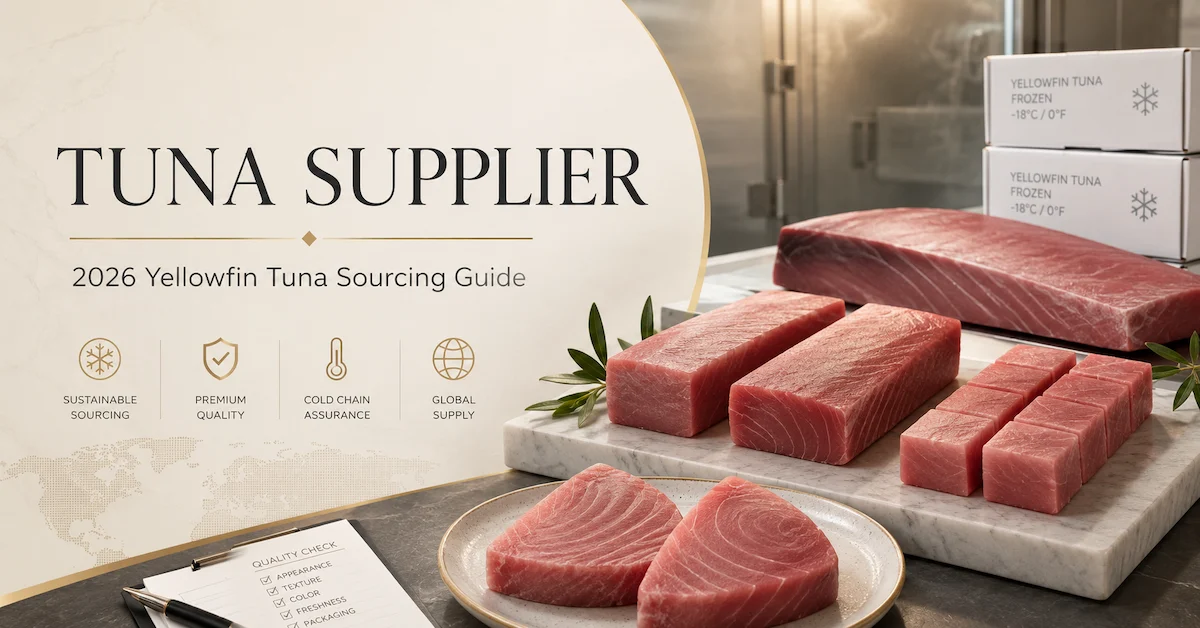


Choosing a reliable frozen tuna supplier is an important decision for seafood importers, wholesalers, supermarkets, sushi distributors, restaurant chains, and food processing companies.
Yellowfin tuna can be supplied as whole fish, loins, steaks, saku blocks, cubes, medallions, minced products, or cooked processing materials. Each format has different requirements for trimming, color, texture, freezing, packaging, storage temperature, traceability, and final application.
The lowest quotation is not always the best commercial offer. A product with poor trimming, unstable color, unclear treatment status, weak packaging, or excessive thawing loss may create a higher real cost after arrival.
Professional buyers should compare suppliers based on usable yield, product consistency, cold-chain capability, food safety controls, export documentation, and long-term supply reliability.
This guide explains how to evaluate frozen yellowfin tuna and prepare a more accurate sourcing request for 2026.
What Should Buyers Expect from a Frozen Tuna Supplier?
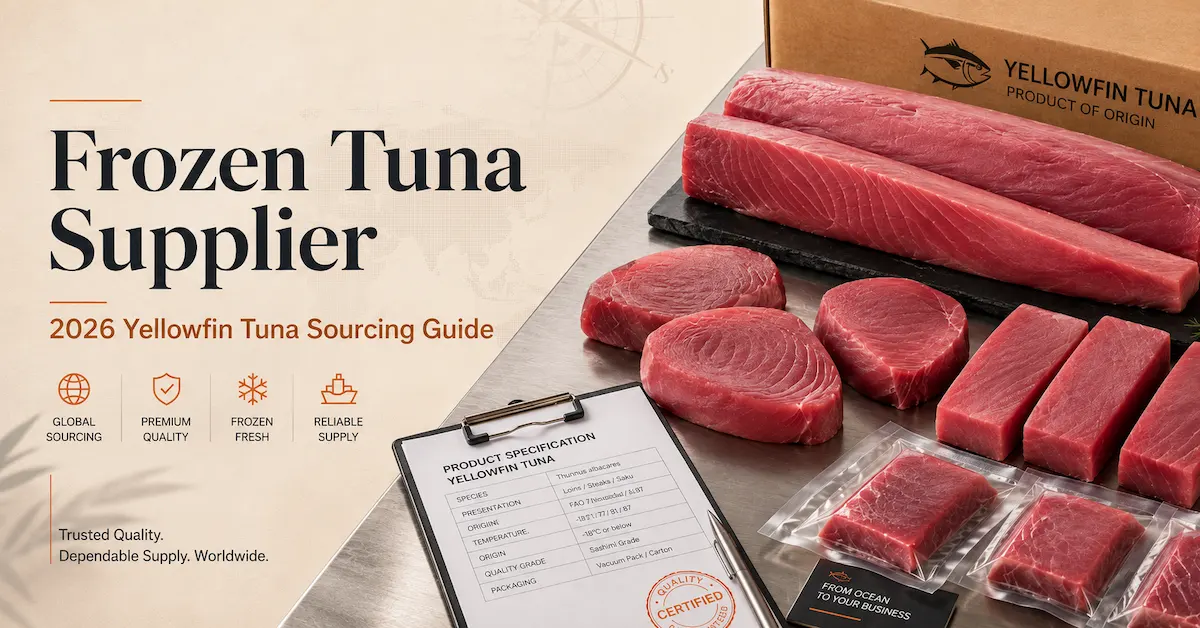
A professional frozen tuna supplier should provide clear and complete information before asking the buyer to confirm an order.
Important details include:
- Commercial and scientific species names
- Catch origin and processing origin
- Wild-caught status
- Fishing method where required
- Product form
- Trimming standard
- Individual size or weight
- Intended application
- Natural or treated color status
- Freezing method
- Storage temperature
- Net weight
- Packaging
- Shelf life
- Batch traceability
- Available export documents
- Sample and inspection options
The supplier should also understand whether the product will be used for sushi, poke bowls, grilled steaks, catering, retail packaging, canning, or further processing.
Bothwin Food currently supplies seafood products for international B2B customers, including premium frozen tuna and other frozen fish categories. Exact tuna species, origin, grade, processing format, packaging, certificates, and availability should be confirmed during quotation.
Buyers can review available seafood through the Products page, learn more about the company through the About Us page, or submit a detailed RFQ through the Contact Us page.
What Is Yellowfin Tuna?
Yellowfin tuna, scientifically known as Thunnus albacares, is a tropical tuna species found in the Pacific, Indian, and Atlantic Oceans.
It is commercially valued for its:
- Firm texture
- Lean meat
- Red or pink appearance
- Flexible cutting formats
- Suitability for grilling and searing
- Use in sushi and poke products
- Ability to be processed into loins, steaks, cubes, and medallions
Yellowfin tuna should not be treated as a single uniform product. Its value depends on fish size, fishing method, onboard handling, chilling speed, processing quality, trimming, freezing technology, storage history, and final application.
A tuna processor purchasing raw material for cooked meals does not necessarily need the same grade as a sushi distributor buying highly trimmed saku blocks.
Main Frozen Tuna Product Formats
A reliable frozen tuna supplier should help buyers select the right format based on their target market.
| Product Form | Main Characteristics | Best Application |
|---|---|---|
| Whole frozen tuna | Lowest processing level | Canning and industrial processing |
| Tuna loins | Large boneless sections | Foodservice and further cutting |
| Tuna steaks | Fixed-weight portions | Restaurants and supermarkets |
| Saku blocks | Rectangular trimmed blocks | Sushi, sashimi, poke, tataki |
| Tuna cubes | Uniform diced pieces | Poke bowls and ready meals |
| Medallions | Smaller round portions | Catering and retail |
| Minced tuna | Smaller processed pieces | Spicy tuna, fillings, patties |
| Cooked loins | Pre-cooked material | Canning and prepared foods |
Frozen Tuna Loins
Tuna loins are large sections removed from the main body of the fish.
They may be supplied as:
- Skinless
- Boneless
- Bloodline-on
- Bloodline-off
- Single-cleaned
- Double-cleaned
- Natural color
- Approved color-treated product
- Vacuum packed
- Individually frozen
Loins are commonly purchased by foodservice distributors, restaurants, processors, smokehouses, and canning companies.
The trimming specification is important because two products described as “yellowfin tuna loin” may provide very different usable yields.
Buyers should clearly define acceptable levels of:
- Bloodline
- Sinew
- Dark meat
- Skin
- Bone
- Surface tissue
- Broken sections
A lower-cost loin may become more expensive if the buyer must remove a large amount of bloodline or sinew after thawing.
Frozen Tuna Steaks
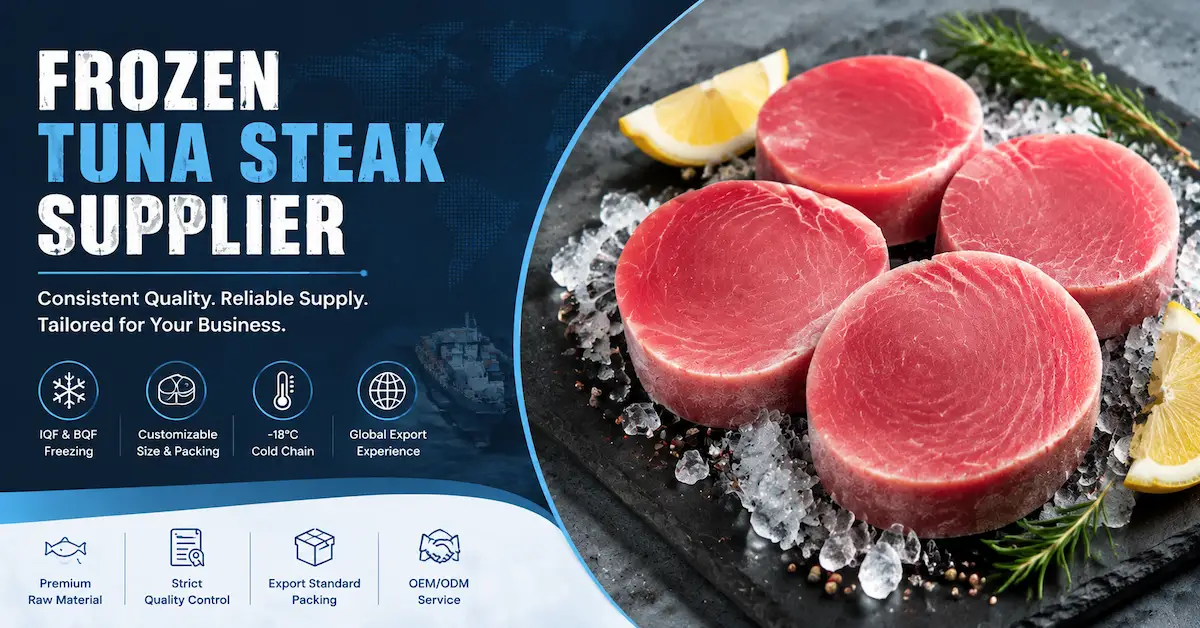
Tuna steaks are portion-controlled cuts produced from tuna loins.
They are commonly used by:
- Restaurants
- Hotels
- Catering companies
- Supermarkets
- Frozen meal manufacturers
- Foodservice distributors
Specifications may include:
- Individual weight
- Diameter
- Thickness
- Bloodline allowance
- Sinew tolerance
- Color range
- Vacuum packaging
- IQF packaging
- Pieces per carton
Uniform thickness helps restaurants control cooking time. Consistent weight helps buyers calculate menu cost and retail pricing.
A professional frozen tuna supplier should provide clear size tolerances rather than use a general term such as “standard steak.”
Tuna Saku Blocks
Saku blocks are rectangular tuna portions that have been trimmed for efficient slicing.
They are commonly used for:
- Sushi
- Sashimi
- Poke
- Tataki
- Premium restaurant dishes
- Retail raw-use products where permitted
Buyers should evaluate:
- Color consistency
- Clarity
- Firmness
- Sinew
- Blood spots
- Browning
- Surface dehydration
- Dimensions
- Individual weight
- Packaging
- Freezing history
The phrase “sashimi grade” does not replace a measurable specification.
Buyers should define the acceptable color, texture, trimming, dimensions, food safety controls, freezing process, and intended use in writing.
Frozen Tuna Cubes and Medallions
Tuna cubes are widely used in poke bowls, salads, kebabs, marinated dishes, and prepared meals.
Important specifications include:
- Cube dimensions
- Size tolerance
- Sinew allowance
- Bloodline allowance
- Broken-piece percentage
- Color requirement
- IQF separation
- Pack weight
- Raw or cooked application
Medallions are smaller round portions commonly supplied to restaurants, hotels, and retail channels.
The quality of cubes and medallions depends heavily on the raw material and trimming process. Buyers should confirm whether the products are produced from center-cut loins or secondary trimmed material.
How to Match Tuna Quality to the Application
Not every buyer needs the highest-priced tuna grade.
| Application | Main Purchasing Priority |
| Sushi and sashimi | Color, clarity, firmness, trimming, food safety |
| Poke bowls | Cube uniformity, color, low sinew |
| Grilled steaks | Portion weight, firmness, cooking yield |
| Hotels and catering | Consistency, cost, portion control |
| Supermarkets | Appearance, packaging, shelf life |
| Prepared meals | Cooking performance and price |
| Canning | Industrial yield and cooked quality |
| Further processing | Stable raw-material specifications |
A suitable frozen tuna supplier should ask how the product will be used before recommending a grade.
Paying for premium raw-use tuna may be unnecessary when the product will be fully cooked or minced. At the same time, using lower-grade processing tuna for premium sushi applications may create quality and food safety risks.
Catch Origin, Processing Origin, and Traceability
The ocean where tuna is caught may be different from the country where it is processed or exported.
Buyers should distinguish between:
- Catch origin
- FAO fishing area
- Fishing vessel or supply source
- Processing country
- Exporting country
- Declared country of origin
Depending on the destination market and buyer program, traceability records may include:
- Catch area
- Vessel information
- Fishing method
- Landing information
- Processing facility
- Production batch
- Packaging date
- Container number
- Catch certificate
- Chain-of-custody documents
Buyers should request traceability information before production, especially when supplying supermarkets, branded seafood programs, or regulated markets.
How Fishing Methods Affect Tuna Supply
Different fishing methods may influence tuna size, volume, handling, traceability, and cost.
| Fishing Method | General Characteristics | Typical Application |
| Longline | Often catches larger individual tuna | Premium loins and steaks |
| Purse seine | Supports larger commercial volume | Processing and industrial supply |
| Pole-and-line | Individually caught fish | Traceable sustainability programs |
| Handline | Smaller-scale individual handling | Premium regional markets |
| Gillnet | Quality and traceability may vary | Processing and regional distribution |
Fishing method alone does not guarantee product quality.
Post-catch handling, chilling speed, bleeding, processing, freezing, and storage conditions may have an equal or greater impact on the final tuna.
Tuna Color, Texture, and Trimming Standards
Tuna quality is often judged through color, firmness, clarity, and usable yield.
Color
Buyers may request a red, pink, or application-specific color range.
However, bright red color alone does not prove freshness. Buyers should also check treatment status, texture, smell, freezing history, and storage records.
Texture
Tuna should have the firmness required for slicing, searing, grilling, or processing.
Soft or mushy products may create:
- Poor slicing performance
- Excessive drip loss
- Lower cooking yield
- Unattractive retail appearance
- Increased production waste
Trimming
The specification should define acceptable quantities of:
- Bloodline
- Sinew
- Skin
- Bone
- Dark meat
- Surface tissue
- Broken material
Clear trimming standards reduce disputes and allow buyers to compare suppliers fairly.
Natural Color vs Color-Treated Tuna
Some tuna products use processes designed to maintain a red appearance. Treatment acceptance and labeling requirements vary by destination market.
Before ordering, buyers should confirm:
- Whether treatment is used
- What method is applied
- Whether it is legal in the destination market
- Whether special labeling is required
- Whether the buyer accepts treated tuna
- Whether the approved sample reflects the bulk order
A supplier should disclose treatment status clearly.
Buyers should not rely only on product photos because lighting, packaging, freezing, and treatment can all affect tuna appearance.
Histamine Risk and Food Safety Control
Tuna is a histamine-forming fish.
Histamine can develop when tuna is exposed to unsuitable time and temperature conditions before processing or freezing. Once high histamine levels have formed, freezing or cooking cannot be relied upon to remove the risk.
Buyers should evaluate:
- Handling after capture
- Chilling speed
- Vessel temperature records
- Receiving temperature
- Sensory examination
- Histamine testing
- Processing temperature
- Freezing time
- Frozen storage
- Container loading
- Batch traceability
- HACCP-based controls
This makes early handling and temperature management critical when selecting a frozen tuna supplier.
A certificate alone is not enough. Buyers should understand how the processor controls time, temperature, hygiene, and batch records.
Freezing and Storage Requirements
Frozen tuna products may use different freezing programs depending on grade and application.
Standard processing or cooking-grade products may be stored under normal commercial frozen conditions according to their specification. Premium raw-use products may require substantially colder freezing and transport conditions.
Buyers should confirm:
- Freezing technology
- Product core temperature
- Warehouse set point
- Transport temperature
- Shelf life
- Temperature tolerance
- Data logger requirements
- Destination cold-storage capability
A buyer should not purchase an ultra-low-temperature product unless the entire logistics chain can maintain the required conditions.
Premium freezing at origin provides little value if the destination warehouse, truck, or retail freezer cannot support the same temperature program.
Frozen Tuna Packaging Options
| Packaging Format | Suitable Products |
| Vacuum bag | Loins, steaks, saku blocks |
| IQF bag | Cubes and smaller portions |
| Interleaved pack | Steaks and medallions |
| Bulk carton | Whole tuna and processing material |
| Retail box | Supermarket steaks and saku |
| Foodservice carton | Restaurants, hotels, distributors |
| Private-label packaging | Retail and branded programs |
Packaging should protect tuna from:
- Dehydration
- Freezer burn
- Oxidation
- Physical damage
- Contamination
- Seal failure
- Temperature fluctuation
Buyers should approve both the tuna sample and packaging sample before mass production.
What Determines Frozen Tuna Prices?
Frozen tuna prices vary according to:
- Species
- Catch ocean
- Fishing method
- Fish size
- Product form
- Quality grade
- Color specification
- Treatment status
- Trimming standard
- Freezing method
- Storage temperature
- Packaging
- Certification
- Order quantity
- Season
- Freight
- Destination
A buyer should not compare a cooking-grade loin with a premium raw-use saku block simply because both are yellowfin tuna.
A fair comparison requires the same:
- Species
- Origin
- Product form
- Grade
- Treatment status
- Trimming
- Weight
- Freezing standard
- Packaging
- Incoterm
Common Risks When Buying Frozen Tuna
Unclear Species
Yellowfin, bigeye, skipjack, albacore, and other tuna species have different values and applications.
Vague Grade Claims
Terms such as “premium” and “sashimi grade” should be supported by measurable criteria.
Hidden Treatment
Color-treatment status must be disclosed before order confirmation.
Weak Histamine Controls
Poor time-temperature handling creates a risk that freezing cannot reverse.
Unstable Color or Texture
Sample and bulk shipment quality may differ when raw material or processing is inconsistent.
Excessive Trimming Loss
Loins with high bloodline or sinew content provide lower usable yield.
Inadequate Cold Chain
Premium tuna may lose value if the transport or destination warehouse cannot maintain the required temperature.
Incomplete Traceability
Missing catch, processing, or batch information may create compliance or customer problems.
How to Choose a Reliable Frozen Tuna Supplier
Buyers should evaluate the complete supply package.
Confirm Product Experience
The supplier should regularly handle the requested tuna species and product form.
Request Full Specifications
Ask for species, catch origin, processing origin, fishing method, grade, trimming, treatment status, freezing method, packaging, shelf life, and storage temperature.
Test Samples
Samples should be evaluated for:
- Species
- Color
- Texture
- Smell
- Sinew
- Bloodline
- Dimensions
- Weight
- Thawing loss
- Cooking or slicing performance
- Packaging
Review Food Safety Controls
Ask about histamine prevention, temperature records, HACCP procedures, batch control, sanitation, and testing.
Confirm Traceability
Verify catch area, processing source, production batch, and required documentation.
Review Cold-Chain Capability
Make sure the supplier and destination facilities can maintain the agreed temperature.
Start with a Trial Order
A trial order helps evaluate consistency, packaging, documents, lead time, communication, and destination performance.
Why Work with Bothwin Food
Bothwin Food supplies frozen seafood and related food products for global B2B buyers. Its current product direction includes Premium Frozen Tuna, frozen fish, shrimp, cephalopods, canned goods, spices, and condiments.
As a flexible frozen tuna supplier, Bothwin Food can help organize purchasing requirements based on:
- Tuna species
- Catch or processing origin
- Product form
- Grade
- Trimming
- Size
- Treatment preference
- Freezing requirement
- Packaging
- Order quantity
- Destination market
- Intended application
Product availability, grade, origin, temperature requirements, certificates, and documentation should be confirmed for each order.
Buyers can review current categories on the Products page, learn more through the About Us page, or submit specifications through the Contact Us page.
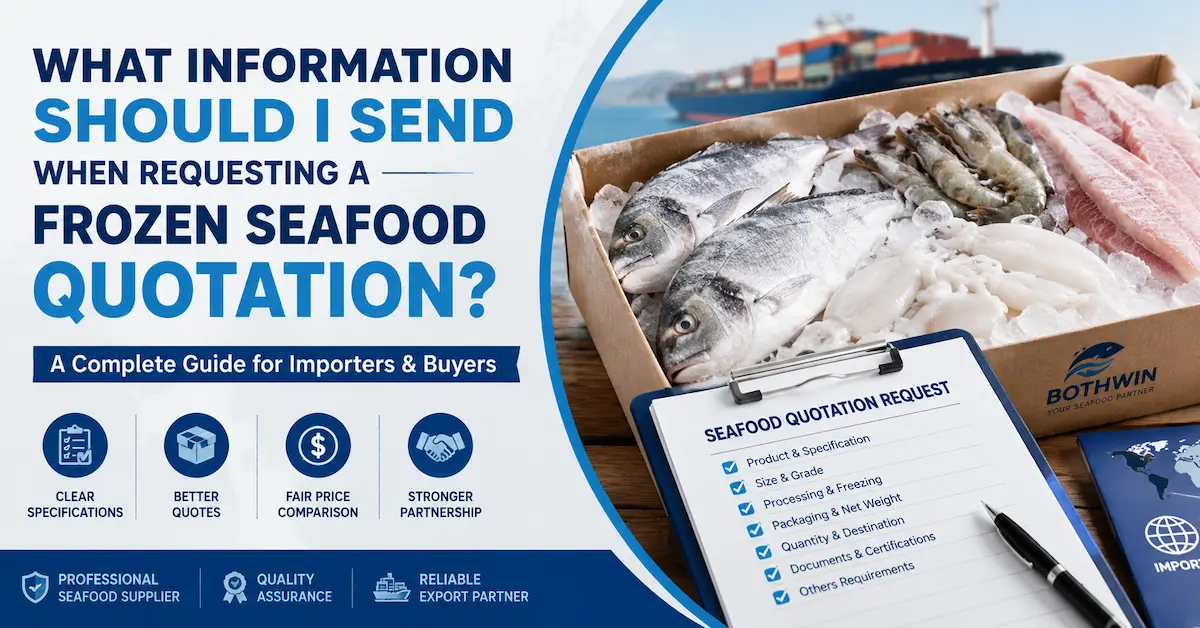
Frozen Tuna RFQ Checklist
To receive an accurate quotation, provide:
- Tuna species
- Scientific name
- Catch origin
- Processing origin
- Fishing method requirement
- Product form
- Grade
- Intended application
- Natural or treated preference
- Trimming standard
- Size or dimensions
- Freezing method
- Required storage temperature
- Net weight
- Packaging
- Order quantity
- Destination country and port
- Required documents
- Histamine-testing requirement
- Sample request
- Target shipment date
FAQ
What does a frozen tuna supplier provide?
A frozen tuna supplier may provide whole tuna, loins, steaks, saku blocks, cubes, medallions, minced tuna, cooked loins, and industrial processing materials.
Is yellowfin tuna suitable for restaurants?
Yes. Yellowfin tuna is used for grilled steaks, seared dishes, poke bowls, sushi, catering, and prepared meals, depending on the grade and food safety controls.
What should buyers check when sourcing yellowfin tuna?
Buyers should confirm species, origin, fishing method, product form, grade, trimming, treatment status, freezing, packaging, histamine controls, traceability, and documents.
What is the difference between a tuna loin and a saku block?
A loin is a large boneless tuna section. A saku block is a smaller rectangular portion with more trimming for uniform slicing.
Is “sashimi grade” an official standard?
It is mainly a commercial term. Buyers should define measurable requirements for color, texture, trimming, freezing, food safety, and intended use.
Why is histamine control important?
Improper time and temperature handling can allow histamine to develop. Freezing and cooking cannot reliably remove histamine after it has formed.
Should buyers choose natural or color-treated tuna?
The correct option depends on destination regulations, customer expectations, labeling rules, and product application. Treatment status should always be disclosed.
What temperature does frozen tuna require?
The required temperature depends on grade, application, freezing method, shelf life, and contract specifications. Premium raw-use products may require colder conditions than cooking-grade tuna.
Should importers request samples?
Yes. Samples help verify species, grade, color, texture, trimming, weight, treatment status, packaging, and thawing performance.
How can buyers request a quotation from Bothwin Food?
Send Bothwin Food the tuna species, product form, grade, treatment preference, freezing requirement, packaging, quantity, destination, documents, and sample requirements.
Conclusion
Choosing a reliable frozen tuna supplier requires more than comparing yellowfin tuna prices.
Global buyers should define the exact species, catch origin, processing origin, product form, grade, trimming, treatment status, freezing method, packaging, histamine controls, traceability, and destination-market requirements.
Bothwin Food supplies Premium Frozen Tuna and related seafood products for international B2B buyers. Contact Bothwin Food with your tuna specifications, intended use, packaging, order quantity, destination, and document requirements to discuss a suitable 2026 sourcing plan.