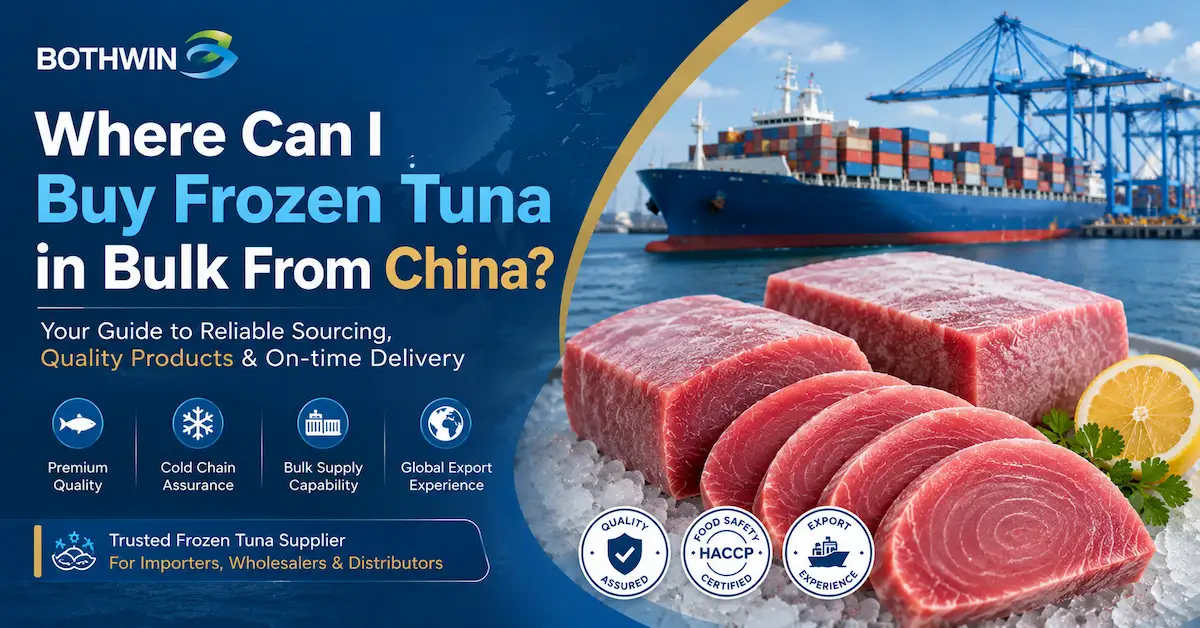


For international seafood buyers, sourcing tuna steaks, tuna loins, and tuna saku from the same supplier can make procurement easier and more consistent.
However, not every frozen tuna exporter offers the same product formats, processing standards, freezing methods, or packaging options.
For importers, wholesalers, foodservice distributors, supermarkets, and seafood processors, the real question is not simply:
“Who sells frozen tuna?”
The more important question is:
Can one frozen tuna exporter supply the right tuna format, specification, packaging, and quality consistently for my market?
Bothwin's current frozen tuna information lists whole round tuna, skinless and boneless loins, tuna steaks, and saku, with IQF/BQF freezing options, customizable size grades, and export-standard carton packaging.
This gives buyers the opportunity to evaluate different tuna formats according to their downstream application instead of treating frozen tuna as one standard commodity.
Explore Bothwin Premium Frozen Tuna
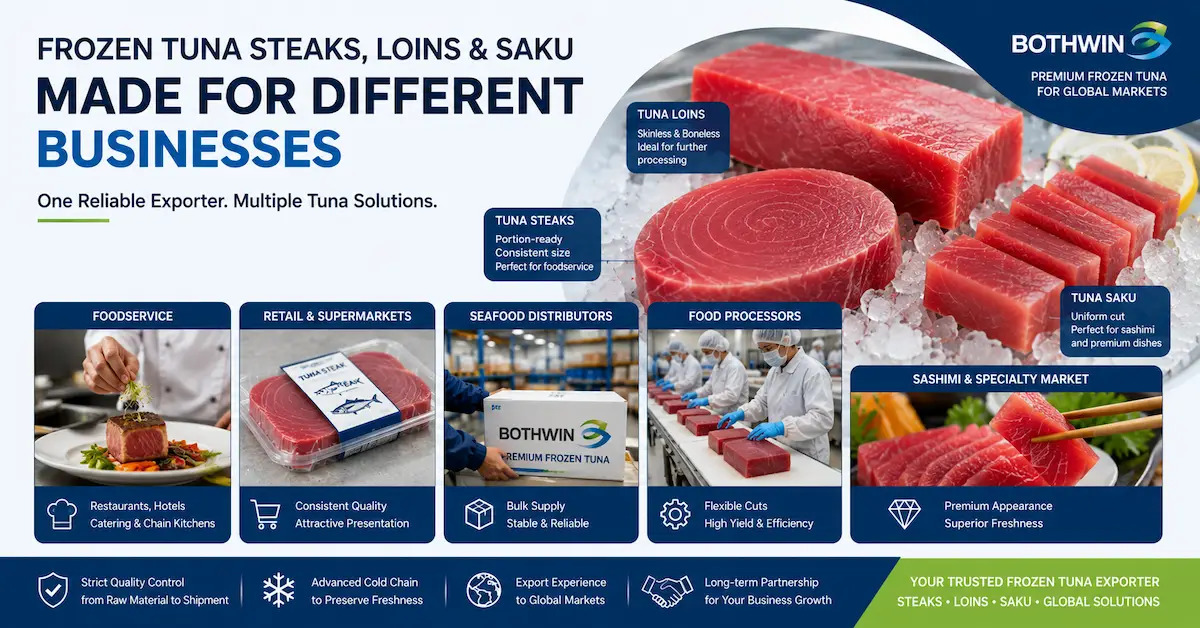
Who Buys Frozen Tuna Steaks, Loins and Saku in Bulk?
Different tuna formats serve different commercial requirements.
Seafood Importers
Importers may purchase multiple tuna formats for distribution to different customers.
They typically focus on:
- stable product specifications
- competitive landed cost
- export documentation
- packaging
- cold-chain management
- repeat-order consistency
A supplier capable of providing several tuna formats can simplify procurement when an importer serves multiple market segments.
Foodservice Distributors
Foodservice distributors may supply:
- restaurants
- hotels
- catering companies
- central kitchens
Their priorities often include:
- portion consistency
- cutting accuracy
- manageable packaging
- predictable thawing
- cooking performance
Tuna steaks can be particularly suitable when customers need ready-to-portion products.
Seafood Processors
Processors may prefer tuna loins because they can perform additional cutting or portioning according to their own production requirements.
Their main concerns can include:
- usable yield
- trimming
- product consistency
- raw material specifications
- freezing format
Specialized Foodservice and Seafood Buyers
Saku-format tuna can be useful when buyers require a relatively uniform rectangular form for specific preparation or portioning applications.
For these buyers, dimensions and intended use should be clearly defined before quotation.
What Is the Difference Between Tuna Steaks, Loins and Saku?
Before comparing exporters, buyers should understand what they are actually purchasing.
| Tuna Format | Main Commercial Advantage | Typical Buyer | Key Specification |
|---|---|---|---|
| Tuna Steak | Portion-ready format | Restaurants, hotels, foodservice | Weight and thickness |
| Tuna Loin | Flexible for further cutting | Processors,distributors | Yield and trimming |
| Tuna Saku | Uniform rectangular format | Specialized foodservice | Dimensions and intended use |
| Whole Round | Maximum downstream processing flexibility | Large processors | Fish size and processing yield |
The current Bothwin tuna product information includes all four formats, allowing buyers to discuss the appropriate product form according to their application.
Tuna Steaks: When Should Buyers Choose Them?
Tuna steaks are often appropriate when buyers want a product that requires less downstream cutting.
For foodservice applications, important specifications may include:
- portion weight
- thickness
- diameter or shape
- skin requirement
- bone requirement
- freezing method
- packaging
Two tuna steaks can have the same weight but different dimensions.
For example, a 150 g steak can be relatively thin and wide or thicker with a smaller diameter.
That difference can affect:
- cooking time
- menu consistency
- plating
- portion control
- kitchen labor
Therefore, buyers should avoid specifying only:
“150 g frozen tuna steak.”
A better specification includes:
Target weight + weight tolerance + target thickness + thickness tolerance.
Bothwin's existing tuna sourcing guidance specifically recommends considering both weight and thickness when buyers need consistent foodservice portions.
Tuna Loins: When Are They Better for Bulk Buyers?
Tuna loins provide more flexibility for further processing.
They can be suitable for:
- seafood processors
- food manufacturers
- distributors
- foodservice suppliers
Compared with portion-ready steaks, loins allow buyers to determine final cuts according to their own production requirements.
Important specifications may include:
- skinless or skin-on
- boneless requirement
- loin size
- trimming standard
- weight range
- freezing method
- packaging
Bothwin currently lists skinless and boneless tuna loins within its tuna product range.
For processors, the most important comparison may therefore be:
Purchase Cost + Processing Yield + Trimming Loss + Labor Cost
rather than simply the quoted price per kilogram.
Tuna Saku: What Should Buyers Confirm?
Saku is a more specific commercial format and should not be treated simply as another name for tuna steak.
For buyers sourcing saku, the RFQ should clearly define:
- product dimensions
- weight range
- tuna species
- trimming requirements
- skin and bone requirements
- freezing method
- packaging
- intended application
The current Bothwin tuna range includes saku as one of its available tuna formats.
For specialized foodservice programs, consistency in dimensions can be particularly important because the product may be used for standardized preparation and presentation.
What Specifications Should Buyers Send to a Frozen Tuna Exporter?
One of the biggest mistakes in international seafood purchasing is asking for a quotation with insufficient information.
For example:
“Please quote tuna steaks, loins and saku.”
This is not enough for an accurate comparison.
A professional RFQ should include:
| Specification | Buyer Should Define |
|---|---|
| Tuna species | Required commercial species |
| Product form | Steak,loin or saku |
| Size | Weight or dimensional range |
| Weight tolerance | Acceptable variation |
| Thickness | Required for steaks |
| Skin | Skin-on or skinless |
| Bone | Boneless or other requirement |
| Trimming | Required trimming standard |
| Freezing | IQF,BQF or agreed method |
| Glazing | Required percentage or basis |
| Net weight | Declared weight basis |
| Packaging | Bulk, vacuum, foodservice or retail |
| Label | Market and customer requirements |
| Quantity | Trial or bulk order volume |
| Destination | Country and port |
| Documents | Required export/import documents |
The more detailed the RFQ, the easier it becomes for suppliers to provide comparable quotations.
Bothwin's current frozen tuna guidance recommends providing product form, species, portion requirements, freezing preference, glazing, net weight, packing format, order quantity, destination, and intended application when requesting a quotation.
IQF vs BQF: Which Freezing Method Should Buyers Choose?
Freezing method should be evaluated according to how the buyer handles the product.
Bothwin's current tuna product information lists IQF and BQF options.
IQF Tuna
IQF means Individually Quick Frozen.
It can be useful when buyers need to:
- remove individual pieces
- control portions
- reduce unnecessary thawing
- manage foodservice inventory
This can be particularly useful for tuna steaks supplied to restaurants or foodservice distributors.
BQF or Bulk-Freezing Applications
A bulk-oriented freezing format may be more suitable when buyers routinely process or thaw larger quantities together.
The correct choice depends on:
- order volume
- storage system
- downstream processing
- kitchen workflow
- labor requirements
- packaging configuration
Therefore, buyers should not automatically assume that one freezing method is better for every application.
How Should Buyers Compare a Frozen Tuna Exporter?
A supplier comparison should cover at least five areas.
| Evaluation Area | Questions Buyers Should Ask |
|---|---|
| Product Range | Can the exporter supply steaks, loins and saku? |
| Specification | Can required sizes and cuts be maintained? |
| Quality Control | How are weight,appearance and frozen condition checked? |
| Packaging | Can packaging match the sales channel? |
| Export Support | Can documentation and shipment requirements be handled? |
A supplier that can technically provide three formats may still not be the best choice if it cannot maintain consistent specifications across repeat orders.
The goal should be:
One supplier + clear specifications + repeatable quality + reliable export execution.
What Quality Checks Should Buyers Perform on Tuna Steaks, Loins and Saku?
Product format changes the quality checks that matter most.
Tuna Steak QC
Check:
- weight
- thickness
- shape consistency
- skin/bone requirements
- surface condition
- packaging integrity
Tuna Loin QC
Check:
- loin size
- trimming
- skinless/boneless condition
- usable yield
- surface appearance
- frozen condition
Tuna Saku QC
Check:
- dimensions
- weight
- shape consistency
- trimming
- frozen condition
- packaging
Across all formats, buyers should also evaluate:
- species identity
- labeling
- net weight
- glazing
- batch identification
- temperature condition
Bothwin's existing tuna quality guidance recommends turning subjective terms such as “premium quality” into measurable acceptance criteria before shipment.
Why Is Glazing Important When Comparing Tuna Exporters?
Glazing can affect how buyers interpret frozen seafood prices.
Ice glazing can help protect frozen seafood from dehydration and freezer burn, but buyers should clearly understand:
- glazing percentage
- net weight
- gross weight
- product weight basis
For example, two suppliers may quote apparently similar prices while offering different glazing levels.
This can change the amount of usable tuna delivered.
Therefore, buyers should compare:
Landed cost per usable kilogram
rather than simply:
Quoted price per carton.
For a detailed explanation, buyers can read:
How Does Glazing Percentage Affect Frozen Seafood Cost for Importers?
How Should Packaging Match Tuna Steaks, Loins and Saku?
Packaging should reflect the buyer's downstream sales channel.
Foodservice Packaging
Suitable for:
- restaurants
- hotels
- catering companies
- foodservice distributors
The focus is usually:
- efficient handling
- portion access
- stable pack configuration
Bulk Processing Packaging
Processors may prioritize:
- larger quantities
- efficient warehouse handling
- reduced packaging complexity
Retail or Private-Label Packaging
Retail buyers may require:
- custom artwork
- product labels
- barcode
- localized language
- declared weight
- storage instructions
Bothwin currently positions its broader seafood supply around export packing and flexible OEM solutions for importers, wholesalers, and foodservice distributors.
Can a Frozen Tuna Exporter Support Customized Specifications?
Customization can be important for buyers who operate:
- restaurant chains
- supermarket programs
- seafood brands
- foodservice distribution
- processing facilities
Possible requirements can include:
- customized size grades
- steak weight
- steak thickness
- loin specifications
- saku dimensions
- packaging format
- private-label requirements
Bothwin's current tuna information states that size grades can be customized according to client requirements and identifies IQF/BQF and export-standard carton packaging as available options.
However, buyers should confirm the exact specification, MOQ, packaging cost, and production schedule for each project before finalizing an order.
How Should Buyers Plan a Bulk Tuna Order?
A practical purchasing process is:
1. Define Application
Restaurant, foodservice, processing, retail, or wholesale.
↓
2. Select Product Format
Steak, loin, saku, or whole round.
↓
3. Define Specification
Species + size + weight + dimensions + processing.
↓
4. Confirm Freezing
IQF, BQF, or another agreed method.
↓
5. Confirm Packaging
Bulk, foodservice, retail, or private label.
↓
6. Request Sample
Evaluate product against the specification.
↓
7. Confirm Commercial Terms
Quantity, delivery, documentation, and shipment requirements.
↓
8. Place Bulk Order
Maintain the approved specification for repeat orders.
What About Lead Time for Frozen Tuna Orders?
Lead time should be confirmed based on the actual order rather than using a generic number.
Factors that may influence production and shipment planning include:
- product format
- required size
- processing requirements
- packaging
- customization
- order quantity
- current production schedule
- destination requirements
This is particularly important for customized tuna steaks and saku because the buyer may require specific dimensions or packaging.
When requesting a quotation, include the target shipment date so the supplier can evaluate production and logistics feasibility.
What Risks Should Importers Consider Before Choosing a Tuna Exporter?
| Risk | Possible Cause | Buyer Protection |
|---|---|---|
| Wrong product format | Vague RFQ | Clearly specify steak/loin/saku |
| Size variation | Undefined tolerance | Set weight/dimension tolerance |
| Weight dispute | Unclear net-weight basis | Confirm net weight |
| Glazing difference | No agreed ratio | Specify glazing |
| Packaging mismatch | Packaging discussed too late | Approve packing before production |
| Quality variation | No acceptance criteria | Create QC checklist |
| Shipment delay | Late planning | Confirm target shipment date |
| Documentation issue | Destination requirements unclear | Review documents early |
| Repeat-order variation | No approved standard | Keep a signed product specification |
The most effective risk-control strategy is to convert every important expectation into a measurable purchasing requirement.
Why Choose Bothwin for Tuna Steaks, Loins and Saku?
Bothwin Development (HK) Limited states that it has operated in the seafood and aquaculture sector since 2005 and supplies farmed and wild seafood to international markets including South America, Europe, Africa, the USA, Southeast Asia, and Central Asia.
For frozen tuna, the current product information lists:
- whole round tuna
- skinless and boneless loins
- tuna steaks
- saku
- IQF/BQF freezing options
- customizable size grades
- export-standard carton packaging
This multi-format capability is particularly relevant for buyers who do not want to manage separate suppliers for every tuna format.
Instead of asking only:
“What is your tuna price?”
buyers can send a complete requirement covering:
- tuna species
- steak/loin/saku format
- size
- weight
- dimensions
- processing
- freezing
- glazing
- packaging
- quantity
- destination
This allows Bothwin to evaluate the actual sourcing requirement rather than quote an undefined commodity product.
Frozen Tuna Steaks, Loins and Saku Buyer Checklist
Before placing an order,confirm:
| Item | Check |
|---|---|
| Tuna species | ☐ |
| Product format | ☐ |
| Size grade | ☐ |
| Steak weight | ☐ |
| Steak thickness | ☐ |
| Saku dimensions | ☐ |
| Loin specification | ☐ |
| Skin/bone requirement | ☐ |
| Freezing method | ☐ |
| Glazing | ☐ |
| Net weight | ☐ |
| Packaging | ☐ |
| Label requirements | ☐ |
| Quality criteria | ☐ |
| Sample approval | ☐ |
| Export documents | ☐ |
| Destination port | ☐ |
| Target shipment date | ☐ |
| Bulk quantity | ☐ |
What Should Buyers Include in a Frozen Tuna RFQ?
For a faster and more accurate quotation,send the exporter this information:
Product: Tuna steak / tuna loin / tuna saku
Species: Required tuna species
Size: Weight or dimensions
Processing: Skinless / boneless / trimmed
Freezing: IQF / BQF
Glazing: Required percentage or basis
Packing: Bulk / foodservice / retail
Quantity: Required volume
Destination: Country + port
Documents: Required import/export documents
Application: Foodservice / wholesale / processing / retail
Target Date: Expected shipment date
This RFQ structure can significantly reduce back-and-forth communication and make supplier quotations easier to compare.
FAQ About Frozen Tuna Steaks, Loins and Saku
Can one frozen tuna exporter supply steaks, loins and saku?
Yes. Bothwin's current tuna product information lists tuna steaks, skinless and boneless loins, saku, and whole round tuna. Buyers should confirm the exact specification, size, quantity, and packaging required for each order.
What is the difference between tuna steak and tuna loin?
Tuna steak is generally a portion-ready format, while tuna loin provides greater flexibility for further cutting and processing. The better option depends on the buyer's application and processing capability.
What is tuna saku?
Tuna saku is a more standardized rectangular-style tuna format. Buyers should specify the required dimensions, weight, trimming, and intended application rather than requesting “saku” without further details.
Which tuna format is best for restaurants?
Tuna steaks can be convenient for restaurants and foodservice operations because they can reduce downstream cutting work. Weight and thickness consistency should be clearly specified.
Which tuna format is better for seafood processors?
Tuna loins can provide greater flexibility for further cutting and processing. Processors should compare yield, trimming requirements, and total processing cost.
Can frozen tuna steak size be customized?
Bothwin's current product information states that size grades can be customized according to client requirements. Exact weight and dimensional ranges should be confirmed in the purchase specification.
Does Bothwin offer IQF and BQF tuna?
Bothwin's current tuna information lists both IQF and BQF freezing options. Buyers should select the format according to their storage, handling, and downstream processing requirements.
How should buyers compare tuna exporter prices?
Compare equivalent specifications, including species, product format, size, processing, glazing, net weight, packaging, trade terms, and delivery conditions. Comparing price alone can produce misleading results.
Should buyers request samples before bulk orders?
For a new supplier relationship, a sample or trial order is a practical way to evaluate product appearance, size consistency, processing, weight, packaging, thaw performance, and suitability before committing to larger volumes.
How can I request a quotation from Bothwin?
Send your required tuna format, species, size, processing requirements, freezing method, glazing, packaging, quantity, destination, and target shipment date through the Bothwin Contact page.
Conclusion
When looking for a frozen tuna exporter that can supply tuna steaks, loins, and saku, international buyers should evaluate more than product availability.
The right supplier should be able to match:
Product Format
→ Specification
→ Processing
→ Freezing
→ Packaging
→ Quality Control
→ Export Requirements
Tuna steaks may be suitable for portion-controlled foodservice applications, while loins can provide greater processing flexibility and saku can serve specialized applications requiring a more standardized format.
For bulk buyers, the most important step is to define the specification before comparing prices.
Bothwin's current tuna range includes whole round tuna, skinless/boneless loins, steaks, and saku, together with IQF/BQF options and customizable size grades.
If your business is sourcing multiple tuna formats, send Bothwin your species, format, size, processing, packaging, quantity, destination, and target shipment date so the requirement can be evaluated on a like-for-like basis.