

What Matters When Buying Whole Frozen Tilapia for Wholesale?
Buying whole frozen tilapia for wholesale is not simply a matter of asking for a price per ton or carton. Professional buyers need a specification that fits how the fish will actually be distributed, displayed, prepared, or processed after arrival.
For an importer supplying traditional seafood markets, fish size and carton economics may be the priority. A foodservice distributor may care more about individual size consistency and easy handling. A retail program may require cleaner presentation, consumer-ready packing, or private labeling.
This is why a useful wholesale specification normally defines several points together:
- tilapia type or species
- individual fish size range
- whole or processed condition
- IQF or block freezing
- glazing requirement
- declared net weight
- carton configuration
- storage requirement
- labeling
- destination market
- intended sales channel
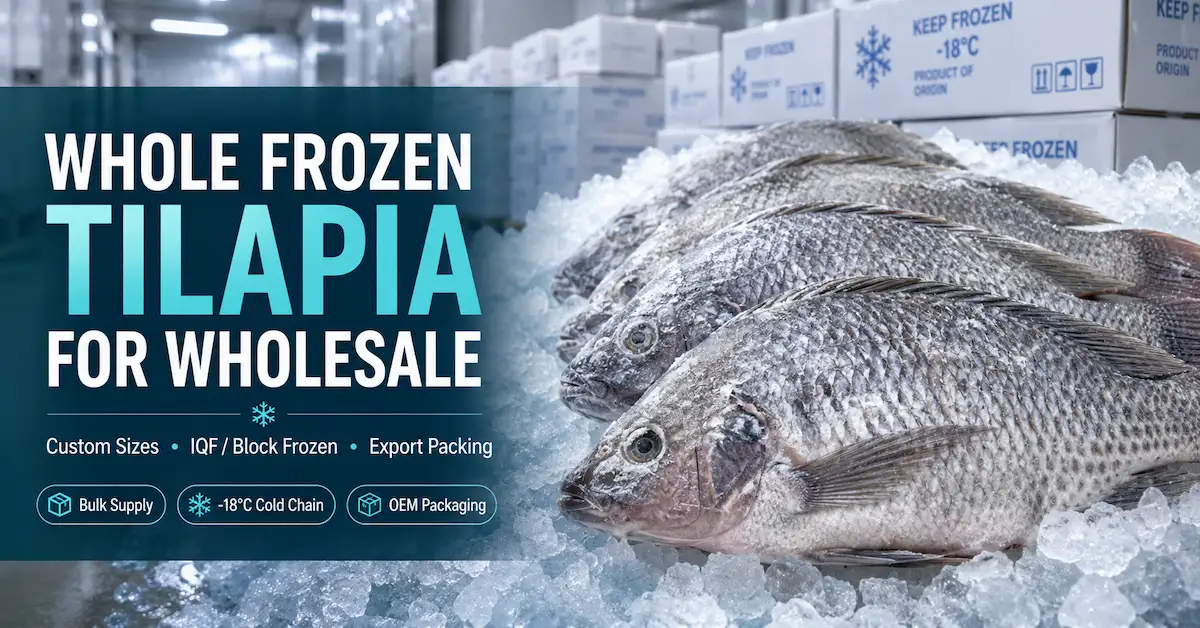
Bothwin's current Whole Frozen Tilapia for Export product page lists whole frozen tilapia under Oreochromis spp., with customized sizes, IQF or block-frozen options, bulk export cartons or OEM packaging, and frozen storage at -18°C or below.
The commercial goal is therefore not to find one “best” tilapia specification. It is to identify the specification that best fits the buyer's downstream market.
Which Buyers Use Whole Frozen Tilapia in Bulk?
Whole frozen tilapia serves several B2B channels, but each channel evaluates the product differently.
Seafood Importers and Wholesalers
Importers commonly need products that can be resold across multiple customers without extensive repacking or processing.
Important purchasing factors include:
- competitive landed cost
- consistent size grading
- bulk carton efficiency
- stable repeat-order specifications
- acceptable glazing
- export documentation
- cold-chain reliability
Bothwin identifies seafood importers, distributors, wholesalers, food processors, catering supply chains, and international trading companies among the target customers for its whole frozen tilapia.
Traditional Seafood Markets
Whole fish often works well in markets where customers recognize and purchase fish by visible size.
For these buyers, a mixed-size carton can make resale pricing more difficult. Narrower size tolerances may therefore have more commercial value than simply reducing the quoted price.
Restaurants and Foodservice Distributors
Foodservice buyers usually need predictable portions.
A restaurant purchasing whole tilapia may care about:
- individual fish weight
- preparation labor
- gutting or scaling
- thaw consistency
- usable meat yield
- cooking presentation
A small difference in individual fish size becomes operationally important when hundreds or thousands of meals must be standardized.
Food Processing Companies
Processors may use whole frozen fish as raw material for further cutting, seasoning, cooking, or value-added products.
Their purchasing decisions often focus on:
- raw-material cost
- processing yield
- fish size
- thaw loss
- production efficiency
How Should Wholesale Buyers Specify Tilapia Size?
Size grading is one of the most important parts of a wholesale order.
Tilapia is commonly traded according to individual fish weight ranges, but the exact grades offered vary by supplier, production lot, and destination market.
Rather than asking only for “medium tilapia,” the RFQ should state a measurable weight range.
A practical specification might include:
- required individual weight range
- acceptable tolerance
- maximum percentage outside the grade
- expected number of fish per carton where relevant
- whether declared size is measured before or after processing
Why Size Consistency Matters
Consistent grading affects more than appearance.
It can influence:
- wholesale resale pricing
- restaurant portion control
- cooking time
- carton piece count
- inventory forecasting
- consumer expectations
For example, a wholesaler selling fish by piece may prefer a tighter grade because buyers can more easily predict unit value.
A processor buying by weight may tolerate a wider range if processing yield remains acceptable.
Match Fish Size to the Sales Channel
| Sales Channel | Main Size Priority | Why |
|---|---|---|
| Wholesale market | Consistent commercial grades | Easier resale and price segmentation |
| Restaurants | Predictable individual portions | Better menu and cooking consistency |
| Supermarket | Visual consistency | Stronger shelf presentation |
| Food processing | Yield and raw-material economics | Focus on usable output |
| Trading company | Market-specific demand | Allows supply to different destinations |
The important lesson is simple: size should be chosen backward from the final customer, not simply from whatever grade carries the lowest quotation.
Whole Round, Scaled or Gutted: Which Format Works for Wholesale?
“Whole frozen tilapia” does not always mean identical processing.
Depending on the market, buyers may require different levels of preparation.
Whole Round Tilapia
The fish remains largely intact.
This format can suit buyers that:
- prioritize lower processing input
- operate their own processing facilities
- supply traditional whole-fish markets
- want maximum downstream flexibility
Scaled Tilapia
Removing scales reduces preparation work for restaurants and retail customers.
It can add processing cost, but it may also reduce labor after delivery.
Gutted Tilapia
Gutted fish can be more convenient for buyers that want a more preparation-ready product.
When comparing a whole-round quotation with a gutted-fish quotation, buyers should not compare price per kilogram alone. The amount of processing already completed and the usable yield must also be considered.
Bothwin's dedicated product page currently lists the commercial product as whole frozen tilapia, while specific customized processing requirements should be confirmed directly before quotation.
For a broader explanation of supplier and processing considerations, buyers can also read Bothwin's existing Whole Frozen Tilapia Supplier Buying Guide.
IQF vs Block Frozen Tilapia for Wholesale Orders
Bothwin lists both IQF and Block Frozen methods for whole frozen tilapia.
The appropriate choice depends largely on how the buyer will handle the fish after arrival.
IQF Whole Tilapia
IQF allows individual frozen fish to be handled separately rather than remaining frozen together as one large block.
This can be useful when:
- customers purchase individual fish
- wholesalers split cartons
- foodservice customers need flexible quantities
- inventory is removed gradually
The main commercial benefit is handling flexibility.
Block Frozen Tilapia
Block freezing can suit large-volume buyers that move or process substantial quantities together.
It may be appropriate for:
- high-volume wholesalers
- processors
- markets where entire cartons are thawed or sold together
- buyers prioritizing bulk logistics efficiency
Which Is Better?
There is no universal answer.
| Factor | IQF | Block Frozen |
| Individual fish access | Strong | Lower |
| Flexible order picking | Strong | More limited |
| Bulk processing | Suitable | Often practical |
| Wholesale carton handling | Flexible | Bulk-oriented |
| Best choice depends on | Resale and handling model | Volume and processing model |
The buyer should choose based on warehouse workflow and customer behavior rather than assuming one freezing method is automatically superior.
FAO guidance distinguishes rapid freezing from frozen storage and notes that good frozen-fish quality depends both on proper freezing and subsequent storage at suitably low temperatures.
Why Glazing and Net Weight Matter in Wholesale Tilapia
Glazing is a thin protective layer of ice applied to frozen fish.
FAO explains that glazing helps reduce undesirable drying and dehydration during frozen storage, which can otherwise contribute to freezer burn and quality deterioration.
For a wholesale buyer, however, glazing is also a commercial issue.
The RFQ should make clear:
- whether the fish is glazed
- agreed glazing level
- gross carton weight
- declared net fish weight
- packaging weight
- pricing basis
Compare Usable Fish, Not Just Carton Price
Consider two hypothetical quotations.
Offer A
- lower carton price
- higher ice/glaze contribution
- lower usable fish weight
Offer B
- slightly higher carton price
- clearer net-weight basis
- more usable product
Looking only at carton price could make Offer A appear cheaper.
For procurement purposes, a more useful comparison is:
effective seafood cost = total product cost ÷ usable net fish weight
This is especially important when thousands of kilograms are purchased in one shipment.
Small differences in usable weight can become meaningful at container scale.
What Packaging Works Best for Wholesale Tilapia?
Bothwin's current product specification states bulk export cartons / OEM available.
The right configuration should reflect the buyer's distribution channel.
Bulk Export Cartons
Often appropriate for:
- importers
- wholesalers
- processors
- distributors
The focus is on efficient handling, protection, stacking, and cold-storage distribution.
Inner Bag or Lined Carton Configurations
These may help protect the product during storage and distribution depending on the agreed packing format.
Retail or Private-Label Packaging
For buyers supplying supermarkets or their own seafood brands, the discussion may include:
- branded packaging
- label language
- product name
- weight declaration
- storage instructions
- barcode
- destination-market information
Packaging should be finalized during specification development—not after the fish has already been produced.
Buyers sourcing multiple seafood categories can review the broader Bothwin Seafood Product Range, which the company positions for importers, wholesalers and foodservice distributors with export packing and flexible OEM solutions.
What Should a Wholesale Quality Check Cover?
Terms such as “premium quality” are difficult to use in a purchase contract because they are subjective.
A better approach is to convert quality expectations into measurable checkpoints.
Frozen Product Inspection
Check:
- fish size against specification
- overall shape and condition
- packaging integrity
- excessive visible ice
- signs of dehydration or freezer burn
- carton weight
- label accuracy
Processing Check
Where processing is required, inspect:
- cleaning consistency
- scaling completeness
- gutting quality
- physical damage
- contamination or foreign material
Controlled Thaw Test
A representative thaw test can help evaluate:
- odor
- flesh firmness
- appearance
- water loss
- processing condition
Batch and Traceability Check
Bothwin's product page states that its tilapia quality-control approach includes HACCP-based management, hygiene and cold-chain control, export inspection, and batch traceability. These are company claims buyers should verify against the documents required for their own market and purchasing program.
Bothwin also describes incoming raw-material, production, pre-shipment, temperature, packaging and traceability controls in its Seafood Processing & Quality Control content.
How Cold-Chain Conditions Affect Wholesale Value
A good frozen product can lose commercial value if storage and distribution conditions are poorly controlled.
Bothwin lists -18°C or below as the storage specification for its whole frozen tilapia.
FDA consumer storage guidance similarly identifies 0°F (-18°C) as a standard freezer temperature, while FAO technical guidance discusses low-temperature frozen storage as a key part of maintaining frozen fish quality.
For B2B buyers, cold-chain questions should include:
- How is frozen storage temperature monitored?
- How is loading handled?
- Is product kept frozen during staging?
- What is the agreed container condition?
- How will receiving inspection be performed?
- Are temperature records required by the buyer?
Cold-chain performance affects more than food safety. It also influences texture, dehydration, appearance, customer complaints, and resale value.
Why Wholesale Buyers Should Compare Total Landed Value
The lowest FOB price is not automatically the lowest-cost purchase.
A wholesale buyer may eventually pay for:
- product
- processing
- packaging
- inland transport
- freight
- import duties
- cold storage
- handling
- thaw loss
- sorting losses
- rejected cartons
- repacking
- customer claims
A useful comparison therefore asks:
How much saleable fish will I receive at the specification my customers actually need?
Common Reasons One Quote Looks Cheaper
A quotation may differ because of:
- smaller fish grades
- different processing
- different freezing method
- different net-weight basis
- glazing differences
- simpler packaging
- different order volume
- different shipping terms
Never compare two prices until the underlying specifications are aligned.
How to Build a Better Wholesale Tilapia RFQ
A structured RFQ allows suppliers to quote the same target product.
Include the following:
- Destination country
- Tilapia type/species requirement
- Whole, scaled, gutted or other requested format
- Individual fish size range
- Size tolerance
- IQF or block frozen
- Glazing requirement
- Net weight per carton
- Packing format
- Private-label requirements
- Expected order quantity
- Storage requirement
- Required export documents
- Target customer or application
- Sample requirement where applicable
Bothwin states that the size of its whole frozen tilapia can be customized upon request and that bulk export cartons and OEM packaging are available.
For a specific project, buyers can send these requirements through the Bothwin Contact Us page.
Wholesale Buying Checklist Before Confirming an Order
Before approving a bulk order, confirm that the purchase agreement clearly answers these questions:
| Checkpoint | Confirm Before Order |
| Product identity | Correct tilapia description/species |
| Fish size | Defined range and tolerance |
| Processing | Whole/scaled/gutted as required |
| Freezing | IQF or block frozen |
| Glazing | Clearly defined |
| Net weight | Clearly stated |
| Carton format | Agreed pack configuration |
| Labels | Correct destination requirements |
| QC | Measurable acceptance criteria |
| Cold chain | Storage and shipment conditions |
| Documents | Destination-market requirements |
| Repeat orders | Same specification can be reproduced |
This checklist shifts purchasing discussions away from vague claims and toward specifications that buyers can inspect and enforce.
FAQ About Whole Frozen Tilapia for Wholesale
What is whole frozen tilapia for wholesale?
It is whole tilapia supplied in commercial quantities for importers, seafood wholesalers, distributors, foodservice businesses, processors and trading companies rather than individual consumer purchases.
Does Bothwin offer customized whole frozen tilapia sizes?
Bothwin's current product page states that whole frozen tilapia sizes can be customized upon request. The specific available grade should be confirmed when requesting a quotation.
Is IQF or block frozen tilapia better for wholesalers?
IQF can offer easier individual-fish handling, while block frozen formats can suit buyers moving or processing larger quantities together. The better option depends on resale method, warehouse operations and customer demand.
Why should buyers specify tilapia size ranges?
Defined grades improve resale consistency, portion control, carton planning and price comparison. Terms such as “small,” “medium,” or “large” are less useful than measurable weight ranges.
Why does glazing matter when buying frozen tilapia?
Glazing helps protect frozen fish against dehydration during storage, but buyers should still know the glazing and net-weight basis so that quotations can be compared using usable product weight.
What packaging is available for wholesale frozen tilapia?
Bothwin currently lists bulk export cartons and OEM packaging for its whole frozen tilapia. Final carton, inner-pack and labeling details should be agreed before production.
At what temperature should Bothwin whole frozen tilapia be stored?
The current Bothwin product specification lists -18°C or below. Buyers should also follow applicable destination-market, storage and logistics requirements.
What should importers inspect before a bulk order?
Check product identity, fish size, processing, freezing method, glazing, net weight, packaging, labeling, frozen condition, traceability and required documentation.
Can whole frozen tilapia be supplied for private-label programs?
Bothwin lists OEM packaging as available. Exact packaging design, quantities, labeling and destination requirements need to be confirmed for each project.
How can I request a wholesale tilapia quotation?
Send Bothwin your destination country, required fish size, processing format, IQF or block preference, glazing, carton weight, packaging, quantity and document requirements through the Contact Us page.
Conclusion
Buying whole frozen tilapia for wholesale successfully depends on defining the product before comparing the price.
Fish size, processing form, freezing method, glazing, net weight, packaging and intended sales channel all influence the real value of a shipment. Importers and wholesalers that compare quotations using identical specifications are in a much stronger position to evaluate usable yield, resale suitability and total landed cost.
For existing product specifications, visit Bothwin Whole Frozen Tilapia for Export. Buyers who need customized size grades, IQF or block-frozen options, bulk export packing or OEM requirements can contact Bothwin with a detailed RFQ for further discussion.