

Export-Grade Black Tiger Shrimp: Prove the Lot Before You Load
Turn the phrase “export grade” into measurable product checks, destination-ready documents, and a release decision your purchasing team can defend.
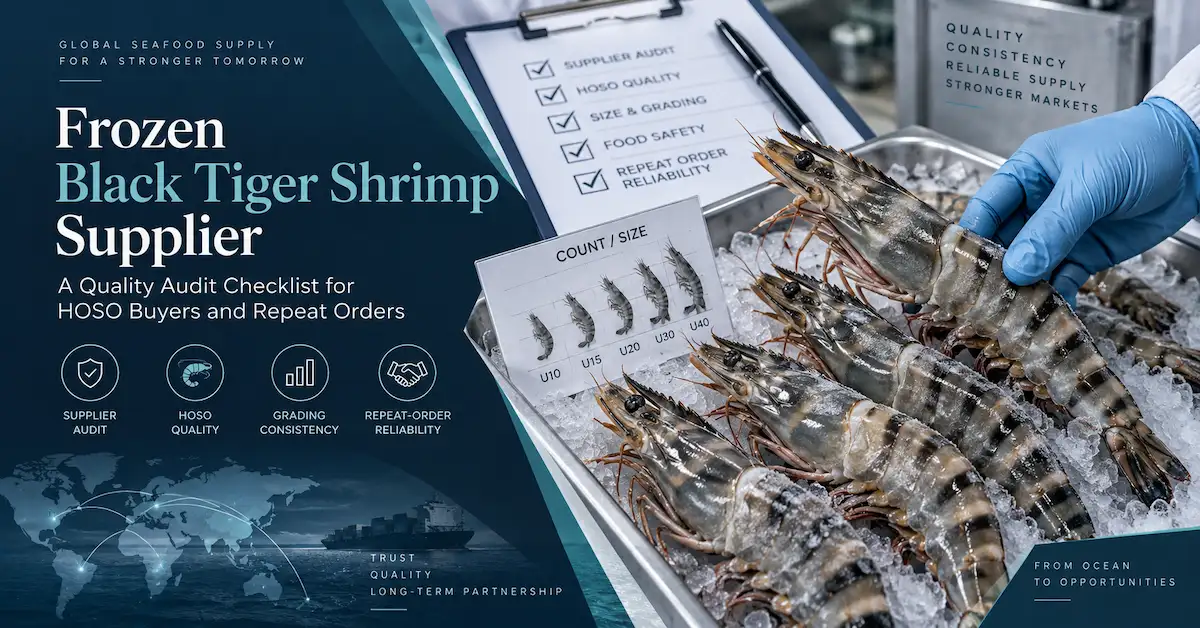
An export grade black tiger shrimp supplier should be able to show how a proposed lot will be evaluated, not merely describe the shrimp as premium. Overseas importers need confidence that product identity, HOSO appearance, grading, net contents, packaging, food-safety documentation, and the shipment itself match what was purchased.
That confidence becomes particularly important when shrimp move from a processing site to a refrigerated warehouse, then into a container and finally through a destination-country inspection. A missing establishment approval, incorrect lot code, disputed deglazed weight, or poorly documented temperature event can interrupt an otherwise successful sale.
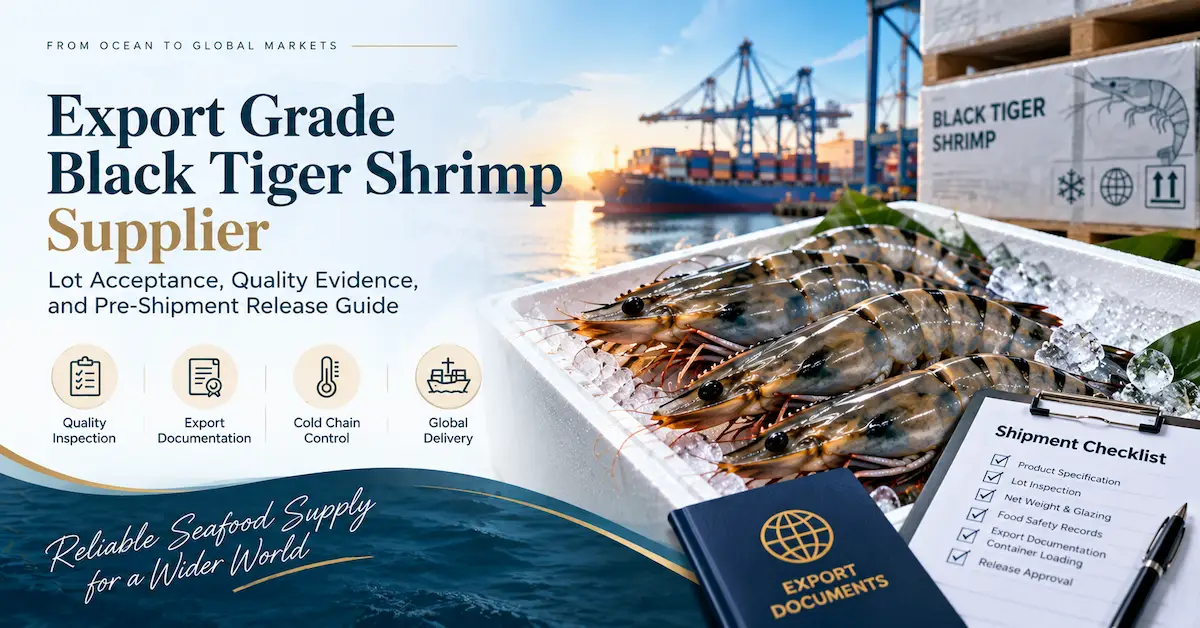
This article focuses on lot acceptance and export readiness. For general product selection and price comparisons, see Bothwin's frozen black tiger shrimp buying guide.
1. What Does “Export Grade” Actually Mean?
When evaluating an export grade black tiger shrimp supplier, international seafood importers should look beyond general quality claims. A reliable purchasing decision requires clearly defined HOSO shrimp specifications, measurable defect criteria, batch traceability, and documentation that meets the destination market's requirements.
Export grade is a trade description. It does not, by itself, identify one globally mandatory shrimp size, allowable defect percentage, certification, or importing-country approval. Two buyers can reasonably impose different specifications for the same raw HOSO product because their customers, regulations, and retail presentations differ.
A defensible export-grade specification has three layers: product quality agreed in the contract, food-safety and market-access requirements applicable to the destination, and evidence connecting inspected cartons to the shipment. One layer cannot compensate for a failure in another. Beautiful shrimp do not overcome missing mandatory certification; complete paperwork does not make an out-of-grade lot acceptable.
The FAO/WHO Codex Standard for Quick-Frozen Shrimps or Prawns (CXS 92-1981) is a relevant international technical reference for quick-frozen shrimp. It addresses matters including composition, defects, labeling and net contents. However, Codex guidance must be considered alongside the destination's laws and the buyer's contract. The standard does not make every exporter automatically approved for every country.
2. Establish the Identity of the Exact Shipment
Black tiger shrimp are generally associated with Penaeus monodon. Before approving a purchase, request confirmation of the species declared for the actual lot. The supplier's legal location, farming origin, processing establishment and port of loading are separate facts; do not infer one from another.
Bothwin's published product is frozen whole Head-On, Shell-On (HOSO) black tiger shrimp, with sizing customized upon request, bulk or OEM packing discussions, and a stated storage requirement of -18°C or below. Public information does not fix the lot's count grade, origin, processing facility, quantity or shipping date. Those details belong in the offer and approved specification.
| Identity field | Evidence needed | Release risk if missing |
|---|---|---|
| Species | Scientific identity and matching product description | Incorrect labeling or customs declaration |
| Raw material origin | Confirmed farmed/harvested origin for the lot | Market-access or origin inconsistency |
| Processing site | Establishment identity and approvals where required | Import inadmissibility |
| Commercial form | Raw/cooked status and whole HOSO reference | Wrong product supplied |
| Lot code | Traceable batch-to-carton linkage | Unclear scope of quality claims |
Keep a single approved description across the purchase order, label, packing list and certificates where required. If documents use different common names, reconcile them before originals are issued.
3. Convert HOSO Appearance Into Inspection Criteria
A whole shrimp earns value partly through visual presentation. Buyers should therefore classify observed issues instead of asking inspectors to judge whether a carton “looks export quality.” Define permitted head looseness, broken bodies, shell damage, discoloration, dehydration, foreign matter and abnormal odor under an appropriate examination method.
| Observation | Potential consequence | Recommended buyer response |
|---|---|---|
| Loose or detached heads | Loss of whole-shrimp presentation value | Use agreed defect definition and allowance |
| Broken body or significant shell damage | Downgrade or customer rejection | Count against the relevant contract category |
| Visible discoloration | Appearance dispute; cause not always established visually | Record extent and evaluate under agreed criteria |
| Excessive dehydration or freezer damage | Quality and saleability reduction | Record severity and evaluate packaging/storage history |
| Foreign matter | Potential food-safety concern | Place affected product on hold for qualified assessment |
| Abnormal odor or suspected thawing | Possible deterioration or handling problem | Hold and investigate; do not release on appearance alone |
Important distinction: melanosis, sometimes called black spot, is not automatically proof that shrimp are unsafe; likewise, normal appearance does not prove they are safe. Food safety requires the appropriate hazard controls and evidence. Commercial appearance limits should never be confused with safety clearance.
Do not invent a universal acceptable percentage for every defect. Define major and minor nonconformities, limits and treatment in the buyer's own approval documents. The exact limits must suit the destination, product form and agreed inspection scheme.
4. Verify Count, Net Contents and Glazing Separately
Count and weight have different purposes. The count grade tells a customer how many HOSO pieces they receive per kilogram or pound; net contents tell the importer how much seafood is supplied. They should not be tested or priced as if they were interchangeable.
Write the count unit, target range, tolerance, weighing state and agreed sampling method. A count measured on peeled shrimp cannot be transferred to HOSO shrimp without changing the weight basis. The inspector should also record how damaged or undersized pieces are treated.
Glaze is protective ice, not edible shrimp. Codex CXS 92-1981 addresses declaration of net contents exclusive of glaze for glazed products. Verify the destination's legal rule and use an agreed deglazing and weighing method. A statement such as “10% glaze” is incomplete without identifying its calculation basis.
Always examine the sampling evidence before extrapolating a shortage. An isolated failed carton does not automatically justify declaring the entire container deficient; the approved sampling and acceptance plan determines what conclusions are supported.
5. Approve a Lot-Specific Sampling Plan
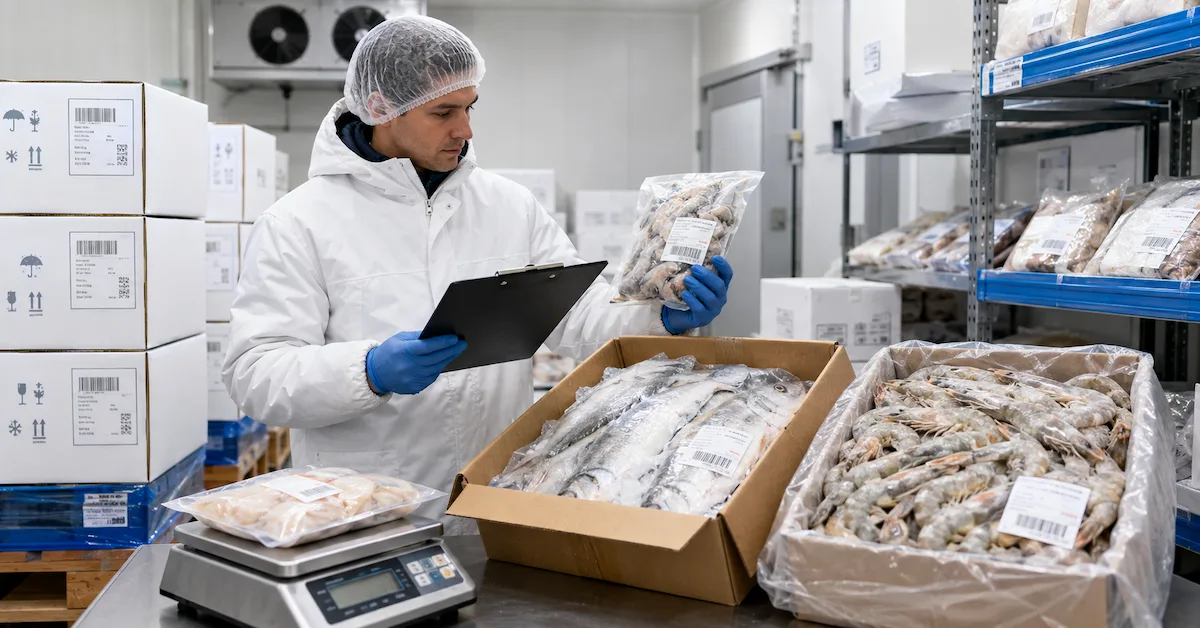
Pre-shipment inspection is only as meaningful as the plan behind it. Inspectors need to know which lot they are testing, how cases are selected, the sample size, the examination method and the criteria for accepting or rejecting the lot. One attractive photograph or top-layer sample is not representative evidence.
Sampling methods should be consistent with applicable standards and the buyer's contractual inspection agreement. Do not borrow an acceptance-quality limit from an unrelated product and apply it without technical review. Choose a qualified inspector or laboratory where specialized testing is required.
Preserve the inspection evidence so it can be compared with receiving findings. A report should state what was inspected—not imply that unexamined shipments or later production were certified by the result.
6. Check Food-Safety Records and Destination Eligibility Before Loading
Commercial inspection does not replace hazard analysis, residue controls, relevant microbiological requirements or legal establishment eligibility. These must be assessed according to the actual species, origin, processing form and destination.
United States: importer verification
For seafood subject to the US Food and Drug Administration's seafood HACCP rules, importers have specific verification duties under 21 CFR 123.12. A supplier's general mention of HACCP is not the same as satisfying importer verification. The importer should maintain appropriate product specifications and verification measures and confirm any other applicable entry and labeling obligations.
European Union: country and establishment checks
EU market access for products of animal origin involves authorization conditions that can include approved non-EU countries and eligible establishments. The European Commission maintains the relevant establishment lists through TRACES. The buyer should verify the actual processing site's listing and applicable certificate requirements before committing to shipment.
Other export markets
Requirements may involve official health certificates, residue limits, labeling language, import permits or additional inspections. Avoid applying the US or EU framework automatically to every destination. The importer, customs broker and competent authority should confirm a market-specific checklist.
Bothwin describes HACCP management, hygiene, cold-chain control and batch traceability on its product page. These are company statements; request current supporting documents identifying the actual facility, scope, validity and relevance to the proposed lot before treating any certificate as verified.
7. Reconcile Labels, Cartons, and Export Documents
Document mistakes can delay cargo even when product quality is satisfactory. A practical shipment file needs internal consistency: product name, scientific identity where relevant, origin, carton count, declared weight, exporter and consignee details, establishment information, container and seal numbers should match wherever required.
| Record | Essential cross-check | Typical owner to confirm |
|---|---|---|
| Approved product specification | HOSO form, count, net weight, defects, pack | Buyer and supplier |
| Commercial invoice | Seller, description, quantity, value and trade terms | Exporter / buyer |
| Packing list | Lot, cartons, net/gross weights, packing | Exporter / warehouse |
| Health or sanitary certificate | Required form and establishment/lot details | Competent authority / exporter |
| Origin and traceability records | Actual raw-material origin and production trail | Relevant supply-chain parties |
| Bill of lading and load record | Container, seal, packages and routing | Carrier / logistics team |
Not all documents are legally required in all markets. For a broader explanation, read Bothwin's seafood export documentation guide. Buyers should review drafts early enough to correct errors before the required originals are issued.
8. Apply a Release, Hold, or Reject Decision
The useful output of quality review is not a long report with no decision. A purchasing team should have clear authority to release conforming goods, put unresolved matters on hold, or reject material that fails mandatory requirements. Corrective action may allow reinspection, but only after the issue has been addressed and the applicable criteria are satisfied.
| Disposition | When it may apply | Next action |
|---|---|---|
| Release | Product and evidence satisfy all critical criteria | Approve loading against the controlled shipment file |
| Hold | Missing result, uncertain lot identity, unresolved discrepancy | Segregate affected goods; request evidence or reinspection |
| Reject / rework | Confirmed unacceptable defect or unmet mandatory requirement | Follow contract, safety obligations and approved corrective process |
Commercial concessions should never be used to bypass food-safety or legal requirements. A buyer may negotiate over a cosmetic defect within lawful limits, but mandatory eligibility and safety failures require appropriate resolution.
Record who signed off, the decision date, the reports reviewed and any open conditions. Release only the lot covered by the evidence. If lot segregation is unreliable, a wider hold may be needed until traceability is restored.
9. Protect the Approved Lot During Container Loading
Approval at the cold store does not guarantee equivalent condition at the destination. Loading adds another set of risks: poor carton handling, equipment faults, airflow obstruction, door-open exposure and incomplete loading records.
Bothwin lists -18°C or below as the storage requirement for its frozen black tiger shrimp product. Shipping teams should confirm the required cargo condition, reefer suitability, pre-trip checks, intended set point and loading arrangements. A reefer display shows the equipment setting—not proof that every carton stayed at the required product temperature.
Useful shipment evidence may include container number, seal, reefer settings, loading time, product condition observations, carton count, pallet arrangement and temperature records where agreed. If an unusual temperature event occurs, preserve the timeline and consult qualified personnel before deciding whether the cargo remains acceptable.
For further cold-chain context, see Bothwin's frozen seafood storage guide.
10. Build a Defensible Claims and Corrective-Action Process
Even a carefully controlled shipment may produce a receiving discrepancy. The importer and supplier should agree on a claim-notification period, evidence requirements, segregation process and resolution path before the container leaves the origin port.
At receipt, keep the affected cases identifiable. Capture the lot code, seal and container reference, arrival conditions, representative photographs, dated sampling results and other relevant records. Preserve packaging and independent inspection evidence where appropriate. Do not rely on a short video of one opened box to prove the condition of an entire shipment.
Traceability is a cost-control tool. If a problem affects 75 clearly identified cartons in a larger order, reliable lot information may allow the parties to isolate those cartons for investigation. If carton identity is lost, the hold could need to extend to more stock until the scope is established. The correct action depends on the hazard, applicable rules and evidence—not a blanket assumption.
Record the root cause, corrective action, responsible owner and verification result. Retain an approved specification version for repeat orders so the same issue does not quietly return in the next shipment.
11. What Bothwin Can Confirm for an Export-Grade Inquiry
Choosing an export grade black tiger shrimp supplier involves confirming product consistency, inspection procedures, export packaging, and shipment documentation. Bothwin supports international seafood sourcing inquiries, allowing buyers to discuss frozen HOSO black tiger shrimp specifications, customized sizing, and packaging requirements before requesting a commercial quotation.
Bothwin Development (HK) Limited describes an export-oriented seafood sourcing and supply business. Its black tiger shrimp product page identifies frozen whole HOSO shrimp, size customization upon request, bulk export and OEM packaging discussions, and storage at -18°C or below. The company also describes quality control and export documentation support.
These published statements provide a starting point, not a substitute for an approved lot specification or proof of universal market authorization. Buyers should request evidence for the actual origin, processing establishment, certification scope, count grade, freezing process, pack, MOQ, lead time, price and destination-specific documents.
Request a Shipment-Ready Black Tiger Shrimp Quote
Tell Bothwin your destination market, HOSO count range, declared net weight, glazing basis, packaging, inspection criteria, order quantity and proposed loading window. Ask the team to confirm the available product, documentation and any conditions that must be settled before production.
12. RFQ Checklist: Ask for Evidence, Not Adjectives
A precise RFQ encourages a more meaningful quotation and identifies gaps early. Include the following items in your initial message:
- Buyer company, destination country, port and distribution channel.
- Frozen black tiger shrimp, scientific species confirmation and required HOSO form.
- Count range, pieces per kilogram or pound, and permitted variation.
- Net shrimp weight, glaze measurement method, carton and inner-pack requirements.
- Agreed appearance defects, sampling plan and inspection responsibility.
- Required origin, processing establishment and destination documentation.
- Trial or bulk quantity, preferred Incoterm, named port and shipment window.
- Request for current MOQ, feasibility, available samples, lead time and quotation validity.
Ask the exporter to mark each requirement confirmed, subject to confirmation, or unavailable. Do not allow blank cells in a supplier comparison to become assumed promises.
Frequently Asked Questions
Is “export grade” a recognized black tiger shrimp certification?
No single universal certification is established by that phrase alone. It is commonly used commercially to describe intended export quality. Buyers should define the grade using product specifications, contractual acceptance criteria and applicable destination requirements.
Which HOSO defects should importers specify?
Common commercial observations include head detachment, broken bodies, shell damage, discoloration and freezer dehydration. Potential safety issues, foreign matter and abnormal product condition require separate controls. Set definitions and limits before shipment.
Does HACCP automatically authorize shrimp imports to the US?
No. The importer must address applicable FDA seafood HACCP verification obligations and other entry requirements. A general HACCP claim or certificate is not blanket authorization for an individual shipment.
What is a pre-shipment lot release?
It is the recorded decision that an identified lot has met the agreed specification and all necessary supporting requirements before loading. A missing critical document or unresolved safety concern is a reason to hold release.
Can Bothwin discuss HOSO export packaging?
Bothwin publicly lists bulk export and OEM packaging options for its black tiger shrimp. Confirm the actual available pack, count, MOQ, artwork conditions and shipment schedule directly for your order.
Conclusion
Choosing an export grade black tiger shrimp supplier means buying a verifiable shipment, not a marketing phrase. The strongest purchasing decisions connect HOSO identity and appearance with controlled sampling, accurate net contents, destination eligibility, matching paperwork and a documented release decision.
Bothwin publishes frozen whole black tiger shrimp with sizing and packing options for discussion. To evaluate a real export project, submit your lot requirements, destination, inspection expectations and order volume, then request written confirmation of the available product and supporting evidence.